


A friend once showed me their IA draft with the same pride people reserve for new phones. The file took ten seconds to open. There were tables everywhere. Screenshots of results. Quotes stacked like bricks.
And yet, reading it felt like walking through a warehouse with no labels.
That’s the trap: in an IB IA, more data can feel like safety. But examiners don’t reward safety. They reward thinking. A better IA is usually the one that selects less, explains more, and stays loyal to a clear question.
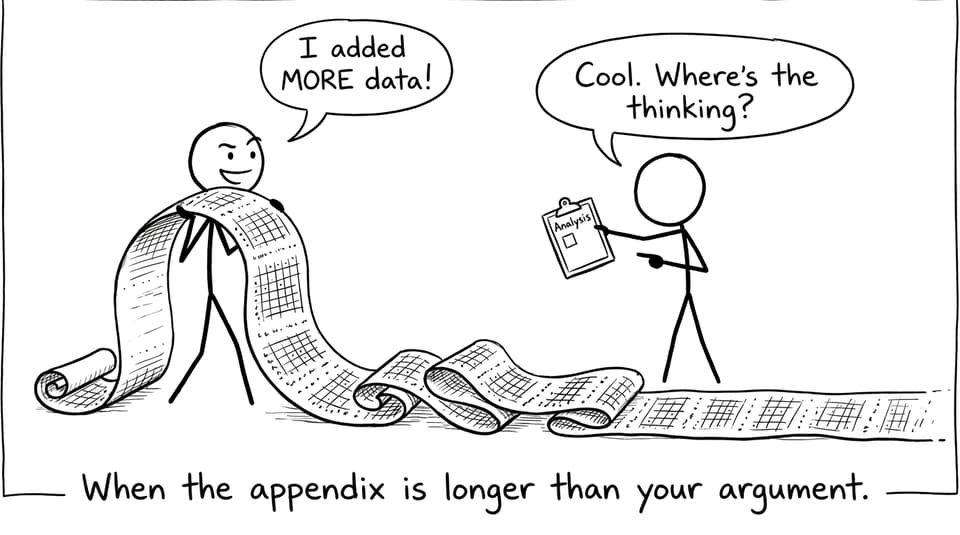
Quick checklist: when your IA has “too much data”
If you spot two or more of these, your IA probably needs trimming:
-
You include results “just in case,” but don’t mention them again.
-
Your analysis paragraph starts with “As shown in Table 4…” and ends with no interpretation.
-
Your conclusion sounds broad because there are too many small findings to judge.
-
Your evaluation lists generic limitations (e.g., “human error”) instead of specific, evidence-based ones.
-
Your research question feels lost inside the evidence.
For a full framework, start with the IB Coursework Guides and map your IA sections to what the rubric actually rewards.
What examiners actually reward in an IA
Examiners don’t grade your ability to collect infinite data. They grade your ability to make meaning from it.
In a strong IA, every table, quote, or statistic does a job:
-
It answers the research question directly.
-
It sets up a clear analytical point.
-
It supports evaluation (reliability, limitations, implications).
If you’re unsure whether your question is strong enough to guide selection, use this guide on refining your IA research question. A focused IA question is like a filter: it keeps the useful evidence and blocks the rest.
Why more data can weaken your IA (even when it’s “good”)
More data dilutes focus in an IA
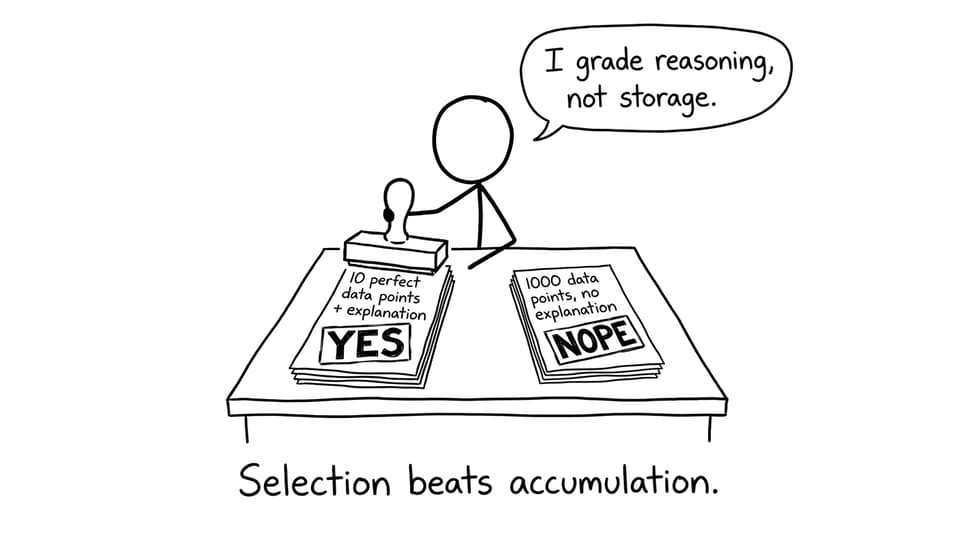
When an IA has too many results, you end up spreading your interpretation thin. Instead of building a line of reasoning, you write a tour guide script: “here’s this, and here’s that.” The reader can’t tell what matters.
A sharper IA often uses fewer data points but treats them with more care: patterns, anomalies, uncertainties, and implications.
If you need help deciding what “care” looks like, read how to use data effectively in your IA analysis.
Data without interpretation turns your IA into a report
The phrase “the data speaks for itself” is comforting and almost always wrong in an IA.
A dataset can show a trend without proving anything. A quote can sound convincing without being relevant. A graph can look impressive without linking back to your aim.
Interpretation is the difference between:
-
Description: what happened.
-
Analysis: why it happened and what it suggests.
-
Evaluation: how confident you should be, and what you’d change.
Too much data makes evaluation vague
Evaluation needs something manageable to evaluate.
When you have a mountain of evidence, limitations become generic (“sample size,” “measurement error”) because it’s hard to trace which limitations matter most. With fewer, well-chosen findings, you can write a stronger evaluation because you’re judging specific decisions.
A useful reminder from RevisionDojo’s subject guidance: in many IAs, appendices are not where marks are earned. Your key evidence and reasoning must live in the main argument. See how explicit this is in subject requirements like IB Physics IA essentials.
How to choose the right amount of data for your IA
Use this three-question test. For each piece of evidence, ask:
-
Does this directly answer my IA research question?
-
Do I explicitly interpret it (not just present it)?
-
Would my conclusion change if I removed it?
If the answer is “no” twice, cut it or move it into a brief summary.
For students in sciences, “enough data” also means enough to justify your methods and statistics, without flooding the reader. This guide on using statistical analysis effectively in an IB science IA can help you find that balance.
A smarter workflow: build an IA around meaning, not volume
Here’s a calmer way to write an IA:
-
Start with a tight question (RevisionDojo’s IA Guides help you align it to the rubric).
-
Collect only what you need to answer that question.
-
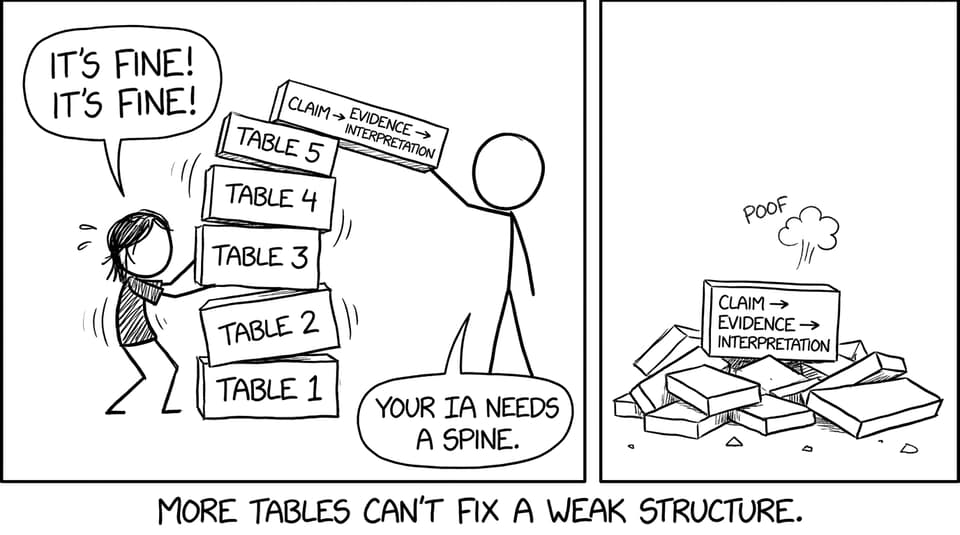
Turn each result into a point: claim, evidence, interpretation.
-
Then evaluate: reliability, limitations, improvements.
If you want models of what “selective and analytical” looks like, browse the Coursework Exemplars Library. Seeing a high-scoring IA can reset your instincts about what’s enough.
When you’re ready for feedback, RevisionDojo’s IB Coursework Grader helps you check whether your IA is actually meeting criteria, not just looking “academic.” Pair that with AI Chat to ask targeted questions like: “What is the strongest claim my data supports?” or “Which graph is redundant?”
Conclusion: the best IA isn’t the longest one
A high-scoring IA is not a storage unit. It’s an argument with evidence.
So aim for less data and more meaning: select what matters, interpret it clearly, and evaluate it honestly. If you want your IA to feel focused from the start, build it with RevisionDojo’s IA Guides, compare against Coursework Exemplars, and use AI Chat and the Grading tools to sharpen every paragraph.
When you stop trying to prove you worked hard and start proving you understand, your IA usually gets better, fast.


