
The trap: you know the content, but the IA still disappoints
You can feel it in your bones: you understand the topic, your classmates ask you for explanations, and exam revision feels manageable. Then your IA comes back and the mark is… fine. Not terrible. Just nowhere near what your knowledge should have earned.
That moment hurts because it feels unfair.
But the IA was never built to reward knowledge the way exams do. In an IA, knowledge is assumed. Marks come from what you do with it: how tightly you frame your question, how selectively you use theory, and how directly your analysis earns rubric points.
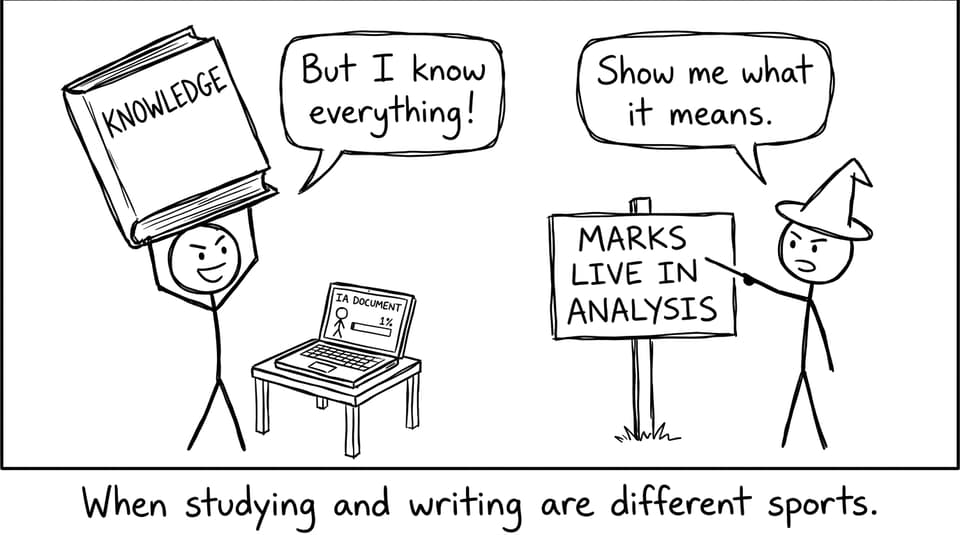
IA reality check: what examiners are actually marking
Use this mini-checklist to spot why a “smart” IA can still score low:
-
Is your IA research question specific enough to control your writing?
-
Does each paragraph answer the question, or just explain the topic?
-
Do you make claims backed by evidence, not just summaries?
-
Is your evaluation precise (limitations, improvements, impact), not generic?
-
Does the structure make moderation easy to follow?
If any of those feel wobbly, the issue usually is not knowledge. It is alignment.
Knowledge is the entry ticket, not the scoreboard
In most subjects, exam questions are designed to reveal what you know. The IA is designed to reveal how you think.
That is why accurate terminology and correct explanations rarely separate top-band work. They are baseline. The rubric assumes you can handle the content and then asks a different question: can you build a focused investigation or argument and judge it like a careful adult?
A helpful comparison is to read a few high-scoring exemplars and watch how little “background dumping” they do. RevisionDojo’s Coursework Exemplars library makes this contrast obvious fast.
Exams reward coverage; an IA rewards selection
A strong exam answer often wins by being complete. A strong IA wins by being selective.
When knowledge is your main tool, it is tempting to include everything you know “just in case.” In an IA, that usually creates:
-
Heavy introductions that delay the real point
-
Long theory sections that do not connect to the data
-
Descriptive discussion that never turns into judgment
If you want a clean model for controlling scope, start with RevisionDojo’s IA Introduction Structure guide. It teaches you to write like you have a map, not like you are emptying your backpack.
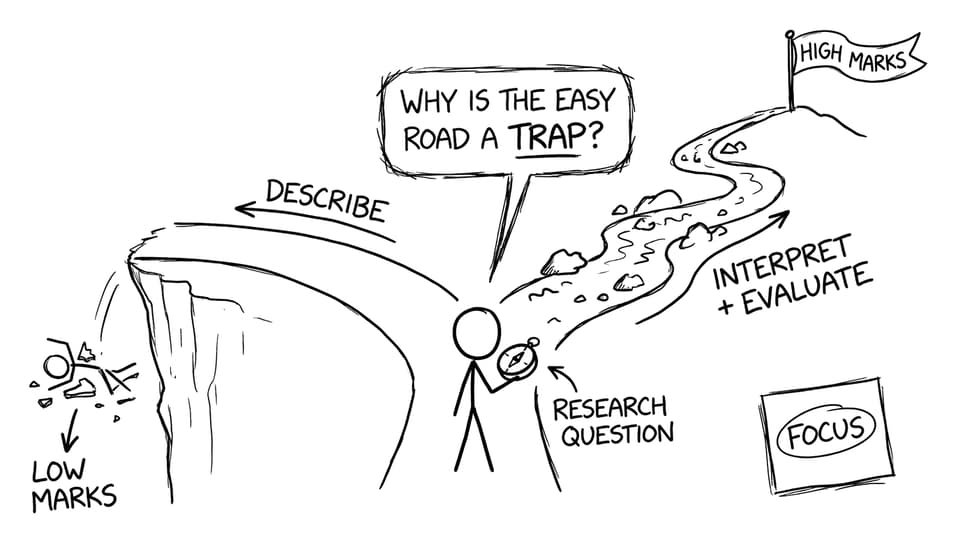
The most common failure mode: description wearing an “analysis” costume
Many weak IA drafts are polished, detailed, and still shallow. They describe what happened, or what a source says, but they do not interpret.
A practical test: highlight every sentence that is only explaining. Then highlight every sentence that makes a judgment.
If the judgment color barely appears, your IA is not under-informed. It is under-argued.
To fix this, tighten your research question first. RevisionDojo’s guide to writing a strong IA research question is the fastest way to force analysis to show up naturally.
Evaluation cannot happen without analytical thinking
Evaluation is where strong students often freeze, because evaluation feels like “opinion.” It is not. In an IA, evaluation is reasoned judgment.
Good evaluation uses your knowledge as a tool:
-
Explain why a limitation matters for validity or reliability
-
Link uncertainty, bias, or method choices to the direction of your conclusion
-
Propose improvements that are feasible and would change the quality of evidence
If your evaluation reads like a list of generic problems, it usually means your analysis did not build the logic needed to support it.
RevisionDojo’s data-use guide for IA analysis helps you move from “I made a graph” to “this trend means something.”
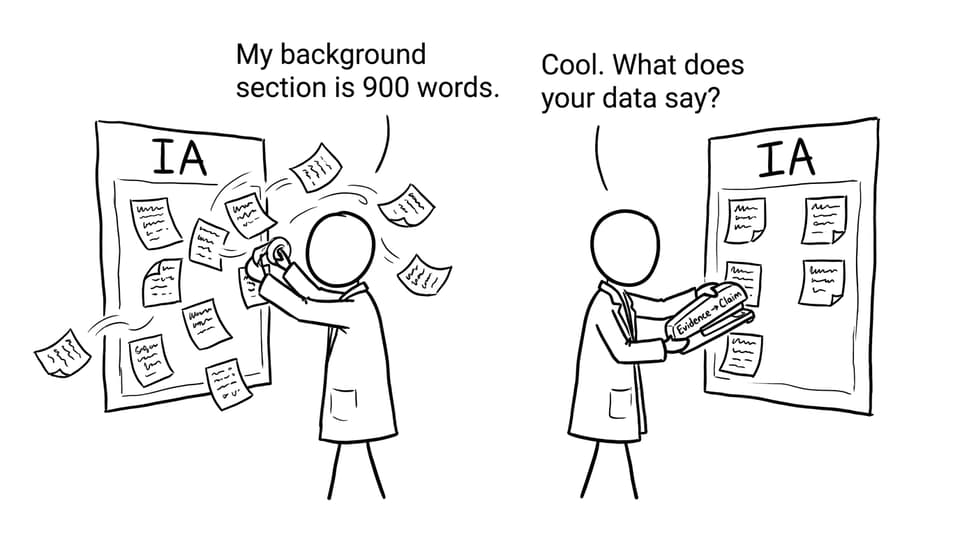
A better workflow: turn knowledge into rubric points
A high-scoring IA often comes from a boring-looking process:
-
Start with criteria clarity using the IA Guides hub
-
Calibrate quality by reading 2-3 similar pieces in coursework exemplars
-
Build the core spine: question -> method/evidence -> analysis -> evaluation
-
Then polish writing
If you want immediate criterion-based feedback, use RevisionDojo’s Coursework Grader. It makes the IA feel measurable, not mysterious.
And if you are juggling multiple subjects, the broader context matters: Which IB subjects have an IA? and Which IA is worth the most marks? help you prioritize intelligently.
Closing: your knowledge is valuable: aim it
Strong knowledge is still an advantage in an IA. It just is not the thing being rewarded directly. When you use knowledge to choose, interpret, and evaluate, the IA stops being a document that shows you studied and becomes a document that shows you can think.
If you want a clear next step, open RevisionDojo’s Coursework Guides, pick your subject, and build your IA around the rubric from the first page. Then keep your exam momentum alive alongside coursework using RevisionDojo’s Questionbank, Study Notes, Flashcards, AI Chat, Grading tools, Predicted Papers, Mock Exams, Coursework Library, and Tutors, thethe full toolkit that turns effort into marks.

