
The IB Anxiety Loop (And How to Break It Before Exams)
The week before IB exams has a specific sound: notification pings, printer whirs, the quiet panic of a group chat that never sleeps. You sit down to revise and your brain does something almost polite: it offers a helpful thought.
"What if I fail?"
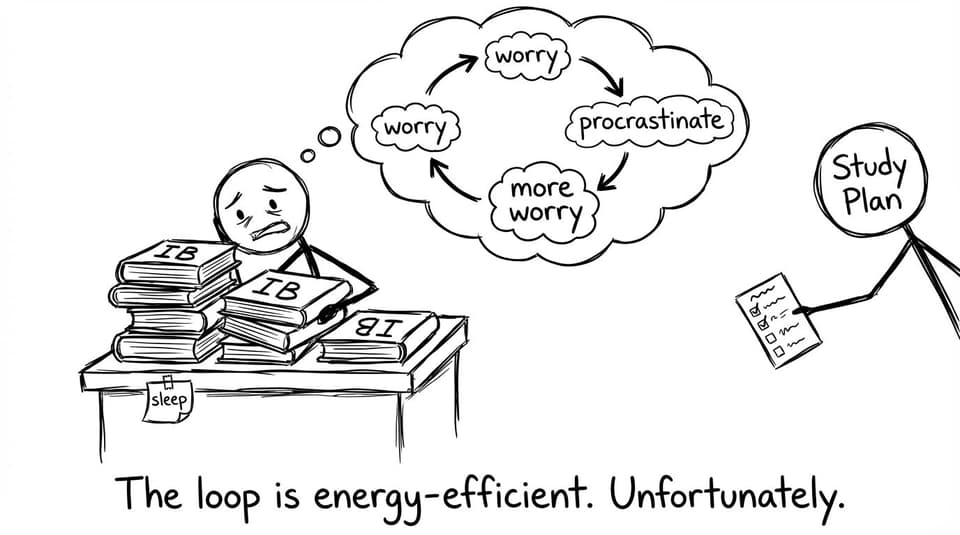
It's a rational question. The IB is demanding, the stakes feel personal, and the syllabus is big enough to make any student feel small. But that thought doesn't stay as a question. It becomes a loop: anxiety makes studying harder, studying less makes anxiety louder, and the whole thing starts to feel like you're running on a treadmill that speeds up whenever you slow down.
This is the IB anxiety loop. The good news is that loops can be broken. Not with a dramatic overnight transformation, but with a few simple interrupts that turn fear into traction.
A quick checklist to break the IB anxiety loop
If you only do one thing from this article, do this in order. It's designed to calm your nervous system and improve your IB results at the same time:
- Name the loop: "This is anxiety, not evidence."
- Shrink the task: 20 minutes, one topic, one paper section.
- Switch to proof-based revision: timed questions, markscheme feedback, error logs.
- Create a minimum viable plan: today, tomorrow, and exam morning.
- Use one home base: fewer resources, more practice.
Revision should feel like collecting proof you can do the IB, not collecting more reasons to worry.
What the IB anxiety loop actually is (and why it feels so convincing)
The loop usually looks like this:
- You think about the IB exam.
- You feel behind.
- You try to revise.
- It feels messy and unclear.
- You escape into "prep" tasks: reorganising notes, watching another video, making a prettier plan.
- You do fewer hard questions.
- Your confidence drops.
- Anxiety rises.
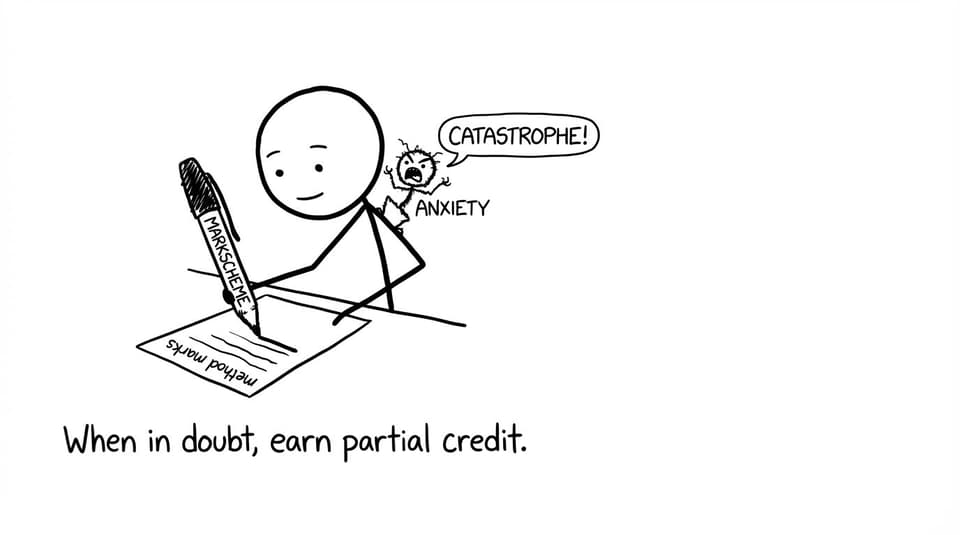
Anxiety is persuasive because it speaks in absolutes: "If you don't understand this now, you never will." The IB, meanwhile, is graded in a way that rewards method, consistency, and partial credit. In other words: the IB is often less absolute than your fear.
The main trap is confusing movement with progress. Movement is opening resources. Progress is answering questions under exam conditions and learning from the markscheme.
That's why the fastest way to break the IB anxiety loop is to move from vague studying to measurable practice.
The first interrupt: stop revising your feelings, start revising your errors
Most IB students try to revise until they "feel ready." The problem is that anxiety can make readiness feel impossible. You can understand a topic and still feel uncertain. You can be prepared and still feel tense.
So switch the goal.
Instead of "feel ready," aim for "reduce repeat errors." That's something you can control. It's also how scores rise.
A simple method:
- Do a short set of IB-style questions (timed if possible).
- Mark it with a markscheme.
- Write down the one reason you lost marks.
- Repeat that reason back to yourself as a rule.
Examples of rules:
- "Define first, then explain."
- "Always show units."
- "State the assumption before the calculation."
- "Use the command term as the structure."
On RevisionDojo, this is where your workflow gets cleaner: use the Questionbank to generate focused practice, then use the Grading tools to make feedback immediate and less emotional. Anxiety hates clarity. Markschemes create it.
The second interrupt: choose depth over breadth (the IB rewards it)
The most common pre-exam strategy is also the most stressful one: trying to touch everything, every day. It creates the comforting illusion of coverage while quietly starving you of mastery.
Instead, pick a smaller number of targets and go deeper.
A better IB plan looks like:
- Two high-yield topics you will master.
- One weak topic you will stabilise.
- One skills block (data response, essays, calculations, analysis) you will repeat daily.
Depth lowers anxiety because it builds certainty. Breadth can increase anxiety because it keeps you in a constant state of re-introduction.
If you need structure, build it from a single base. RevisionDojo's Study Notes and Flashcards are ideal for quick recall loops, but the anchor should still be questions. Notes tell you what you know. Questions tell you what you can do.
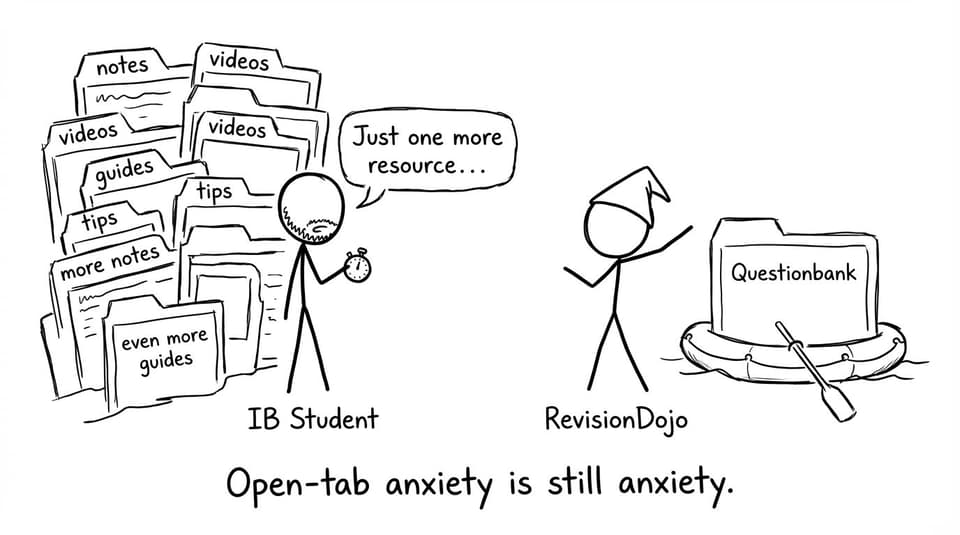
The third interrupt: replace "resource collecting" with "attempting"
There's a quiet form of procrastination that looks responsible: downloading another guide, opening another folder, colour-coding another plan. It feels like you're preparing for the IB, but it keeps you away from the one thing that creates confidence: attempting.
Here's a rule that helps:
If you can't point to a markscheme, it doesn't count as revision.
That doesn't mean reading is useless. It means reading is support work. Attempting is the main workout.
A clean daily IB cycle:
- 10 minutes: review Flashcards (recall, not rereading)
- 30 minutes: Questionbank set on one topic
- 15 minutes: mark, log errors, write one rule
- 10 minutes: fix one error type with a mini drill
Keep it small enough that anxiety can't negotiate with it.
The fourth interrupt: practise the exam feeling, not just the content
A lot of IB anxiety is not about knowledge. It's about the experience of the exam: the clock, the silence, the fear of blanking, the sense that everyone else is faster.
So practise that feeling on purpose.
Do one timed block per day. Not a full paper if that overwhelms you. Just a block that forces your brain to operate under constraint.
- One data response
- One essay plan + one paragraph
- One short-answer section
- One set of calculations
Then debrief like an athlete:
- What went well?
- What cost me time?
- What was my first sign of panic?
- What is my response script next time?
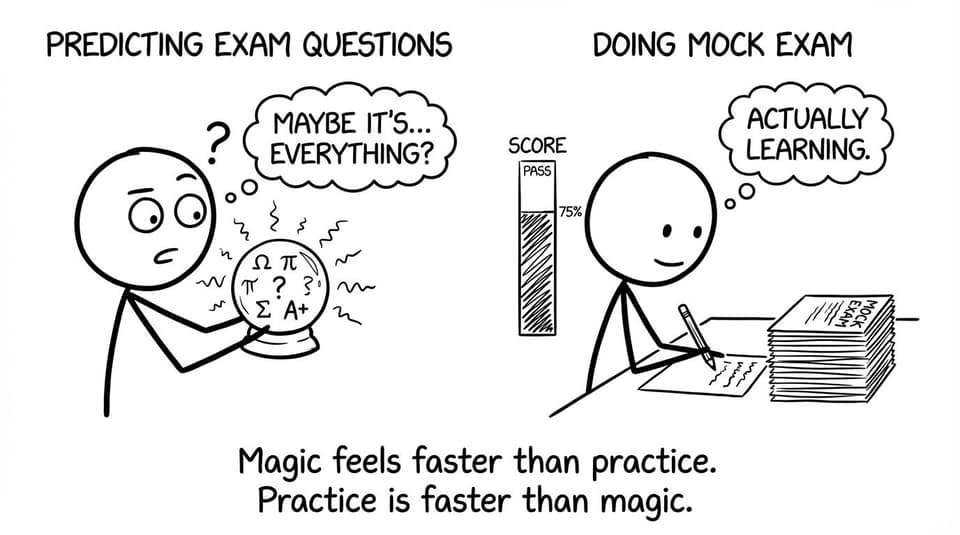
RevisionDojo's Mock Exams and Predicted Papers help here because they let you simulate pressure in manageable pieces. The goal isn't to predict the future. It's to make the future feel familiar.
The fifth interrupt: build a two-sentence "panic protocol"
When panic hits, your brain tries to solve your entire IB life in one breath. That's why it feels like drowning. A protocol is a script that stops the spiral.
Write this on paper:
- "I am having an anxiety moment, not a failure moment."
- "My job is to earn the next mark."
Then define "next mark" for your subjects:
- In essay subjects: write the next claim, then evidence.
- In sciences: state the relationship, then substitute values.
- In maths: write the first line you know is true.
This works because the IB is mark-by-mark, not mood-by-mood.
If you want support while you practise this, RevisionDojo's AI Chat can act like a calm study partner: ask it to generate a single IB-style question, then ask for feedback on your reasoning, then return to your protocol when you wobble.
A simple 7-day plan to break the IB anxiety loop
This is intentionally boring. Boring is good. Boring is repeatable.
Days 1-2: reduce chaos
- Choose one home base for IB revision (Questionbank + notes).
- Make a list of your top 10 error types from recent work.
- Do one timed block per subject.
Days 3-5: build proof
- Daily: Flashcards (10 min) + Questionbank (30-45 min) + marking (20 min).
- One longer session: a Mock Exam section.
- One reflection: update your error log and rules.
Days 6-7: taper and sharpen
- Focus on weak-but-fixable errors.
- Do lighter timed sets.
- Prepare exam-day basics: stationery, time plan, sleep window.
You're not trying to become a different person in a week. You're trying to become a person who can do the next question.
Bringing it home: break the IB anxiety loop with proof
The IB anxiety loop thrives in the foggy places: the "maybe," the "what if," the endless scrolling for the perfect resource. You don't beat it by becoming fearless. You beat it by becoming specific.
Do the next timed set. Mark it. Write the rule. Repeat.
If you want one place to do that calmly, RevisionDojo is built for it: Questionbank for targeted practice, Study Notes and Flashcards for recall, AI Chat for guided explanations, Grading tools for fast feedback, Predicted Papers and Mock Exams for exam realism, plus a Coursework Library and Tutors when you need extra support.
Your goal isn't to "finish the IB." It's to break the loop before it breaks your confidence. Start with the next question.