

A hook to remember on exam day (IB Biology)
If every student in your class had to be the teacher, the janitor, the IT team, and the principal at the same time, school would technically still be “running” for a day or two. Then the Wi‑Fi would fail, the lessons would blur, and someone would forget to unlock the doors.
That’s multicellular life without cell specialization. In IB Biology, this topic looks simple on paper. But it’s actually a survival story: how organisms stay large, stable, coordinated, and fast enough to deal with a messy world.

Quick exam checklist: what to say about cell specialization (IB Biology)
Use this as a fast paragraph plan in IB Biology:
-
Define cell specialization/differentiation: cells become structurally and functionally adapted for specific roles
-
Explain division of labor: efficiency increases when tasks are split
-
Connect to tissues, organs, systems: cooperation and coordination
-
Link to homeostasis: specialized regulation keeps conditions stable
-
Mention limits of diffusion: specialization supports transport and larger body size
-
Optional extension: specialization is driven by gene expression differences (same DNA, different genes switched on/off)
For syllabus-aligned practice, keep open: IB Biology Topic B2.3: Cell Specialization and the matching Cell Specialization Notes.
Division of labor: why “generalist cells” don’t scale
The core advantage of cell specialization is division of labor. A neuron is built for rapid signaling. A muscle fiber is built to contract. A red blood cell is built to transport oxygen. An epithelial cell is built to form protective, selective barriers.
In IB Biology, you can phrase the logic like this: specialization increases efficiency because structure matches function. The organism gets more output per unit time and energy, which matters when survival depends on speed, repair, and response.
To drill this in exam style, use Cell Specialization Questionbank and test yourself until “structure adapted to function” becomes automatic.
Efficiency and size: diffusion is a quiet limiting factor
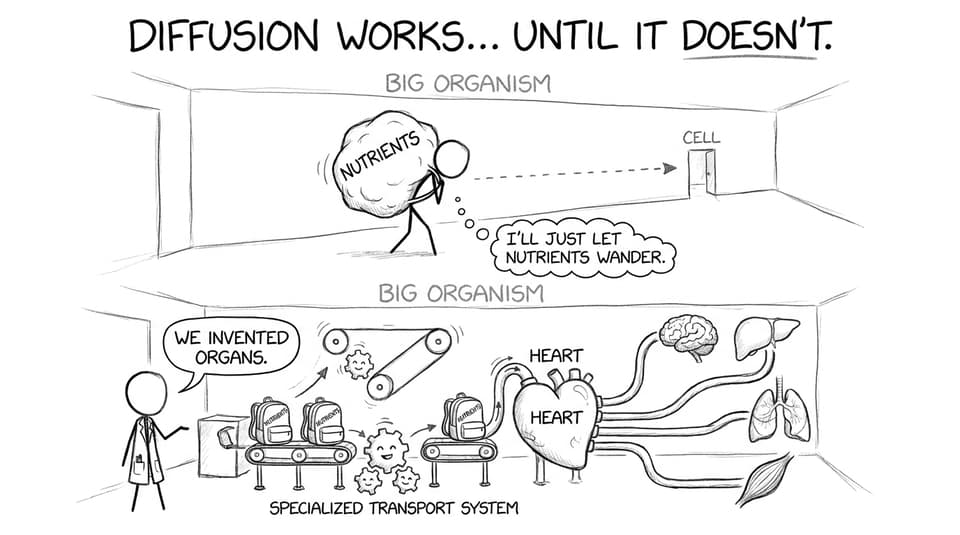
Unicellular organisms can rely heavily on diffusion because distances are tiny. But multicellular organisms are big enough that diffusion becomes slow and unreliable over long pathways.
This is where cell specialization becomes a size enabler. Specialized cells build transport networks (like blood vessels), exchange surfaces (like alveoli), and coordinated movement systems. Without that, large organisms would struggle to deliver oxygen and nutrients, and wastes would accumulate in the wrong places.
If you want the bigger chapter map, browse IB Biology B - Form and Function and the broader Cell biology hub.
Coordination: from specialized cells to organs that cooperate
Specialized cells don’t live as isolated specialists. They form tissues, tissues form organs, and organs form systems that coordinate through chemical and electrical signaling.
That coordination is why multicellular organisms can do complex tasks at the same time: digestion while moving, gas exchange while maintaining body temperature, defense while repairing damage. In exam language for IB Biology, you’re describing an integrated hierarchy where specialized parts create reliable whole-organism function.
When you need a refresher on how cells build higher levels of organization, see Tissues Notes and connect it back to specialization.
Homeostasis: specialization as a stability system
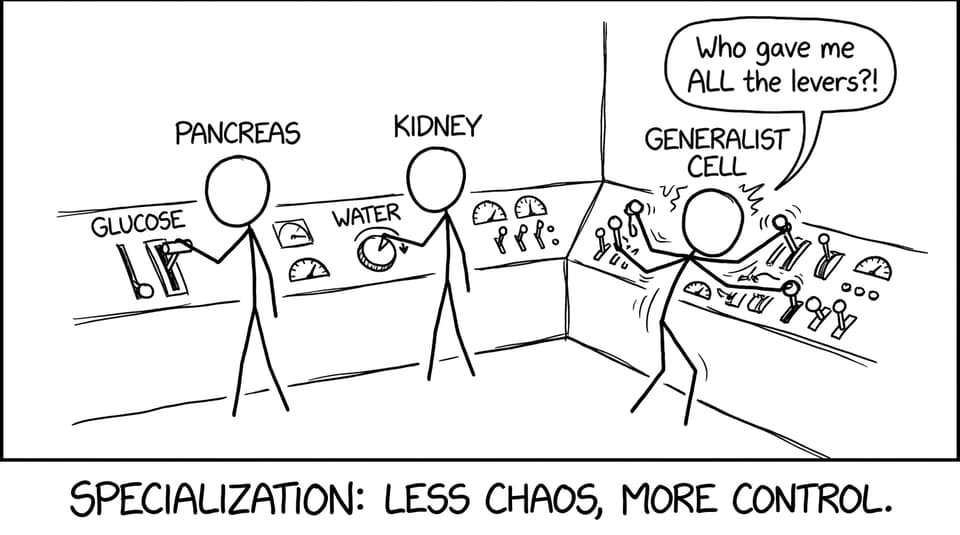
Homeostasis is basically “survival through consistency.” Your enzymes, membranes, and metabolic pathways work best in narrow ranges. Specialized cells keep those ranges stable: pancreatic beta cells regulate blood glucose, kidney cells balance water and ions, and neurons help coordinate rapid responses.
In IB Biology, a strong answer usually includes the idea that homeostasis requires sensors, control centers, and effectors. Specialization makes those roles clear and fast. Without it, regulation becomes slow, noisy, and error-prone.
The mechanism (HL-friendly): same DNA, different gene expression
A common confusion in IB Biology is thinking specialized cells have different DNA. Most body cells have the same genome, but they express different sets of genes. That selective gene expression produces different proteins, which build different cell structures, which create different functions.
If you’re HL (or aiming for top marks), tie your explanation to gene regulation using: How Gene Expression Creates Cell Specialization and extension notes like Cell differentiation (HL) Notes.
A strong way to finish (and revise smarter)
Cell specialization is essential because it turns a multicellular organism from a crowd of cells into a coordinated system: division of labor, efficient transport beyond diffusion limits, stable homeostasis, and organs that cooperate under pressure. That’s the survival logic you want to write in IB Biology essays and short answers.
When you’re ready to convert understanding into marks, build a loop with RevisionDojo: start with the Cell Specialization Flashcards, test with the B2.3 Questionbank, then rehearse under time using IB Predicted Papers. If you get stuck mid-revision, use RevisionDojo’s AI Chat, Study Notes, and Grading tools to tighten your explanations before the next mock exam.