
When you revise IB Biology, proteins can start to feel like a magic trick. A question shows you a chain of letters, a few arrows, maybe a diagram of a coiled ribbon, and suddenly you are expected to explain how that “string” becomes an enzyme, a hormone, or a membrane channel.
The trick isn’t magic. It’s chemistry.
At the center of it all is one small, reliable idea: the bond that holds amino acids together is the peptide bond. If you can explain that bond clearly, you unlock marks across proteins, enzymes, digestion, and even gene expression.
Quick checklist for peptide-bond questions in IB Biology
Use this as your 20-second mental template in IB Biology exams:
-
Name the bond: peptide bond (a covalent bond)
-
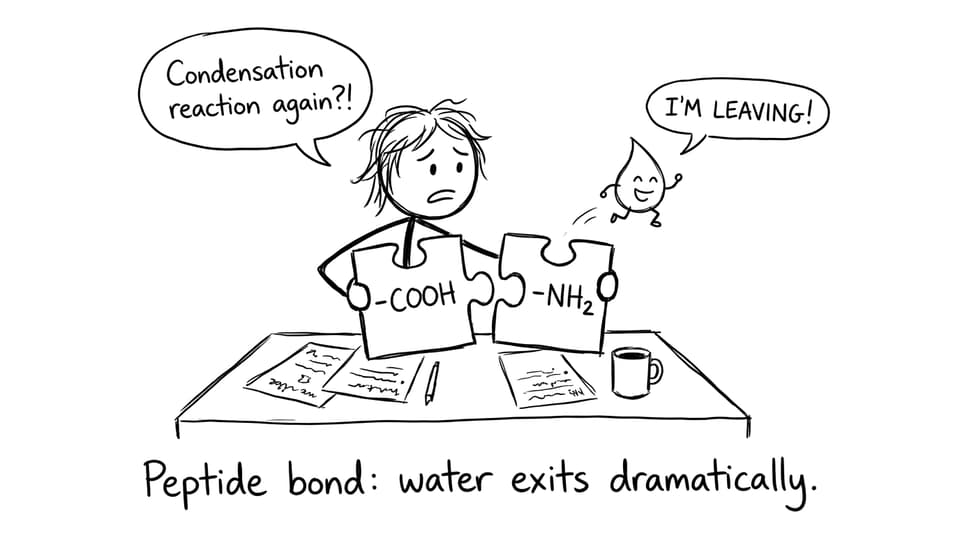
State where it forms: between carboxyl group of one amino acid and amine group of another
-
State how it forms: condensation reaction (water released)
-
State how it breaks: hydrolysis (water added)
-
Link to structure: forms the primary structure (sequence) of proteins
For a clean syllabus-aligned explanation of proteins and where peptide bonds fit, use Notes for 2.4 Proteins or the newer-syllabus overview in Notes for B1.2 Proteins.
The peptide bond in IB Biology: what it is (and what it’s not)
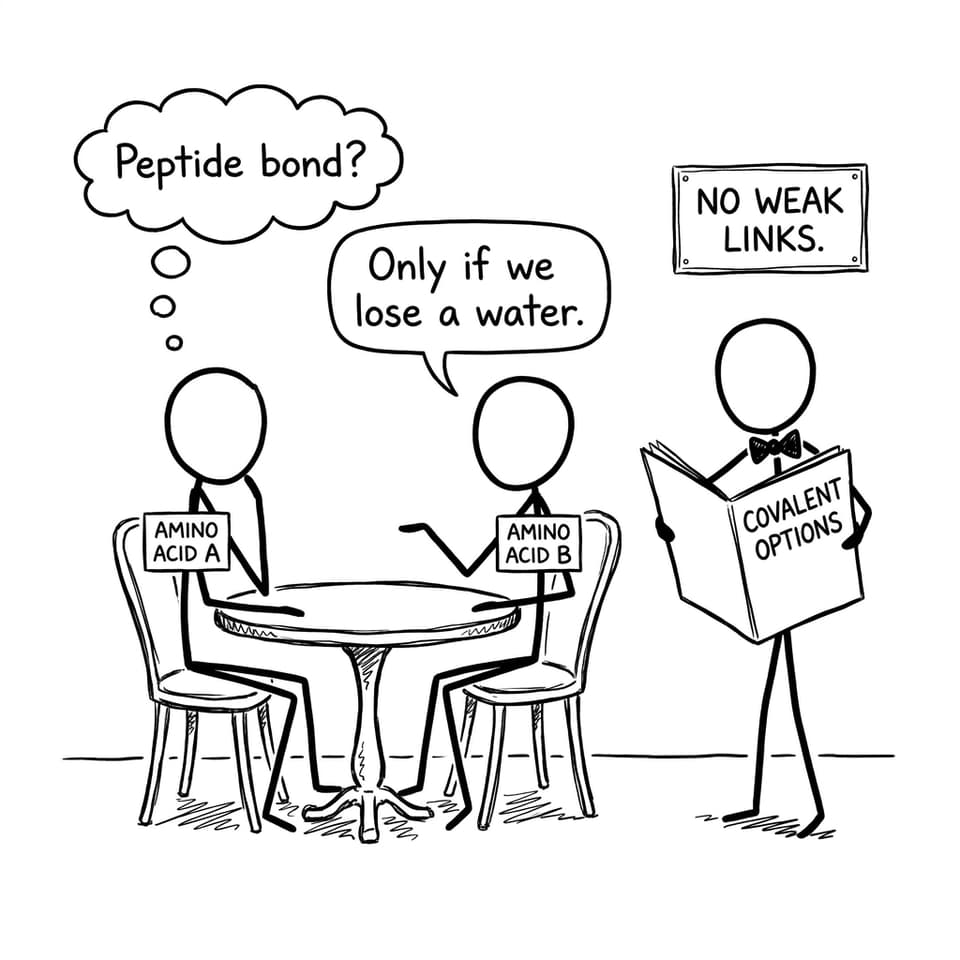
In IB Biology, the bond that links amino acids in a polypeptide is the peptide bond. This is a covalent bond, meaning it involves the sharing of electrons. That detail matters because it hints at stability: peptide bonds are not “weak attractions” that fall apart when you blink. They are real chemical links in the backbone of every protein.
A peptide bond forms specifically between:
-
the carboxyl group (COOH) of amino acid 1
-
the amine group (NH₂) of amino acid 2
The result is a repeating backbone pattern that examiners love: C(=O)N. You don’t always have to draw it, but you should be able to recognize it.
Want exam-style practice on this exact subtopic? Use the IB Biology Topic B1.2 Proteins Questionbank to see how peptide bonds get tested in different question formats.
How peptide bonds form: condensation (dehydration) reaction
In IB Biology, you’re expected to describe peptide bond formation as a condensation reaction (also called dehydration synthesis). The key point is simple: water is released.
A strong exam explanation sounds like this:
-
The carboxyl group loses an OH
-
The amine group loses an H
-
These combine to form H₂O
-
A peptide bond forms between the carbon of the carboxyl group and the nitrogen of the amine group
After one bond forms, you get a dipeptide. Repeat the process, and you build a polypeptide.
If your answers sometimes lose marks even when your biology is correct, it’s often a command-term problem. Pair this topic with How to Understand IB Biology Command Terms for Exam Success so your “describe” and “explain” responses match what the markscheme rewards.
Breaking peptide bonds: hydrolysis (why digestion questions keep returning)
Hydrolysis is the reverse of condensation. In IB Biology, the clean phrasing is:
- Hydrolysis breaks peptide bonds by adding water.
This shows up in digestion, metabolism, and enzyme questions because cells constantly build and break macromolecules. In digestion, protease enzymes catalyze hydrolysis, turning polypeptides into shorter peptides and then amino acids that can be absorbed.
This is also a useful bridge to Internal Assessment thinking: if you run an enzyme investigation (for example, protease activity under different conditions), the underlying “why” often traces back to bonds forming and breaking.
For IA planning support and exemplars, use IB Biology IA: 8 Essential Tips to Score a 7 (Expert Guide) and browse high-quality samples in IB Biology IA Examples. If you want a full criteria-driven roadmap, the IB Biology Internal Assessment Guide is built for exactly that.
Why peptide bonds matter for protein structure (and exam marks)
A peptide bond is not just “the link.” In IB Biology, it’s the reason proteins have a primary structure at all: the unique sequence of amino acids.
That sequence controls how the protein folds into higher levels of structure. Change the sequence, and you may change interactions between R-groups, which can alter the final shape and function. This is why a single substitution can matter in enzymes, receptors, or structural proteins.
To connect peptide bonds to the bigger structure story (especially if you’re HL), review B1.2.7 Impact of primary structure on the conformation of proteins Notes and the extension idea in B1.2.4 Infinite variety of possible peptide chains Notes.
Where peptide bonds appear in IB Biology exams
Peptide bonds are popular because they connect units that students often revise separately:
-
Macromolecules and basic biochemistry
-
Enzymes and digestion
-
Translation and protein synthesis
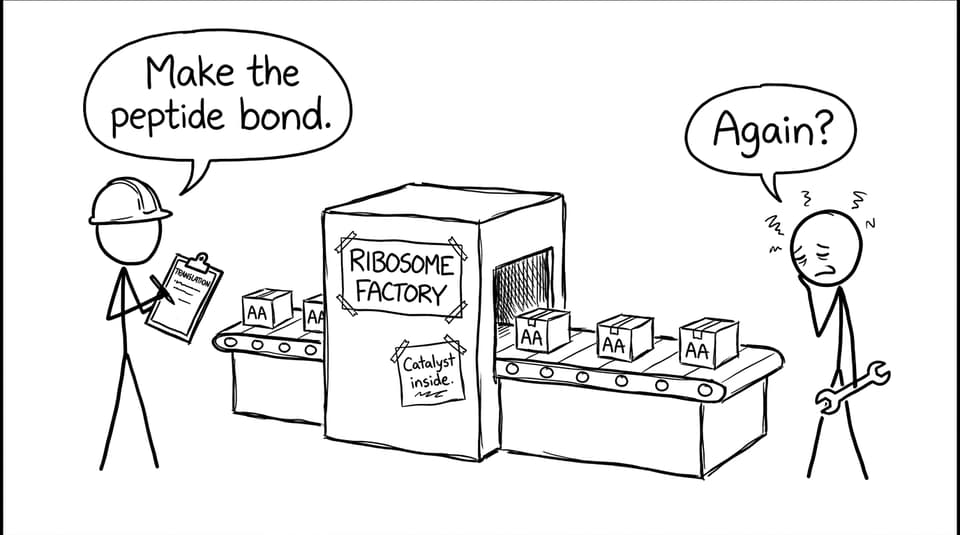
If you want to see the bond in its “real workplace,” check IB Biology 7.3 Translation Notes, where ribosomes catalyze peptide bond formation as the polypeptide chain grows.
A calm way to lock this topic down (with RevisionDojo)
If you’re studying IB Biology under time pressure, peptide bonds are a smart target: small concept, big payoff. Learn one clean definition, one clean mechanism (condensation), and one clean reverse (hydrolysis). Then practice until your wording becomes automatic.
RevisionDojo is built for that kind of mastery: use the Study Notes to get the model explanation, the Questionbank to meet the exam style repeatedly, and Flashcards to keep the mechanism sharp. When you get stuck on phrasing, AI Chat can help you rewrite an answer to match command terms, and the Grading tools can show what earns marks. When exam season gets real, Predicted Papers, Mock Exams, and the Tutors option help turn understanding into performance.
The bond that holds amino acids together is a peptide bond. In IB Biology, that one sentence is the start of a lot of easy marks, if you learn how to expand it with precision.