
You only need one letter to change a story.
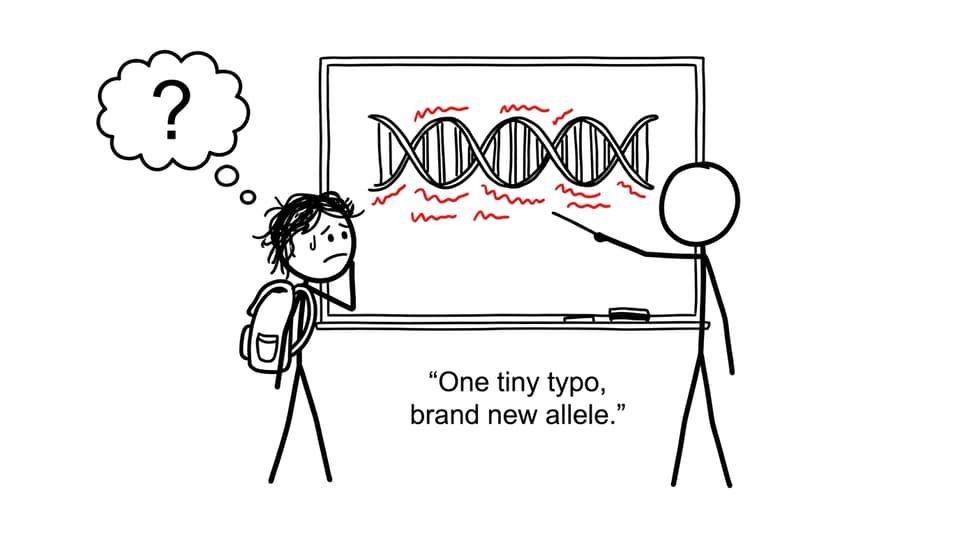
In IB Biology, that letter might be a single base in DNA. Swap it, delete it, copy it twice, and suddenly a gene has a new version. That new version is a new allele. Most of the time nothing dramatic happens. But occasionally, a tiny molecular typo becomes the start of real variation, the kind evolution can test, and the kind examiners love to ask you to explain.
The exam definition: mutation becomes a new allele
In IB Biology, keep the chain of logic tight:
-
A mutation is a change in the DNA nucleotide sequence.
-
If that change happens within a gene, the gene now exists in a different sequence form.
-
That different sequence form is a new allele.
This is why mutations are the ultimate source of genetic variation in populations. For a quick syllabus-aligned refresh, see IB Biology Topic D1.3: Mutations and Gene Editing.
Quick checklist: what you must be able to explain
Before you move on, check you can do these in IB Biology language:
-
Define allele and mutation clearly
-
Distinguish point mutations vs insertions/deletions
-
Explain silent, neutral, and harmful/beneficial outcomes
-
State why germ-line mutations matter more than somatic mutations for inheritance
RevisionDojo’s 3.1 Genes Notes are useful here because they tie together gene, locus, allele, and mutation in one place.
How DNA replication errors create new alleles
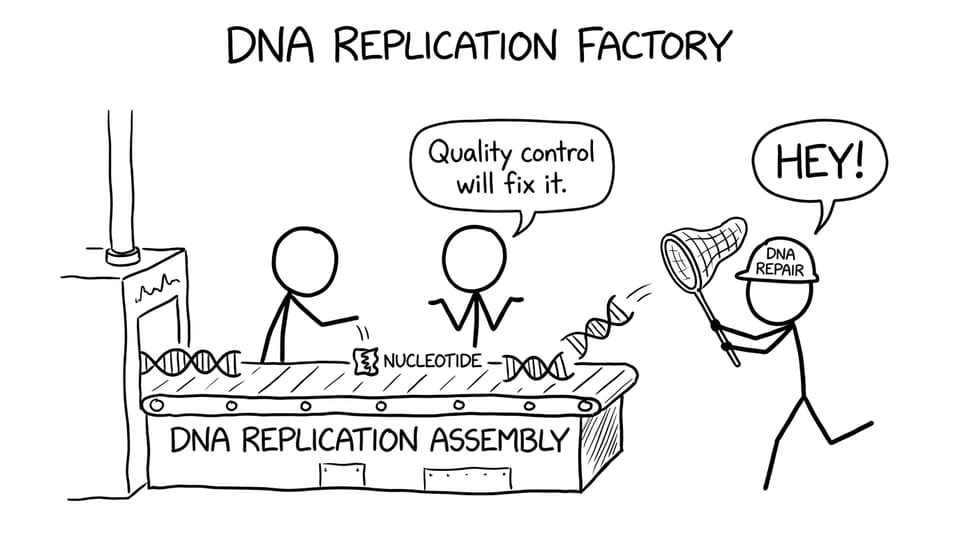
A lot of mutation begins with something unromantic: DNA polymerase mispairs a base during replication. Cells often correct mistakes with repair enzymes, but not always. When an error escapes repair, it becomes fixed in the DNA sequence after the next replication cycle. At that point, IB Biology expects you to call it a mutation and recognize that it has created a new allele.
For related content that sits next to this in the syllabus, explore IB Biology Topic D1.2: Protein Synthesis (because many questions ask you to connect DNA change to mRNA codon to amino acid).
Mutation types that produce new alleles (and what they do)
Base substitutions (point mutations)
A base substitution replaces one nucleotide with another. In IB Biology, the key is the codon-level consequence:
-
It might be silent (same amino acid)
-
It might change one amino acid (sometimes called missense in broader biology)
-
It might create a stop codon (often severe)
A classic example is sickle-cell disease, where a single substitution changes an amino acid in beta-globin. For focused revision, use D1.3.2 Consequences of Base Substitutions Notes.
Insertions and deletions (possible frameshift)
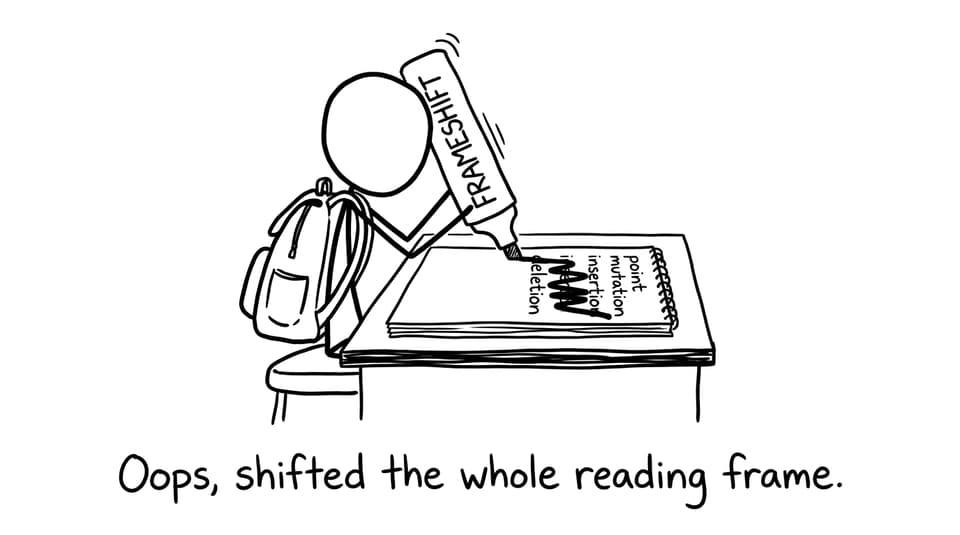
Insertions and deletions add or remove nucleotides. If they are not in multiples of three, they can cause a frameshift, changing every downstream codon. Many frameshifts produce nonfunctional proteins, but the exam point is simpler: they still generate a new DNA sequence, therefore a new allele.
Duplications: new copy, new evolutionary room
Gene duplication creates an extra copy of a gene. One copy can keep doing the original job while the other accumulates changes over time. In IB Biology, this is a clean way to explain how entirely new functions can evolve without immediately harming the organism.
Why some new alleles change nothing (and still matter)
Students sometimes assume “new allele” means “new trait.” In IB Biology, you should be more careful. Many alleles differ in DNA sequence but do not noticeably change phenotype.
-
Silent mutations change DNA but not amino acid sequence.
-
Neutral mutations may change an amino acid but not protein function.
Even when the phenotype looks identical, the allele still exists in the gene pool as variation. If the environment shifts later, yesterday’s invisible allele can become tomorrow’s advantage.
A helpful contrast topic is epigenetics: changes in gene expression without changing DNA sequence. See D2.2.4 Epigenesis Notes to avoid mixing these up in explanations.
The inheritance rule: germ line vs somatic mutations
To become part of a population’s heritable variation, mutations must occur in cells that form gametes (or in gametes themselves). Somatic mutations can matter for the individual (for example, cancer), but they are not usually passed to offspring.
If you want more genetics practice around how alleles show up in families, IB Biology Topic D3.2 Inheritance is the natural next stop.
Bring it home: revise like the examiner thinks
The story of new alleles is simple, but powerful: DNA mutation changes sequence, sequence change creates a new allele, and those alleles are the raw material for evolution. In IB Biology, clarity beats complexity. Define terms, name the mutation type, and state the consequence.
When you are ready to turn understanding into marks, RevisionDojo is built for that moment: targeted Study Notes, fast Flashcards, exam-style practice in the Questionbank, instant help via AI Chat, and confidence boosters like Predicted Papers, Mock Exams, and Grading tools. If you are juggling IA deadlines too, the Coursework Library and Tutors help keep your genetics revision steady, not frantic.
For your next session, start with Notes for D1.3 Mutations and Gene Editing, then test yourself until “mutation creates new alleles” feels automatic in IB Biology exam language.