
If you have ever walked out of an IB Biology exam thinking, “I knew the topic… so why did I drop marks?” the answer is often a single word in the question. Not the biology. The verb. In IB Biology, command terms are quiet instructions that decide your structure, depth, and even how many points you should make. Miss the instruction, and your best knowledge can land like a perfect punch thrown in the wrong direction.
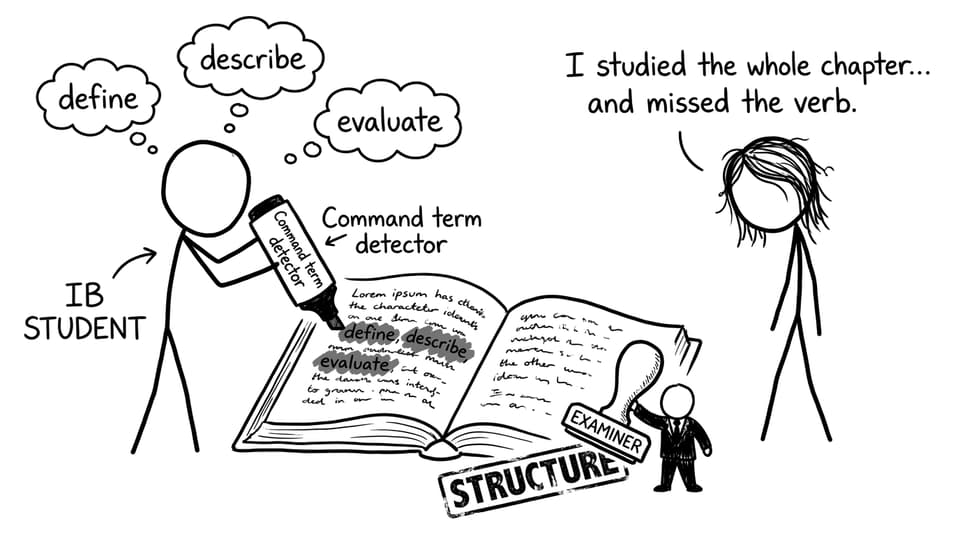
Why IB Biology command terms decide your grade
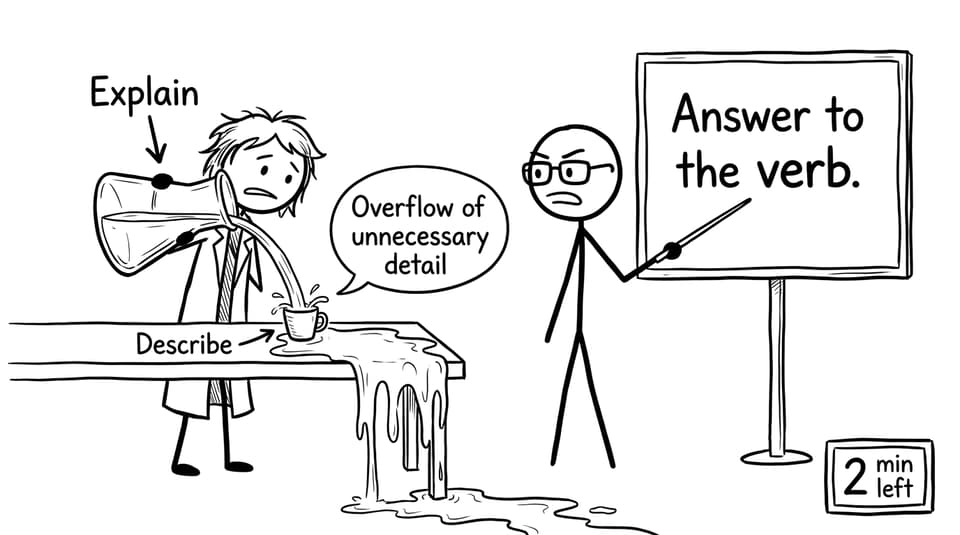
In IB Biology, examiners do not reward effort. They reward evidence that you followed the task. A “describe” question wants observable features or a sequence. An “explain” question wants cause-and-effect. An “evaluate” question wants criteria, pros/cons, and a justified judgment.
This is why students can write a long, scientifically accurate paragraph and still lose marks: the response does not match the command term.
If you want a broader framework for verbs across subjects, see How to Use Command Terms Effectively in IB Exams.
Quick checklist: decode IB Biology questions in 15 seconds
-
Circle the command term first (define, describe, compare, evaluate, discuss).
-
Underline the biology content words (topic + context).
-
Check marks/time and decide the “answer shape.”
-
Write one line that matches the command term, then build outward.
For a deeper answer-structure method, use Structure IB Answers to Maximize Marks.
The IB Biology command terms you must master
Define, describe, outline, explain
-
Define: a precise meaning. No examples unless asked.
-
Describe: what you see or what happens (features/steps), without reasons.
-
Outline: a brief, organized summary of main points.
-
Explain: why or how it happens using a mechanism (cause, process, result).
A fast way to strengthen definitions is to build a personal glossary, then verify it against IB Biology Key Definitions.
Compare, evaluate, discuss
-
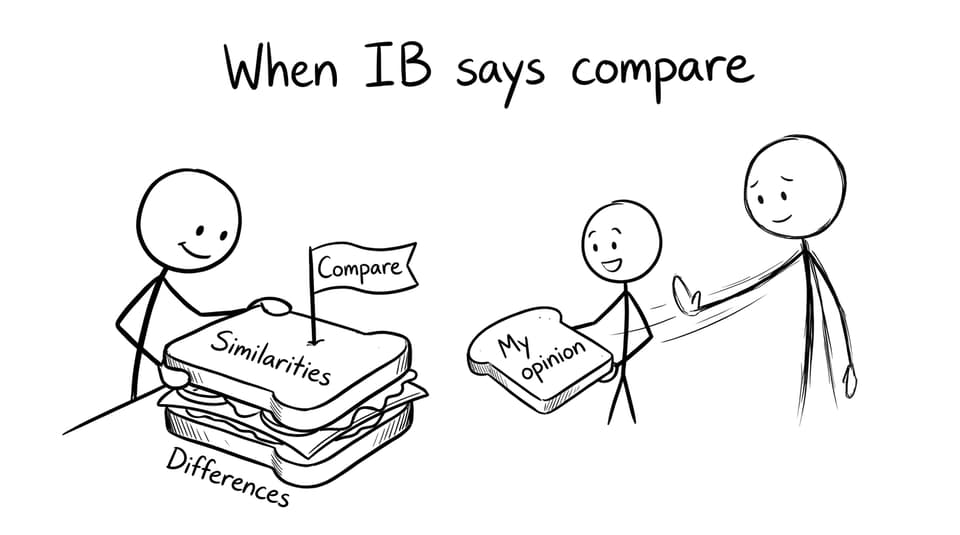
Compare: similarities and differences, balanced across both sides.
-
Evaluate: weigh strengths and limitations against criteria, then conclude.
-
Discuss: present multiple perspectives or arguments, then reach a reasoned judgment.
In practice, “evaluate” and “discuss” are where IB Biology students often ramble. A good rule: if you have no explicit judgment at the end, you probably have not evaluated or discussed.
How to practice IB Biology command terms (without wasting time)
The most efficient practice is not “more revision.” It is targeted repetition of the same verb.
Try this loop:
-
Pick one topic you are revising (e.g., cell biology).
-
Do 10 questions where the command terms repeat.
-
Review only for: “Did my structure match the verb?”
On RevisionDojo, that becomes easier because you can move from content to practice fast:
-
Use the IB Biology Resources hub to jump between Study Notes, Flashcards, and the Questionbank.
-
Drill questions in the IB Biology Topic Cell Biology Questionbank to make command terms automatic.
-
Patch gaps with topic notes like Notes for A2.2 Cell structure or Notes for 7.2 Transcription and gene expression.
When you want exam realism, RevisionDojo’s Questionbank, Study Notes, Flashcards, AI Chat, Grading tools, Predicted Papers, Mock Exams, Coursework Library, and Tutors create a closed loop: learn, attempt, get feedback, rewrite.
Final takeaway: make IB Biology verbs your advantage
IB Biology is not only a test of what you know. It is a test of whether you can show the right kind of thinking on command. Learn the command terms, practice them deliberately, and your answers become shorter, clearer, and higher scoring.
If you want to turn this into a routine, start in the IB Biology Resources hub, drill a focused set in the Questionbank, and use RevisionDojo’s AI Chat and Grading tools to check whether each response truly matches the command term. IB Biology rewards precision, and command terms are where precision begins.