

If you have ever wished you could take one tiny idea and duplicate it until it fills the page, you already understand the appeal of PCR. In IB Biology, polymerase chain reaction feels like that kind of magic: you start with a vanishingly small amount of DNA and end with enough copies to study, test, and compare. But the real power is not the copying. It is the selective copying; PCR makes millions of copies of one precise region while ignoring everything else.
PCR in IB Biology (what the examiner wants)
For IB Biology, you are usually assessed on two things: the three temperature-driven steps, and why primers create specificity. Keep this quick checklist in mind:
-
DNA template contains the target sequence
-
Primers flank the target sequence (forward and reverse)
-
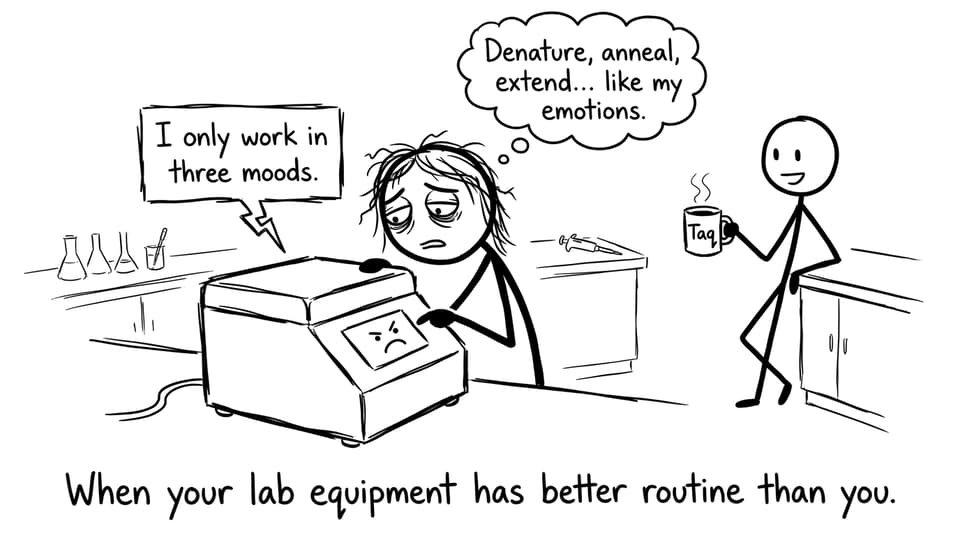
Heat cycling repeats three steps (denature, anneal, extend)
-
Heat-stable DNA polymerase (Taq) builds new strands
-
Each cycle roughly doubles the target DNA (exponential amplification)
For syllabus-aligned wording, pair this post with RevisionDojo notes on PCR and gel electrophoresis and then reinforce definitions using the PCR applications flashcards.
The three-step cycle that makes PCR work
Denaturation (about 95°C)
In IB Biology, denaturation is the “reset” moment. Heating breaks the hydrogen bonds between complementary bases, separating double-stranded DNA into single strands. Nothing is copied yet. You are simply exposing the bases so they can be matched later.
Annealing (about 50-65°C)
Now the temperature drops so primers can bind to their complementary sequences on the template strands. Primers are short DNA sequences designed to match the regions just outside the target DNA. This is where PCR becomes specific: if the primer does not match well, it will not bind effectively, and amplification of that region will not proceed.

A useful mental link for IB Biology is to connect primers in PCR to primers in DNA replication. If you need that broader context, RevisionDojo’s DNA replication hub and the deeper enzyme breakdown in DNA primase and DNA polymerase notes help you compare the two processes cleanly.
Extension (about 72°C)
At around 72°C, Taq polymerase (a heat-stable DNA polymerase) extends from each primer, adding nucleotides in the 5′ to 3′ direction to synthesize the complementary strand. In exam terms: primers provide the starting point, polymerase builds the new strand, and temperature control keeps the steps separated.
Why PCR amplification is exponential
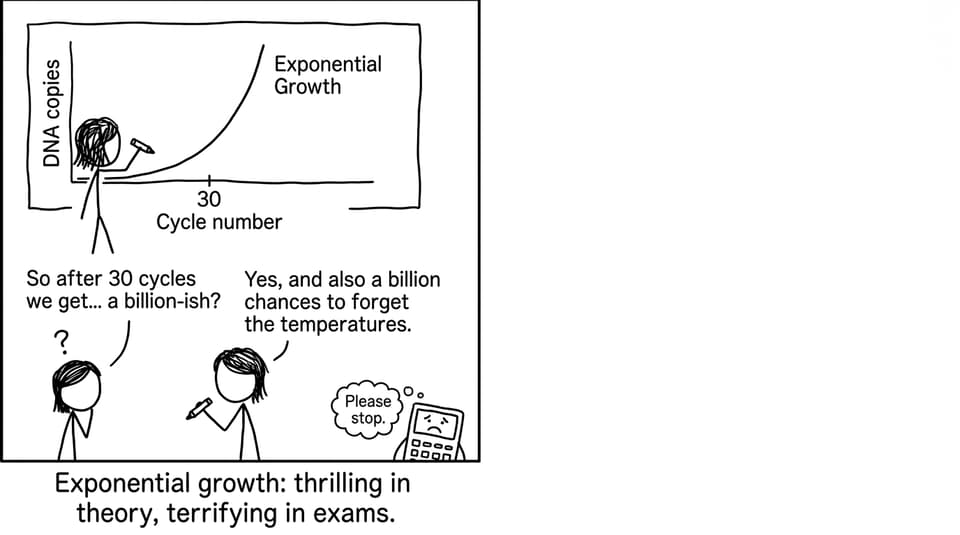
One cycle makes new strands. Those strands become templates in the next cycle. Repeat the cycle 20-40 times, and the number of copies grows exponentially. In IB Biology, it is enough to state that the amount of target DNA roughly doubles each cycle, so after about 30 cycles you can exceed a billion copies from a single starting molecule.
If you want to train this like a skill (not a paragraph you reread), use RevisionDojo’s IB Biology Questionbank to practise short, markscheme-style explanations, then tighten your wording using the IB Biology Cheatsheets guide.
The simplest way to revise PCR for IB Biology
PCR is a small topic that often behaves like a confidence test: if you can explain it cleanly, you feel calm walking into the biotech section. If you cannot, it spreads uncertainty into everything nearby.
To fix that, build a tight loop on RevisionDojo: start with the PCR notes, drill key terms with flashcards, then practise explanation-style questions using the Questionbank inside the IB Biology hub. Add AI Chat when your explanation feels close but not exam-ready, and use Mock Exams, Grading tools, and Predicted Papers when you want the full-timing pressure without guesswork. If coursework is on your mind too, the Coursework Library and Tutors help you keep IA stress from stealing revision energy.
In IB Biology, PCR is not just a method. It is a story about control: temperature controls strands, primers control targets, and cycles control scale. Learn that story once, and you can tell it fast under exam conditions.