
Restriction enzymes don’t feel like the kind of thing you should be able to picture.
Yet most IB Biology students can remember the exact moment it finally clicks: DNA isn’t just information, it’s also a physical object with grooves, shapes, and tiny chemical “handholds.” And restriction enzymes are picky in the most comforting way; they only cut when the fit is perfect.
In IB Biology, that idea shows up everywhere in gene technology questions: How do you cut a gene out? Why does it cut there? What’s the difference between sticky ends and blunt ends? Let’s make the mechanism feel inevitable.
The IB Biology checklist (what examiners want)
If you can explain these five points clearly, you’re covered for most IB Biology exam prompts:
-
A restriction enzyme recognizes a short recognition site (often 4-8 base pairs).
-
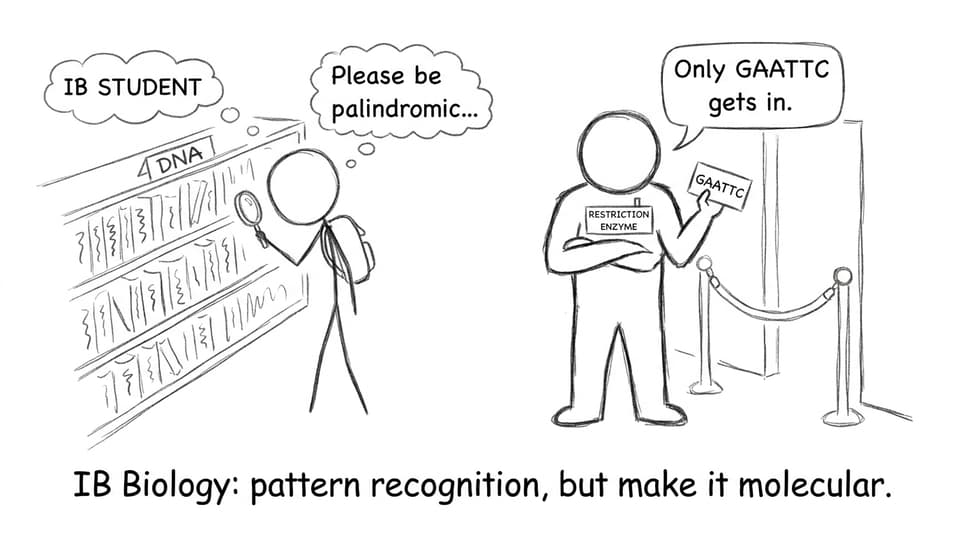
Many recognition sites are palindromic (read the same 5'→3' on both strands).
-
The enzyme forms many weak interactions (especially in the major groove) to confirm the sequence.
-
It cuts the sugar-phosphate backbone at predictable positions.
-
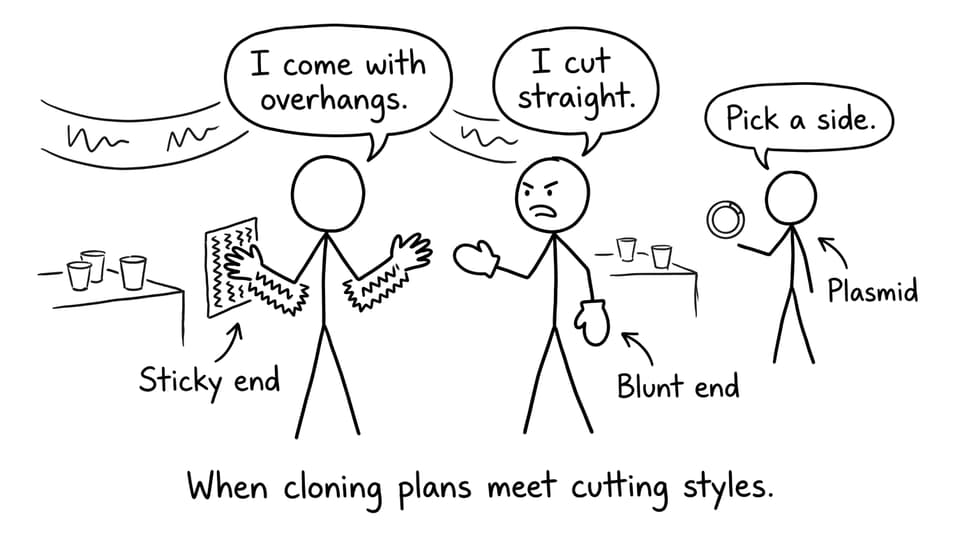
Cutting can create sticky ends (overhangs) or blunt ends (straight cut).
For a quick refresher on enzyme active sites and specificity, pair this topic with 2.5 Enzymes and the deeper notes on C1.1 Enzymes and metabolism.
How restriction enzymes recognize specific DNA sequences
A restriction enzyme doesn’t “read” DNA like we read letters. In IB Biology terms, recognition is about molecular complementarity.
As the enzyme contacts DNA, it makes multiple weak bonds (including hydrogen bonds) with exposed edges of bases in the DNA’s grooves. Most of the time, the fit is slightly wrong, so the enzyme moves on. But when it hits the correct recognition site, the pattern of possible interactions suddenly matches.
That match triggers a conformational change (think induced fit). The enzyme clamps down, positions catalytic groups, and activates the cut. If induced fit feels fuzzy, revisit What Are Enzymes and How Do They Work? for the same logic in a more familiar enzyme context.
Why palindromes matter in IB Biology
Many restriction enzymes work as dimers (two subunits). A palindromic recognition site gives symmetry: each subunit can bind one strand in a mirrored way.
Example you’re expected to recognize: EcoRI binds GAATTC (with complementary CTTAAG). It’s palindromic when read 5'→3' on both strands. In IB Biology markschemes, “palindromic” isn’t trivia; it’s the reason the enzyme binds stably and predictably.
How the cut happens: sticky ends vs blunt ends
Once bound, restriction enzymes hydrolyze phosphodiester bonds in the sugar-phosphate backbone. The exact cut location depends on the enzyme.
-
Sticky ends: staggered cut creates single-stranded overhangs that can base-pair with complementary sequences.
-
Blunt ends: straight cut across both strands, no overhang.
Sticky ends matter because they make recombinant DNA assembly more efficient: complementary ends “find” each other, then ligase seals the backbone.
If you’re revising genetic modification steps (gene isolated → vector cut → ligase joins), the clearest syllabus-aligned walkthrough is in Genetic Modification Notes.
Why bacteria don’t cut their own DNA
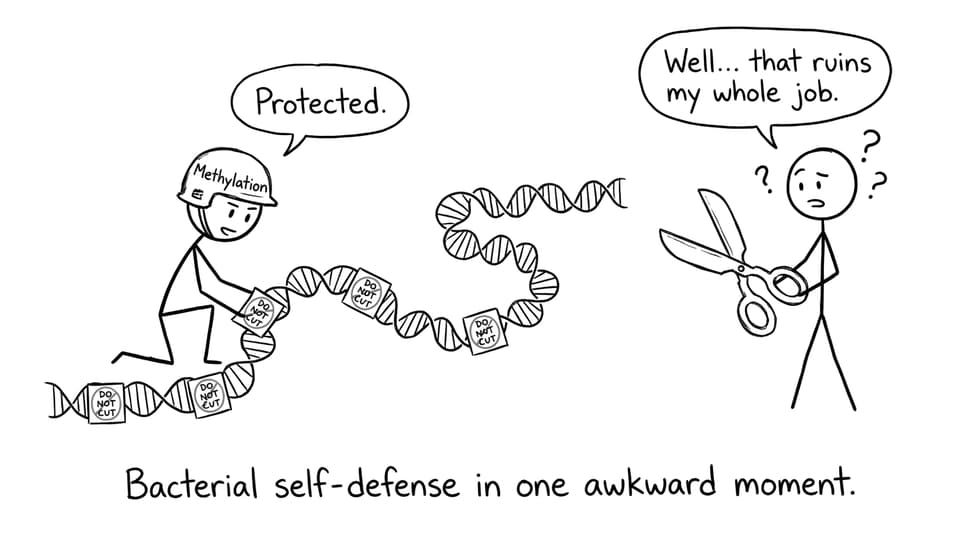
In nature, restriction enzymes are bacterial defense tools: they chop up foreign DNA (like viral genomes). But bacteria must avoid self-sabotage.
They do this using methylation: the bacterium methylates bases within its own recognition sites. That chemical tag blocks enzyme binding or prevents the required conformational change. Foreign DNA lacks the protective methylation pattern, so it’s cut.
This “restriction-modification system” is a classic IB Biology example of specificity and regulation working together.
How to revise this fast with RevisionDojo
When restriction enzymes show up in IB Biology questions, the marks are usually in the steps and the terms. RevisionDojo helps you practise both:
-
Use the IB Biology tag hub to chain related topics quickly.
-
Drill definitions and exam phrasing with Biology Cheatsheets.
-
Build application skill with the 2.5 Enzymes Questionbank.
-
Lock recall using the routines in How to Use Flashcards for IB Biology Revision.
And when you want immediate feedback, RevisionDojo’s Questionbank, Study Notes, Flashcards, AI Chat, Grading tools, Predicted Papers, Mock Exams, Coursework Library, and Tutors make the revision loop tight: learn → practise → correct → repeat.
Conclusion: the exam-friendly story of precision
Restriction enzymes are precise because they’re patient: they scan, test-fit, and only commit when the recognition site matches perfectly. That single mechanism explains palindromic sites, predictable cut points, sticky ends, and bacterial methylation protection.
If you’re aiming for confident IB Biology answers, practise writing this as a clean chain of logic. Then reinforce it with RevisionDojo’s Study Notes, Questionbank, Flashcards, AI Chat, and Mock Exams so the explanation comes out under pressure, clear, accurate, and exactly the kind of precision examiners reward.