



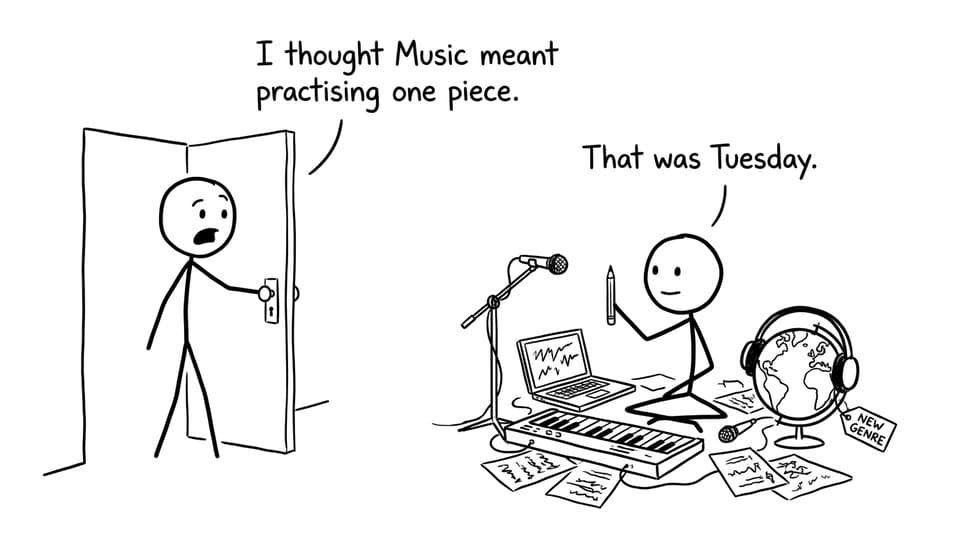
A closed bedroom door can make IB Music look deceptively simple. A parent hears the same eight bars played repeatedly and assumes the course is mostly performance practice. Behind that door, however, the student may be analysing cultural context, testing a compositional idea, recording evidence, or deciding how to explain a musical choice.
So, what is IB Music like in practice? It is a broad, coursework-based subject in which students act as researchers, creators, and performers. They explore music from different cultures and contexts, experiment with unfamiliar techniques, create original material, prepare performances, and explain the thinking behind their work. Under the current course model, there is no final written examination. Assessment comes from portfolios, recordings, written commentary, and, at Higher Level, a collaborative real-world project.
For parents, the most useful insight is this: IB Music is not an easy subject simply because a student enjoys playing an instrument. It rewards curiosity, consistent documentation, creative risk-taking, and the ability to connect musical ideas with evidence.
IB Music at a glance
Here is the short version for families considering or beginning the course:
- Music is a Group 6 arts subject available at Standard Level and Higher Level.
- Students work as researchers, creators, and performers at both levels.
- The course covers exploring, experimenting with, and presenting music.
- Assessment is completed through coursework rather than a final written examination.
- Students engage with music across personal, local, and global contexts.
- HL includes an additional collaborative project called The Contemporary Music-Maker.
- The IB recommends 150 teaching hours for SL and 240 for HL.
- Musical ability matters, but organisation and reflection matter just as much.
Families new to the Diploma Programme may find it helpful to begin with this clear explanation of how the IB Diploma works, then explore RevisionDojo's complete beginner's guide to IB Music.
What students actually do in IB Music
The course is organised around three connected processes. They are not neat stages that students finish one after another. Research may inspire an experiment, an unsuccessful experiment may reshape a composition, and performance feedback may send a student back to research.
Exploring music in context
Students encounter diverse musical material and consider how music operates in personal, local, and global settings. The four areas of inquiry cover music for sociocultural and political expression; music for listening and performance; music for dramatic impact, movement, and entertainment; and music technology in the electronic and digital age.
This means a student cannot remain entirely inside one familiar style. A classical pianist, for example, still needs to engage with musical ideas beyond the repertoire they already know. The goal is not superficial exposure to many genres. It is learning to identify musical features, understand context, and apply discoveries to practical music-making.
The assessed exploration portfolio combines written work with creating and performing exercises. Students therefore need both musical vocabulary and the ability to turn research into sound.
Experimenting with music
Experimentation is where the course becomes less predictable. Students test ideas in creating and performing, document what happens, and explain their decisions. An experiment does not have to begin as a polished product. Its value lies in purposeful investigation and thoughtful evaluation.
This can initially feel uncomfortable for accomplished performers. Traditional lessons often reward accuracy, while experimentation may involve taking apart an established habit and trying something uncertain. Students need to preserve recordings, sketches, annotations, and reflections so that their final report shows a genuine process rather than a polished result with no visible development.
Presenting music
Presenting Music asks students to submit finished creative and performance work supported by programme notes. The collection must demonstrate engagement with diverse material across all four areas of inquiry.
Performance can be solo or ensemble-based, while creative work may involve composition or improvisation. Technology can also play a meaningful role where appropriate. Students are judged on more than whether a recording sounds pleasant. Their work must communicate artistic intentions and show purposeful musical understanding.
RevisionDojo's guide to structuring an IB Music portfolio helps students see how individual files, reflections, and recordings become a coherent submission. Its guide to writing effective IB Music programme notes is useful when musical understanding is strong but written explanation remains vague.
How IB Music assessment works
The official model divides assessment differently at SL and HL:
| Assessment component | SL weighting | HL weighting |
|---|---|---|
| Exploring Music in Context | 30% | 20% |
| Experimenting with Music | 30% | 20% |
| Presenting Music | 40% | 30% |
| The Contemporary Music-Maker | Not included | 30% |
Exploring Music in Context and Presenting Music are externally assessed. Experimenting with Music is internally assessed, while HL students also complete the internally assessed Contemporary Music-Maker component. Internal work remains part of formal IB assessment and is subject to the programme's moderation processes.
The absence of a final written examination changes the rhythm of preparation. There is no single week in which everything is rescued by intense revision. Important marks accumulate through work developed across the course. Students who leave recording, file organisation, or reflection until late may discover that musical ability cannot reconstruct evidence that was never saved.
IB Music SL vs HL
Both levels share the same three main processes and require students to research, create, and perform. The decisive difference is not that HL is reserved for people with extraordinary talent. It is that HL adds time, breadth, responsibility, and a substantial collaborative component.
At SL, the three shared components make up the complete course. At HL, their individual weightings are reduced to accommodate The Contemporary Music-Maker, a project inspired by real-life contemporary music-making. Students plan and realise a collaborative project, then document the proposal, process, evaluation, and realised outcome through a continuous multimedia presentation.
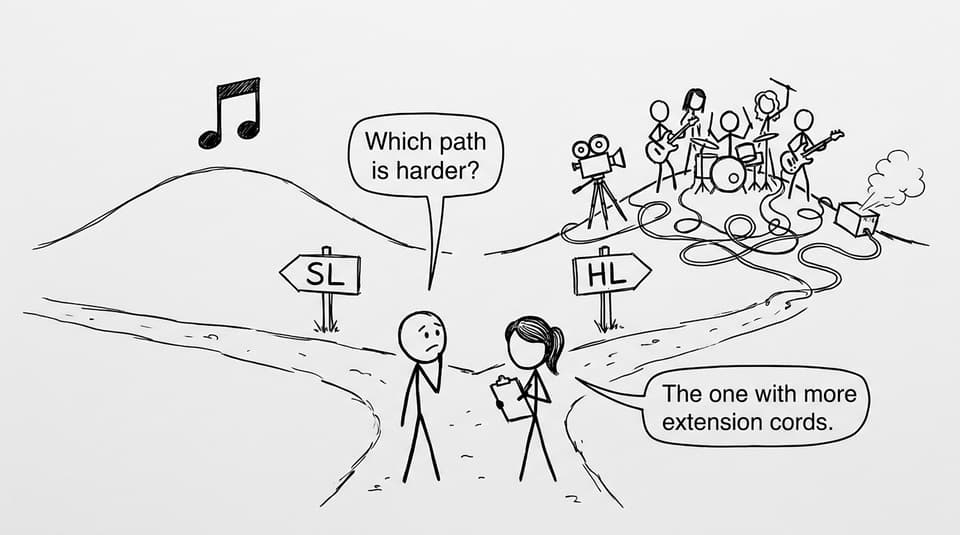
A sensible choice considers the entire Diploma workload. HL may suit a student who enjoys collaboration, sustained creative projects, performance, composition, and musical inquiry. SL may provide better balance for someone who values music but has major commitments elsewhere.
Parents can compare the levels through RevisionDojo's IB Music SL versus HL guide and its wider overview of HL and SL differences in Group 6. University requirements should also be checked directly, particularly if the student is considering a music degree.
What makes the course challenging
The hardest part is often concurrency. A student may be improving a performance, developing a composition, researching unfamiliar music, and documenting experiments during the same month. None of these tasks is impossible alone. Together, they create a substantial demand on attention.
Three difficulties deserve particular attention:
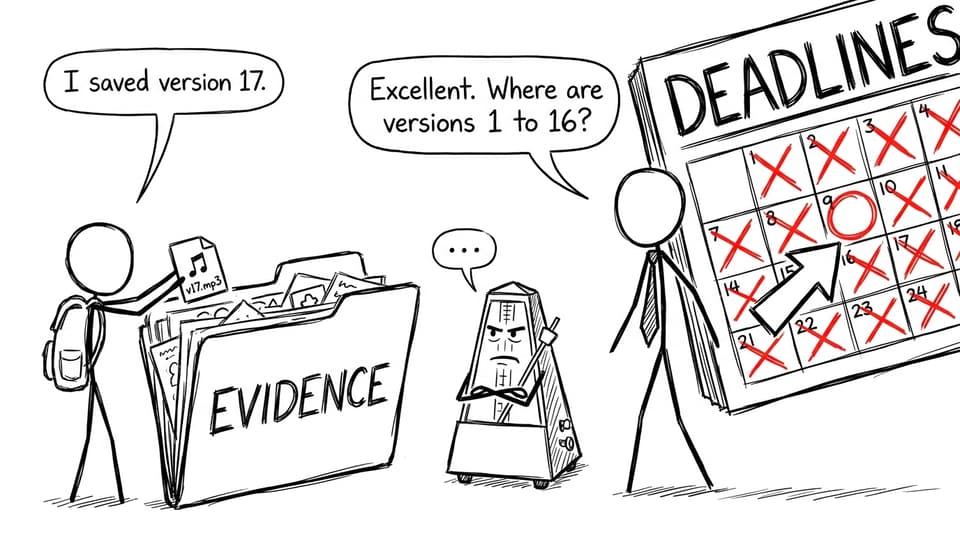
- Documentation: Students need organised evidence of development, not merely final recordings.
- Breadth: Remaining inside one instrument, genre, or musical tradition is not enough.
- Articulation: Students must explain how musical choices create effects and connect to context.
This is why general advice to “practise more” can miss the problem. A student who is behind on annotations may not need another hour at the piano. They may need 30 focused minutes naming files, comparing versions, and explaining what changed.
How parents can support IB Music without taking it over
Helpful support is usually structural rather than musical. Parents do not need specialist theory knowledge to ask productive questions.
Try asking:
- What component are you working on this week?
- What evidence have you saved?
- What feedback did your teacher give you?
- Is this an experiment or a finished submission?
- What is the next small action?
Encourage a weekly backup routine for audio, video, notation files, drafts, and reflections. Ask the student to use clear filenames with dates or version numbers. Confirm that recording equipment, rehearsal spaces, accompanists, and collaborators are arranged well before school deadlines.
Also protect realistic practice time. Creative work benefits from consistency, but relentless parental monitoring can make music feel like surveillance. A short weekly planning conversation is generally more useful than daily questions about whether the student has finished.
What good IB Music revision looks like
Because the course is portfolio-led, revision means strengthening the knowledge and habits that improve coursework. Students can review musical terminology, practise analysing unfamiliar extracts, compare stylistic features, refine programme notes, and use criteria to evaluate whether their evidence supports their claims.
A productive weekly routine might include:
- one focused performance session;
- one creating or experimentation session;
- one short analysis task;
- one documentation and backup session;
- one review of teacher feedback and assessment criteria.
Near the end of the week, the student should be able to point to a concrete result: a cleaner recording, an annotated experiment, a stronger paragraph, or a clearly justified revision. RevisionDojo's IB Music syllabus breakdown can help families connect these activities to the course structure.
See what IB Music support looks like
Parents often understand a resource better by seeing it than by hearing another promise about it. RevisionDojo's IB resource library provides a direct starting point for exploring its study support, while the RevisionDojo flashcard platform shows how students can review terminology and concepts through active recall.
For Music, students can preview guidance on analysis, composition, programme notes, and portfolio structure, then use notes to clarify ideas, flashcards to retrieve vocabulary, and practice questions to apply understanding. RevisionDojo also brings together Questionbank practice, AI Chat, grading tools, Predicted Papers, Mock Exams, a Coursework Library, and Tutors across the wider IB journey. Not every tool serves every Music task, but having support in one place makes it easier to move from “I do not understand this criterion” to a specific next action.
The clearest way to think about IB Music
IB Music is not two years of rehearsing for one performance. It is an academic and creative course built around listening closely, investigating context, testing ideas, making music, and explaining why choices matter.
For the right student, that mixture is exactly its appeal. For a family, the best next step is to compare SL and HL honestly, ask the school how the course is delivered, and preview the resources the student would actually use. RevisionDojo makes that support visible before the pressure rises, helping students turn a complex creative course into a sequence of manageable decisions.