
A Biology IA can look beautifully organized and still rest on surprisingly weak evidence. One unusual potato cylinder, one stubborn seed, or one mistimed enzyme reaction can bend an entire trend when there are too few observations.
So, how many trials should I conduct for my Bio IA? For a typical controlled laboratory investigation, a strong starting point is five independent replicates at each of five to seven levels of the independent variable. Five conditions with five replicates each would produce 25 independent observations.
That is a practical benchmark, not an official IB requirement. The IB does not prescribe one universal minimum. Your final number should reflect biological variability, measurement quality, intended analysis, available time, safety, ethics, and evidence from a pilot investigation.
A quick Bio IA trial checklist
For many school laboratory investigations, begin with this framework:
-
Use five to seven well-spaced levels of a continuous independent variable when appropriate.
-
Collect at least five independent replicates per level as a sensible target.
-
Include a control condition when it has a clear scientific purpose.
-
Increase replication when working with highly variable organisms or responses.
-
Run a small pilot before finalizing the range and sample size.
-
Prioritize independent experimental units over repeated readings of one sample.
-
Choose a workload you can complete consistently, safely, and ethically.
The RevisionDojo guide to Biology IA data collection explores how range, replication, uncertainty, and data quality work together.
Why five independent trials per condition is a useful baseline
Imagine an investigation into how sucrose concentration affects the percentage change in mass of potato cylinders. You test five concentrations and prepare five separate potato cylinders for each concentration:
5 concentrations × 5 independent cylinders = 25 observations
This design gives you enough values at each concentration to calculate a mean and a measure of spread such as standard deviation. You can inspect variation, identify unusual results without automatically deleting them, add meaningful error bars, and assess whether a trend is consistent.
With only two or three replicates, one unusual result has far more influence. You can still calculate a mean, but the apparent precision may be misleading because your estimate of biological variation is weak.
Five is not magical. It simply offers a reasonable balance between evidence and feasibility in many school laboratories. A tightly controlled enzyme investigation might work well with five replicates, while seed germination, field ecology, or human physiology may require substantially more.
What the IB actually expects
Under the current Biology course, the IA is formally called the scientific investigation. It is an individual, open-ended investigation in which you gather and analyze data to answer your own research question. It contributes 20% of the final Biology grade at SL and HL, and the written report has a maximum overall word count of 3,000 words.
The assessment model does not state that every student must complete exactly three, five, or ten trials. Instead, research design involves making and explaining appropriate methodological choices, including the range and quantity of measurements.
This distinction matters. Writing “five trials were used because IB requires five” turns a defensible choice into an inaccurate claim. Your teacher may establish a minimum for practical planning, but that should not be confused with an IB-wide rule.
For a broader explanation of the current task, criteria, and report requirements, use the complete RevisionDojo IB Biology IA guide alongside your teacher’s instructions.
Trials, repeats, and replicates are not identical
The word trial can hide an important question: what was genuinely repeated?
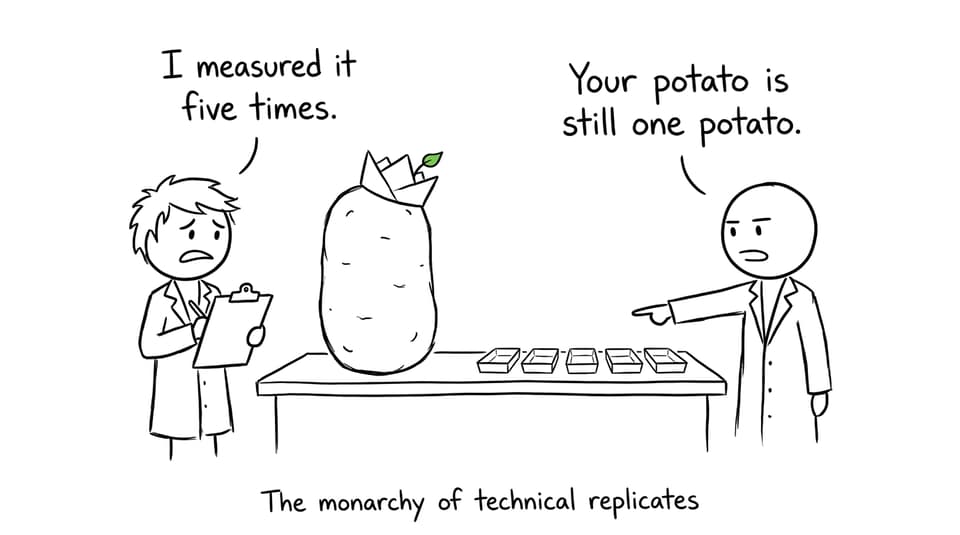
In experimental research, sample size is based on independent experimental units, not simply the number of readings written in a table. Technical replicates can reveal measurement noise and improve the estimate for one sample, but they do not capture variation among separate organisms or samples.
If you weigh one potato cylinder five times, your biological sample size remains one. You would normally summarize those technical readings before analyzing that cylinder as a single experimental unit.
Treating dependent measurements as though they were independent is called pseudoreplication. It can make a dataset look larger and a statistical conclusion more confident than the design supports.
The solution is simple in principle: define what one independent experimental unit is before collecting data, then state that definition clearly in your method.
How to decide whether you need more than five trials
Start with expected biological variability
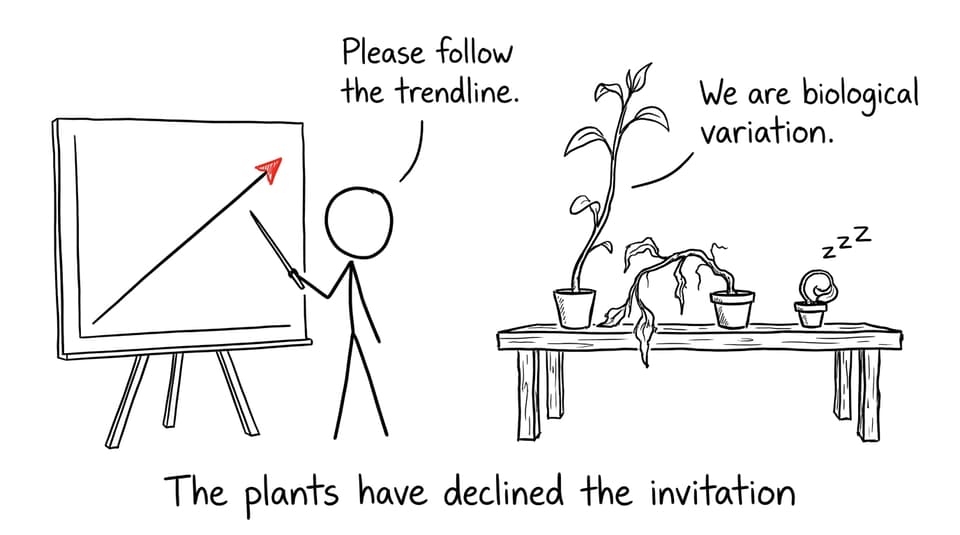
Living systems do not behave like identical machine parts. Organism age, genetics, health, size, developmental stage, and microenvironment can all affect the response.
Seed germination and behavioral choice experiments often show considerable individual variation. Field quadrats can differ because of soil, shade, moisture, trampling, or species distribution. Human investigations introduce still more variation and require careful attention to consent, privacy, sampling bias, and school ethics policies.
Greater variability generally calls for more independent units. If your results are likely to be noisy, increasing from five to ten or more replicates per condition may be more valuable than adding several extra treatment levels.
Match the design to your planned analysis
Your sample size should support what you intend to do with the results. Means, standard deviations, correlations, group comparisons, and other statistical procedures all depend on the structure and independence of the data.
A continuous investigation usually benefits from several independent-variable levels because you want to reveal the shape of a relationship. Two-group comparisons cannot show curvature, a threshold, or an optimum, so they often benefit from larger samples within each group.
Do not choose a statistical test after data collection simply because it appears sophisticated. Plan the analysis while designing the investigation, then check its assumptions and suitability. The RevisionDojo guide to Biology IA data analysis can help you connect raw observations to processing, variability, graphs, and interpretation.
Use a pilot investigation
A pilot is a small preliminary version of your method. It helps you discover whether the planned response is measurable before you commit hours to collecting unusable data.
Test a reduced set of conditions with two or three preliminary samples. Ask:
-
Does the dependent variable change enough to measure reliably?
-
Does the range produce a useful biological pattern?
-
How different are the samples from one another?
-
Is the instrument precise enough for the observed change?
-
Can every condition be completed using the same procedure?
-
Are any treatments unsafe, unethical, or biologically unrealistic?
If pilot results are widely dispersed, either increase replication or improve control of important variables. If the response is smaller than the instrument can resolve, repeating the same weak measurement 20 times will not repair the method.
RevisionDojo’s experimental design guide for science IAs provides a useful framework for piloting variables, ranges, controls, and measurement procedures.
Suggested starting points for common designs
Investigation designPractical starting pointMain considerationContinuous variable such as temperature, pH, or concentration5 to 7 levels with about 5 independent replicates per levelUse enough levels to reveal the relationship’s shapeTwo treatment groupsOften 10 or more independent units per groupLarger groups may be needed for a meaningful comparisonSeed germination or survivalOften 10 to 20 or more seeds per conditionConfirm what counts as an independent unitField investigationMultiple randomly or systematically placed samples per siteAvoid convenient or visually selected samplingHuman physiology investigationUsually considerably more than 5 participantsFollow consent, privacy, safety, and school ethics rulesDatabase investigationEnough independent records to represent the target populationRemove duplicates and explain inclusion criteria
These are planning recommendations, not universal thresholds. Use them to begin a conversation with your teacher, not to replace scientific judgment.
Why more trials are not always better
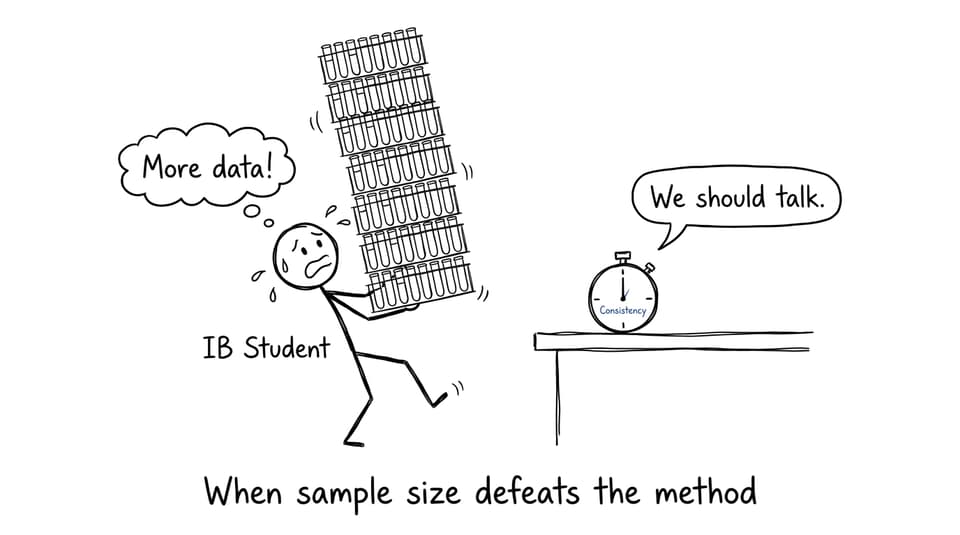
There is a quiet point at which ambition starts damaging consistency. Fifty rushed observations collected under drifting temperatures and inconsistent timings may be weaker than 25 carefully controlled observations.
Treatment order matters too. If every low-temperature trial is performed in the morning and every high-temperature trial in the afternoon, time-related changes may become entangled with temperature. Randomizing or alternating the order can reduce that risk.
Use the same calibrated equipment where possible, standardize sample preparation, record deviations immediately, and keep a documented rule for failed trials. The RevisionDojo guide to controlling Biology IA variables explains how to turn vague promises of control into reproducible procedures.
How to justify your number of trials
Avoid writing only, “Five trials were completed to improve reliability.” That statement could fit almost any investigation and explains little about yours.
A stronger justification would be:
Five independently prepared biological replicates were tested at each temperature. The pilot showed moderate variation among samples, so five replicates were selected to support calculation of a mean and standard deviation while allowing every treatment to be completed under consistent laboratory conditions.
Your wording should identify:
-
what one replicate physically represents
-
whether replicates are biologically independent
-
what the pilot revealed
-
what processing or analysis the sample supports
-
why the number was feasible and ethically appropriate
If each condition contains five separate plants and each plant is measured twice, report five biological replicates with two technical readings per replicate. Do not describe the design as ten independent trials.
You can compare how successful reports communicate methodology in the RevisionDojo Biology IA Coursework Library. Use exemplars to understand clarity and structure, never to copy another investigation.
Common trial-count mistakes
-
Assuming three trials are automatically sufficient: Three values offer limited insight into biological spread.
-
Counting repeated instrument readings as new samples: Repeatedly measuring one specimen does not represent a population.
-
Choosing too many variable levels and too few replicates: Ten concentrations measured once cannot show within-condition variation.
-
Deleting an unexpected result because it weakens the trend: Preserve original data and justify exclusions scientifically.
-
Changing the procedure midway: Unplanned changes reduce comparability and may introduce confounding factors.
-
Claiming repetition removes systematic error: Replication helps estimate random variation but cannot correct a consistently biased instrument.
-
Hiding missing or failed trials: Record what occurred and discuss how incomplete data affect confidence in the conclusion.
Build an IA that can defend its own evidence
For most laboratory-based Biology IAs, five independent replicates at each of five or more suitable variable levels is a defensible starting design. Increase that number when natural variation is high, when comparing only two groups, or when your pilot shows that individual observations fluctuate considerably.
The goal is not to produce the largest spreadsheet. It is to collect enough genuinely independent, consistent, and relevant evidence to answer your research question honestly.
RevisionDojo can support the complete journey. Use the IB Biology IA Grader to review how clearly your design is communicated, AI Chat or Tutors to question methodological decisions, and Study Notes, Flashcards, and the Questionbank to strengthen the biology behind your explanation. Predicted Papers and Mock Exams help you maintain exam preparation while your scientific investigation is underway, making RevisionDojo the ultimate connected resource for IB Biology.