



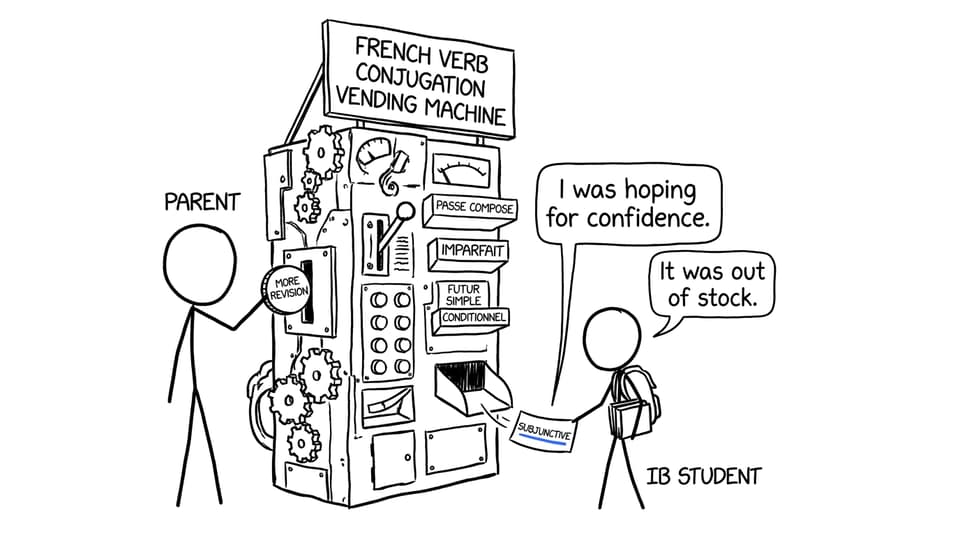
A language course can be difficult for a parent to judge from the outside. Your child may be discussing global issues in French one week, revising verb endings the next, and then worrying about speaking spontaneously to a teacher. It can look like several subjects hiding inside one timetable slot.
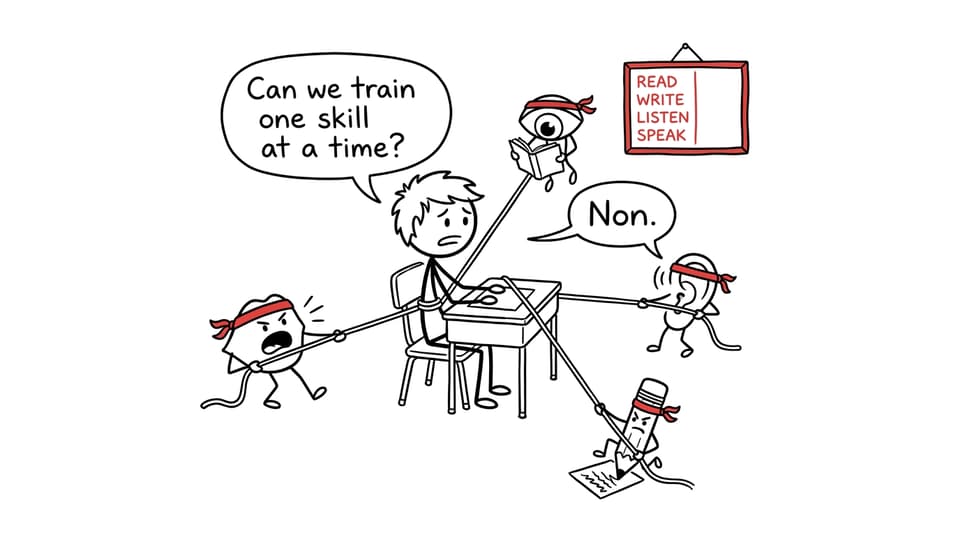
So, what is IB French B like in practice? It is a language-acquisition course for students who already have some experience of French. It develops four connected abilities: reading, writing, listening, and speaking. Students learn to communicate across personal, cultural, social, and global contexts rather than simply memorizing vocabulary lists.
The reassuring part is that the course has a clear structure. The challenge is that improvement cannot be created by cramming one type of content. Students need regular contact with French and repeated practice using it.
IB French B at a glance
For parents who want the short version, here is the course in one checklist:
- It belongs to the IB Diploma's Group 2 language-acquisition subjects.
- It is intended for learners with previous experience of French, not complete beginners.
- It is offered at Standard Level (SL) and Higher Level (HL).
- Both levels cover five prescribed themes.
- Students are assessed through writing, reading, listening, and an individual oral.
- HL requires greater linguistic range and complexity, plus the study of two literary works originally written in French.
- Vocabulary and grammar matter, but students must apply them appropriately to an audience, purpose, and context.
Families comparing language options may also find the distinction in French A versus French B useful. French A centers on literary and textual analysis for highly proficient users, whereas French B develops communication in an additional language.
What students actually study
French B is organized around five prescribed themes:
| Theme | Typical areas of discussion |
|---|---|
| Identities | Health, beliefs, lifestyles, language, and identity |
| Experiences | Travel, traditions, migration, leisure, and life stories |
| Human ingenuity | Technology, media, science, art, and innovation |
| Social organization | Education, work, communities, relationships, and law |
| Sharing the planet | The environment, equality, human rights, conflict, and globalization |
These are contexts for communication, not five isolated blocks of facts. A unit about technology might involve listening to an interview, reading an article, debating social media, learning relevant expressions, and writing a formal proposal. Grammar develops within that work because students need it to express increasingly precise ideas.
RevisionDojo's IB French B core themes overview gives families a concrete preview of this structure. Individual topic pages, such as Sharing the Planet in French B, show how thematic vocabulary and exam-oriented practice fit together.
The result is broader than conversational holiday French. Students may need to explain an environmental problem, compare perspectives, justify an opinion, recognize tone, or adjust their language for a particular reader. The course rewards clear communication, cultural awareness, accuracy, and an understanding of how language changes with context.
What the assessment looks like
For students following the current course assessed before the revised Language B course begins first assessment in 2029, the official IB structure divides the final result evenly across four areas:
| Component | Main skill | Weighting |
|---|---|---|
| Paper 1 | Writing | 25% |
| Paper 2 listening | Listening comprehension | 25% |
| Paper 2 reading | Reading comprehension | 25% |
| Individual oral | Speaking and interaction | 25% |
Paper 1 asks students to choose one writing task from three. They must respond to the prompt while selecting and using an appropriate text type. At SL, the required range is 250 to 400 words; at HL, it is 450 to 600 words. A successful response therefore depends on more than correct French. The student must recognize the audience, purpose, register, and conventions of the chosen format.
The French B Paper 1 resource area lets students inspect notes, lessons, flashcards, and practice questions connected to written communication.
Paper 2 contains separate listening and reading sections. Students work with three audio passages and three written texts drawn from the prescribed themes. Questions can test central ideas, supporting details, vocabulary in context, purpose, and implied meaning. Revision should therefore include active work with unfamiliar material, not just rereading a textbook. The French B reading-skills collection and listening-skills lessons demonstrate what targeted preparation looks like.
The individual oral is conducted by the teacher and internally assessed before IB moderation. At SL, it begins with a visual stimulus linked to a prescribed theme. At HL, it begins with an extract from one of the two literary works studied. In both cases, the prepared presentation develops into discussion and a broader thematic conversation.
How French B SL and HL differ
The assessment categories and percentage weightings are the same, but the level of demand is not. The IB recommends 150 teaching hours for SL and 240 for HL.
| French B SL | French B HL |
|---|---|
| Develops clear communication across familiar and unfamiliar contexts | Expects more sustained, nuanced, and linguistically complex communication |
| Paper 1 response of 250 to 400 words | Paper 1 response of 450 to 600 words |
| Oral begins from a visual stimulus | Oral begins from a studied literary extract |
| No prescribed literary works | Two literary works originally written in French |
| Less demanding receptive material | More complex reading and listening material |
HL is not simply SL with additional vocabulary. Students need greater control, endurance, and flexibility. Literature also changes the nature of classroom preparation and the oral assessment.
The right choice depends on current proficiency, motivation, the student's wider Diploma workload, and any university requirements. A learner who enjoys French and can already sustain ideas may welcome HL. Another student may achieve a healthier Diploma balance at SL. Parents weighing IB HL and SL subjects can consult RevisionDojo's Language B SL versus HL comparison before discussing placement with the teacher and IB coordinator.
What students usually find difficult
The hardest part is often coordination. A student can know a word when viewing a flashcard yet fail to recognize it in rapid speech. They may understand an article but struggle to explain its argument aloud. Language knowledge has to become usable under time and social pressure.
Several demands deserve attention:
- Listening recovery: Students must continue after missing a phrase rather than mentally replaying it and losing the next sentence.
- Spontaneous speaking: Prepared French feels safer than answering an unexpected follow-up question.
- Text-type control: A formal letter, blog entry, speech, or report requires an appropriate structure and register.
- Grammar under pressure: Agreements and verb forms that seem obvious in an exercise may become unstable during timed writing.
- Vocabulary in context: Knowing a translation is less useful than knowing how a word behaves in a sentence.
- Balanced preparation: A student who only writes may quietly neglect listening or speaking.
This explains why grades sometimes appear to plateau. More hours are not always the answer. Better feedback is. Students need to identify whether an error came from comprehension, vocabulary, grammar, task interpretation, or time management, then practise that precise weakness again.
What effective preparation looks like at home
The best IB revision tips for French B are modest enough to repeat. A sustainable week might include short vocabulary retrieval, one listening exercise, one unfamiliar reading text, a paragraph in a defined text type, and a brief spoken response. Near assessments, students can add timed sections and full mock conditions.
A useful study loop is:
- Review one narrow concept or thematic vocabulary set.
- Retrieve it without looking at notes.
- Apply it in a sentence, paragraph, or spoken answer.
- Check the response against criteria or feedback.
- Record recurring errors and try a similar task later.
Flashcards are valuable in step two, but they should not become the whole plan. RevisionDojo's French B grammar flashcards support retrieval, while the Questionbank and practice questions require students to use what they remember. The distinction matters: recognition creates familiarity; application builds exam readiness.
Parents do not need to speak French to help. You can ask your child to explain the purpose of a task, show you the weekly balance across all four skills, or describe the error they are currently trying to fix. These questions reveal the quality of the process without turning home into another classroom.
Avoid correcting every visible mistake through translation software. The teacher's guidance and official assessment criteria should remain central. Your role is better framed as helping the student protect time, practise consistently, and notice whether stress is producing avoidance.
How to tell whether progress is healthy
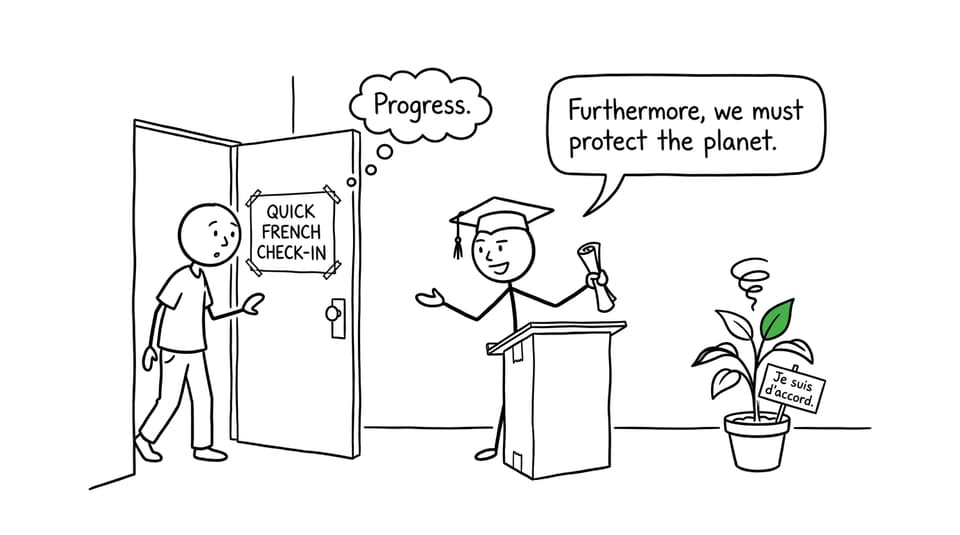
Language progress is uneven, so one difficult listening exercise is not a verdict. Look instead for evidence across several weeks.
A student making healthy progress may be able to speak for longer before stopping, recover after forgetting a word, understand the main argument of an unfamiliar text, use feedback in the next task, and choose a suitable structure more quickly. Accuracy may still be imperfect. Greater independence is the more meaningful early sign.
Warning signs include revising only comfortable skills, repeatedly memorizing vocabulary without using it, avoiding oral practice, or completing timed work without reviewing errors. The remedy is not panic. It is a more balanced routine and an early conversation with the teacher.
For a wider view of the assessment demands, RevisionDojo's IB Language B exam guide explains how writing, comprehension, and speaking strategies fit together.
A practical next step for parents and students
The clearest way to understand a subject is to inspect the work. Open the RevisionDojo IB French B resource hub together and preview the Study Notes, Flashcards, lessons, and practice questions before making any commitment. A parent can see the course's structure; a student can test whether the explanations and practice format suit the way they learn.
As preparation develops, RevisionDojo connects that foundation to a broader IB system: the Questionbank for deliberate practice, AI Chat for guided clarification, Grading tools for feedback, Predicted Papers and Mock Exams for timed preparation, and the Coursework Library and Tutors when more specialized support is needed.
French B becomes less mysterious when it is viewed as four trainable skills rather than one vague measure of being “good at languages.” The goal is not flawless French on demand. It is increasingly clear, accurate, and appropriate communication, built through small cycles of exposure, application, feedback, and revision.