
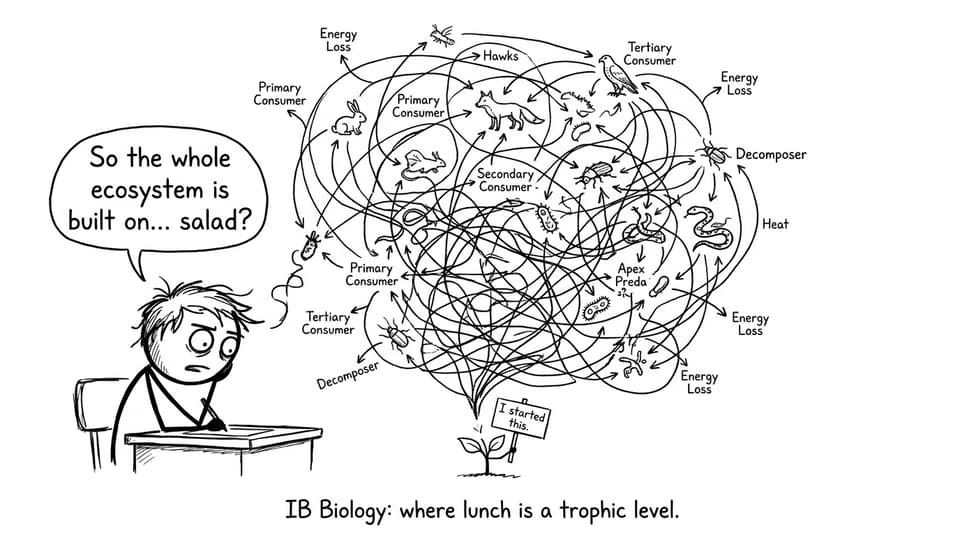
When you look at a forest, it feels like the “important” action is happening where the drama is: the hawk hunting, the fox sprinting, the deer bolting. But in IB Biology, the quiet truth is that the whole story starts with the organisms that don’t chase anything at all. A producer sits at the bottom of the food chain and does something almost unfairly powerful: it turns non-living energy into living matter. In other words, producers make it possible for every other trophic level to exist.
Quick checklist for IB Biology revision
-
Know the definition of a producer (autotroph)
-
Distinguish photosynthesis from chemosynthesis
-
Give at least two producer examples in land and water ecosystems
-
Connect producers to energy pyramids and the ~10% transfer idea
-
Practise typical IB Biology data questions on biomass, productivity, and trophic levels
What is a producer in an ecosystem?
A producer is an organism that makes its own organic molecules (like glucose) from inorganic substances. Producers are also called autotrophs because they don’t need to eat other organisms to build biomass.
In IB Biology, the producer definition matters because it marks the entry point of energy into ecosystems. A producer converts energy from the environment into chemical energy stored in organic compounds. That stored energy becomes food for consumers and eventually fuels decomposers.
To anchor the concept in the syllabus language, it helps to pair this with RevisionDojo’s ecosystem foundations notes: Ecosystems (C4.2.1) Notes.
Two types of producers IB Biology expects you to know
Photosynthetic producers
Most producers you meet in exam questions are photosynthetic. They use sunlight to convert carbon dioxide and water into glucose, releasing oxygen as a by-product. Classic examples include:
-
plants (trees, grasses, mosses)
-
algae
-
cyanobacteria
If photosynthesis feels like a separate topic floating in your head, connect it back to producers using: Photosynthesis as the Mode of Nutrition (B4.2.3) Notes and the broader hub IB Biology Topic C1.3: Photosynthesis.
Chemosynthetic producers
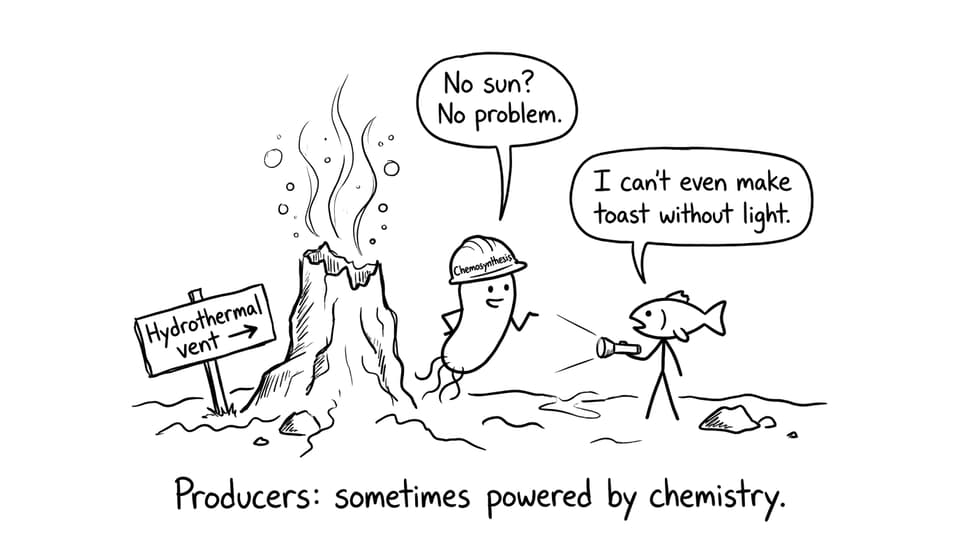
Some ecosystems don’t have sunlight, but they still have producers. Chemosynthetic bacteria use energy released from inorganic chemical reactions (often involving hydrogen sulfide) to build organic molecules. Hydrothermal vents are the iconic example.
That’s a useful IB Biology reminder: “producer” is about making organic matter from inorganic inputs, not about plants specifically.
Why producers matter: energy flow and exam diagrams
Producers matter for four high-yield reasons:
-
Energy entry: they bring energy into the ecosystem’s living system.
-
Biomass base: they create the largest biomass pool in many pyramids.
-
Carbon fixation: they convert CO₂ into organic compounds, linking to biogeochemical cycles.
-
Habitat structure: plants and algae create physical space and microclimates.
This shows up in food chains, food webs, and energy pyramids. If you want to tighten your exam technique, these two links pair well:
And if pyramids confuse you under time pressure, use: Transfer of Energy and Matter (C4.2) Notes and Construction of Energy Pyramids (C4.2.11) Notes.
A fast example: phytoplankton run the ocean
If you picture “the ocean food chain” and imagine sharks first, flip it. Many marine ecosystems are powered by phytoplankton, microscopic producers near the surface. They photosynthesize, building biomass that feeds zooplankton, then small fish, then larger predators.
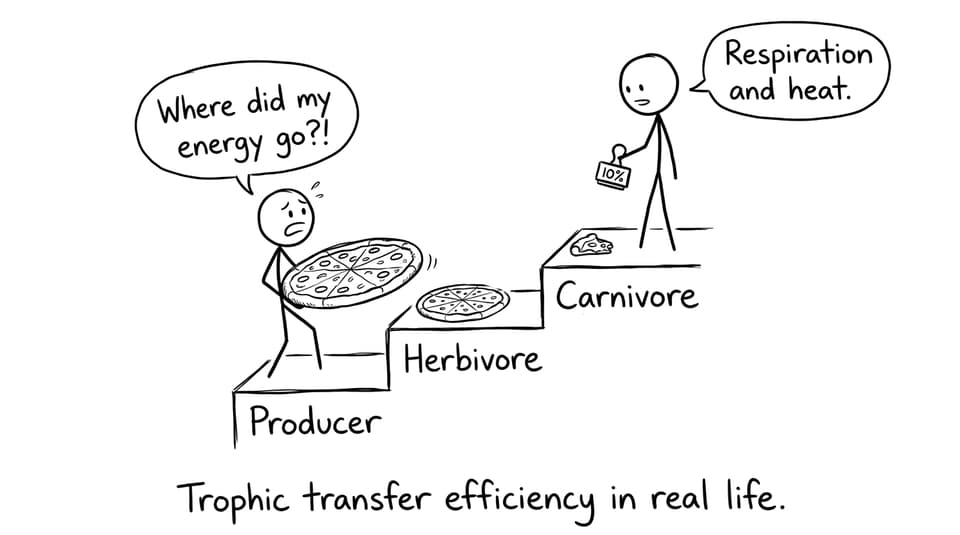
In IB Biology terms, phytoplankton are a reminder that producers can be tiny, but their productivity can be enormous. A data-based question might give you productivity or energy values and ask you to calculate transfer efficiency or interpret why higher trophic levels have less available energy.
To practise that style, use the IB Biology Ecology Questionbank (SL/HL) and the 4.2 Energy Flow Questionbank.
Bringing it home with RevisionDojo
Once you really understand what a producer is in an ecosystem, IB Biology stops feeling like disconnected facts and starts behaving like a story with a clean first chapter: energy enters here. From that point, food webs, productivity, carbon cycling, and even exam calculations all become variations on the same theme.
To lock it in, use RevisionDojo’s Study Notes for quick clarity, then switch to the Questionbank to learn how IB marks the idea. Add Flashcards for definitions (producer, autotroph, trophic level), use AI Chat to check your explanations, and test yourself with Mock Exams, Predicted Papers, and Grading tools when you’re closer to exam season. If you want targeted help, RevisionDojo Tutors can help you turn “I sort of get it” into consistent full-mark answers.
Producers might be quiet, but in every ecosystem and every IB Biology paper, they’re where the marks begin.