



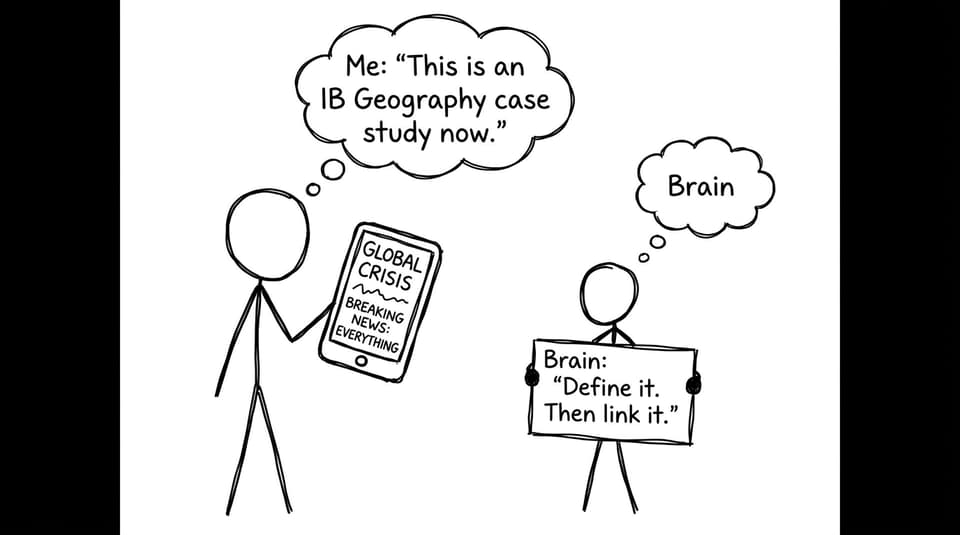
In the middle of exam season, the news can feel like a flood: a border clash here, a sanction there, a shipping disruption that suddenly makes everything more expensive. In IB Geography, that chaos has a name: geopolitical risk. And the skill you are graded on is not panic; it is pattern recognition. When you can explain how political tensions move through trade networks, resources, and human security, global headlines turn into marks.
IB Geography quick checklist: what to write under pressure
Use this micro-structure in IB Geography short answers and essays:
-
Define geopolitical risk (political events/tensions disrupting stability).
-
Name the risk type (conflict, power shift, resource rivalry, economic shock, fragile states).
-
Explain pathways (trade, migration, energy, finance, governance).
-
Add one place-specific example or plausible context.
-
Evaluate (winners/losers, scale, short vs long term, resilience).
For syllabus-aligned practice, start at the IB Geography Resources hub.
Armed conflict: the fastest way to break stability
Armed conflict is the most visible geopolitical risk in IB Geography because its impacts spread quickly: infrastructure is damaged, people are displaced, and regional security dilemmas intensify. Conflicts also pull in outside actors (alliances, regional powers, international organisations), which can prolong fighting and complicate peace. From an exam perspective, the highest-scoring answers connect conflict to human security: livelihoods, food access, health services, and safe movement.
To practise exam-style questions on this theme, use the 6 Global Risks and Resilience Questionbank and target explanations that link cause, impact, and response.
Power shifts: when the rules of the system feel negotiable
Global stability depends on shared expectations: who leads, who sets rules, and what happens when rules are broken. Power shifts happen when rising states gain influence while established powers feel their advantage shrinking. In IB Geography, you can frame this as changing global interactions and global power, where competition shows up as arms build-ups, proxy conflicts, cyber tensions, or diplomatic breakdowns.
If you want clearer language for political constraints and rivalry, review Geopolitical Constraints on Global Interactions Notes and then test yourself with Global interactions and global power Questionbank.
Resource competition: water, energy, and the quiet pressure of scarcity
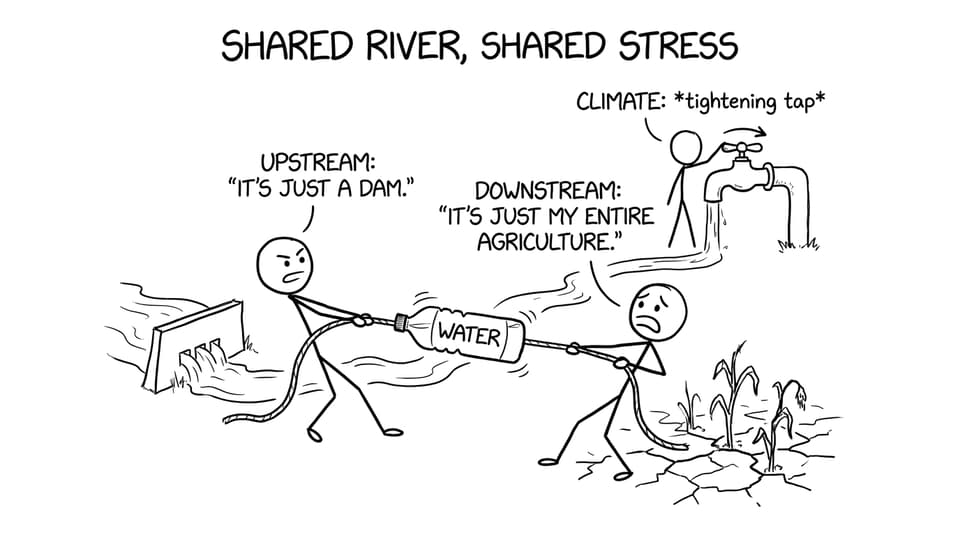
Some geopolitical risks escalate without a single shot fired. Resource competition is one of the most examinable threats in IB Geography because it connects scarcity to bargaining power. Shared river basins, energy routes, and strategic minerals can become flashpoints when demand rises or supplies become uncertain. Climate change often acts like a multiplier, reducing availability or increasing variability, which raises tensions even where relationships were once stable.
For a strong resource angle, pair Resource Inequality and Geopolitics with the broader unit Global Resource Consumption and Security.
Economic instability: when interdependence turns into contagion
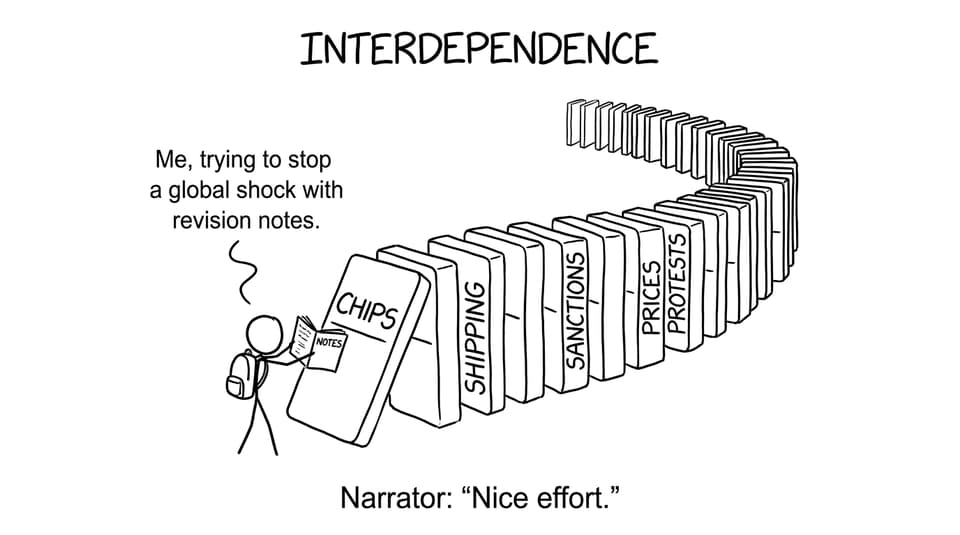
Trade disputes, sanctions, and protectionism can fracture supply chains that were designed for efficiency, not resilience. In IB Geography, this is where you earn evaluation marks: economic shocks spread through networks, raising prices, increasing unemployment, and sometimes triggering unrest. Countries highly dependent on imports or single export sectors are especially vulnerable. The key is to write about pathways, how one decision in one place travels through finance, shipping, and consumer costs elsewhere.
To connect “risk” to “resilience,” keep What Is the Role of Resilience in Managing Global Risks? open as your evaluation anchor.
Fragile states and spillover: instability that leaks across borders
When governance is weak because of corruption, low legitimacy, or limited capacity to provide services, states can become vulnerable to internal conflict and humanitarian crises. In IB Geography, that matters because these crises rarely stay contained: refugees move, neighbouring labour markets shift, border regions destabilise, and international intervention becomes more likely. Strong answers avoid stereotypes and instead explain how vulnerability and capacity shape outcomes.
For an exam-ready way to store examples, use the template in IB Geography Case Studies: A Comprehensive Exam Guide.
Conclusion: turn global noise into IB Geography marks
Geopolitical risks threaten global stability because they disrupt the systems people depend on: security, trade, resources, and governance. In IB Geography, your advantage comes from explaining connections calmly: conflict to displacement, power shifts to cooperation breakdown, resource scarcity to tension, and economic shocks to social instability. If you want to revise this unit with less stress and more structure, build your practice loop on RevisionDojo using the Questionbank, Study Notes, Flashcards, AI Chat, Grading tools, Predicted Papers, Mock Exams, and even the Coursework Library and Tutors when you need targeted help. Start here: 6 Global Risks and Resilience and make IB Geography feel predictable again.