



Resilience is what you notice after the shock
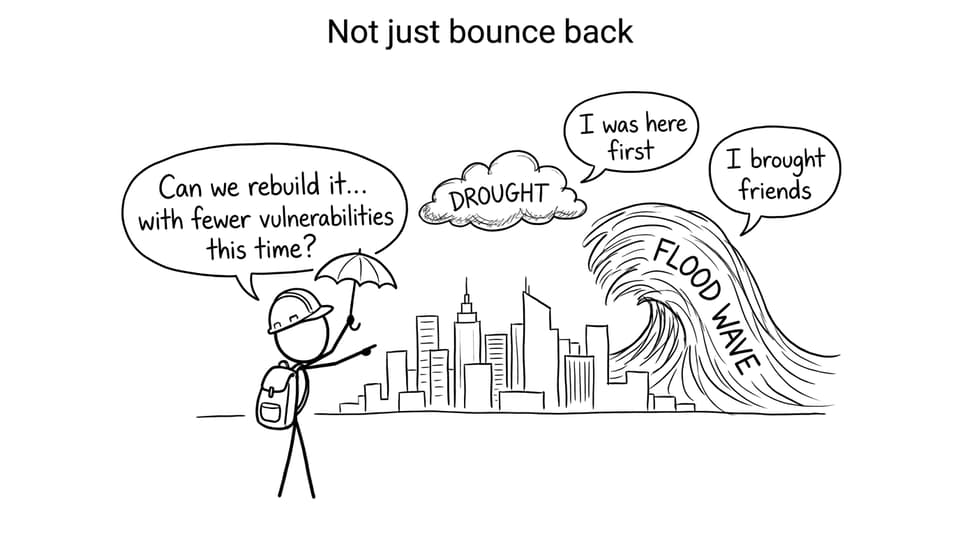
The strange thing about global risks is how ordinary the day before looks. A heatwave forecast is just an icon on your phone. A supply chain disruption is just a headline. Then, suddenly, your city is rationing water or your family is paying more for basic goods. In IB Geography, resilience is the idea that explains why some places wobble and keep going, while others spiral.
Resilience matters because global risks are rarely “single events.” They cascade. A cyclone becomes a health crisis, which becomes an education crisis, which becomes a long recovery shaped by governance, inequality, and planning. If you can explain resilience clearly in IB Geography, you can usually earn marks not just for knowledge, but for evaluation.
A quick exam checklist for resilience (use this in IB Geography essays)
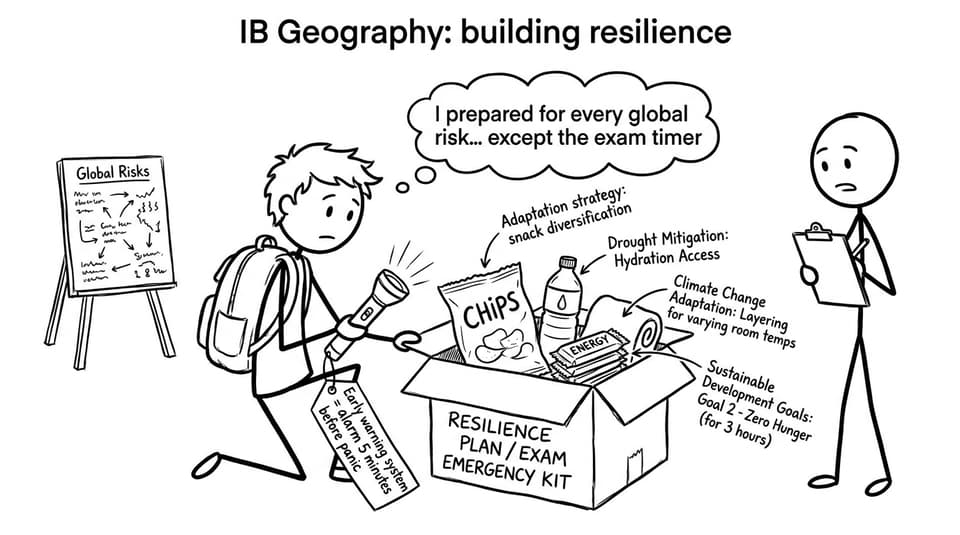
When a question asks about the role of resilience in managing global risks, build your answer around four verbs:
-
Anticipate (prediction, planning, early warning)
-
Absorb (protection, strong infrastructure, buffers)
-
Recover (response systems, safety nets, rebuilding)
-
Adapt (long-term adjustment, “build back better”)
To make this exam-ready, attach at least one inequality point: resilience capacity is uneven by income, governance quality, and social cohesion.
For syllabus-aligned practice, start with the Global Risks and Resilience hub on RevisionDojo: 6 Global Risks and Resilience.
Proactive resilience: reducing vulnerability before the risk hits
In IB Geography, resilience begins before a hazard arrives. Proactive resilience is about shrinking vulnerability through design and planning: flood defences, drought-tolerant agriculture, risk zoning, and early warning systems.
This is where exam answers get sharper if you separate exposure from vulnerability. Exposure is being in the path of risk. Vulnerability is how badly that risk will harm you. Two coastal cities may share exposure, but their vulnerability differs depending on housing quality, savings, insurance, and governance.
If you want quick recall of definitions and examples for this unit, use Flashcards for 6 Global Risks and Resilience (HL only).
Response and recovery: resilience during the crisis
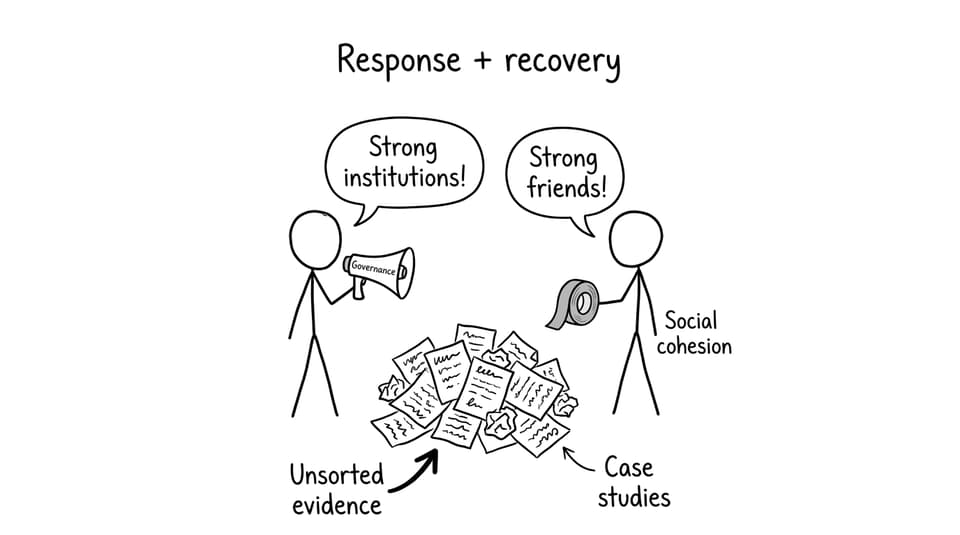
Resilience is also what happens in the middle of chaos. Strong emergency services, healthcare capacity, and coordinated governance reduce mortality and shorten disruption. Social safety nets matter, too: when households have support, recovery is less likely to lock in long-term poverty.
In IB Geography responses, it helps to evaluate trade-offs. Rapid response saves lives, but it can also be unequal (who receives aid first?) or unsustainable (temporary housing becoming permanent). Use that tension to move from description into analysis.
For exam-style prompts that force you to apply resilience concepts, practise with the Global Risks and Resilience Questionbank.
Adaptation: when the “new normal” becomes the exam point
Some global risks cannot be fully prevented, especially climate-related ones. That pushes resilience into adaptation: changing crop types, redesigning buildings for heat, rethinking water systems, diversifying economies away from a single vulnerable sector.
This is a high-scoring IB Geography angle because it links resilience to development and justice. High-income countries often adapt with technology and finance, while lower-income contexts may rely on community knowledge, local networks, and external support. The difference is not only money. It is planning capacity, political stability, and whether people trust institutions.
If you need a connected example for essays, revise the human security link in How Do Environmental Risks Threaten Human Security?.
How to turn resilience into marks with RevisionDojo
A lot of students “know” resilience but write it too vaguely. RevisionDojo helps you make it precise:
-
Study Notes to lock the concept (and the vocabulary) into place: Global Risks and Resilience Notes
-
Questionbank to practise application under pressure: IB Geography Resources
-
Flashcards for active recall across topics: IB Geography Flashcards
-
AI Chat to test explanations and improve clarity
-
Grading tools to tighten evaluation in 10-mark answers
-
Predicted Papers and Mock Exams to rehearse timing and structure
-
Coursework Library and Tutors when you want higher-level feedback and stronger case study use
If you’re building case study paragraphs for resilience, keep this nearby: IB Geography Case Studies: A Comprehensive Exam Guide.
Conclusion: resilience is a skill, not a slogan
Global risks are getting more connected, which means resilience is becoming more important, not less. In IB Geography, the role of resilience is to reduce vulnerability before crises, strengthen response and recovery during crises, and enable adaptation when conditions change for good. If you can structure that clearly and evaluate it with inequality, scale, and time, you are writing the kind of answer examiners reward.
To make your resilience responses sharper, practise the topic with RevisionDojo’s Study Notes, Questionbank, Flashcards, AI Chat, and Grading tools inside the IB Geography Resources.