
A parent can watch their child work through six subjects, an Extended Essay, Theory of Knowledge, CAS commitments, internal assessments, and final exams and still wonder: Will any of this matter when they eventually apply for a job?
The reassuring answer is yes, but not quite in the way families sometimes expect. Employers do not usually hire someone simply because they completed the IB Diploma. They hire for qualifications, experience, judgment, communication, reliability, and role-specific ability. The Diploma's value lies in how closely its demands can align with those qualities.
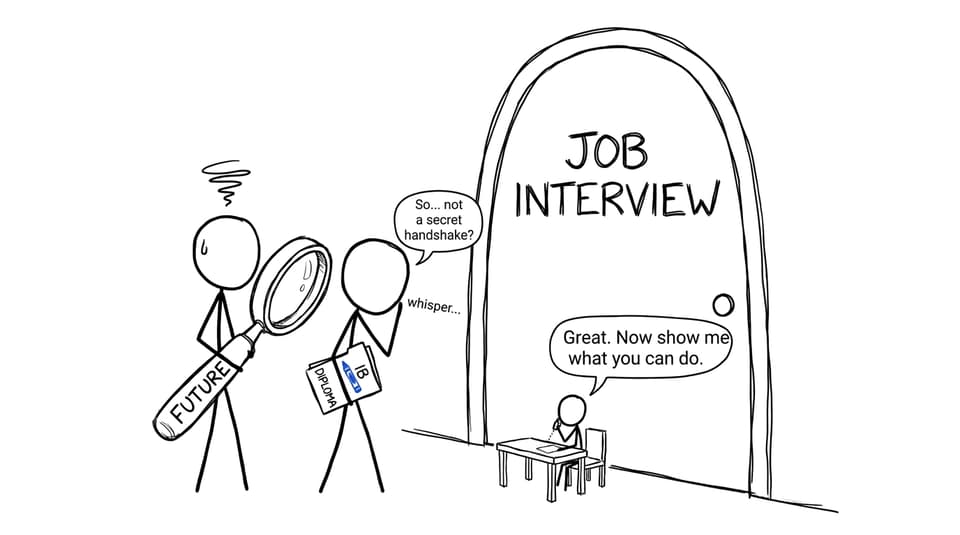
The question behind searches for what employers think of IB therefore needs a careful answer. Employers familiar with the programme may regard it as a rigorous international qualification. Others may know little about its structure. In both cases, the lasting advantage comes from the skills a student can demonstrate, not from assuming the letters "IB" will speak for themselves.
The short answer for IB Diploma parents
Here is the clearest overview:
- The IB is primarily an academic qualification, not a professional credential.
- Employer familiarity varies by country, sector, organization, and recruiter.
- Its underlying skills are widely relevant, particularly critical thinking, communication, research, organization, and ethical reasoning.
- University performance and experience usually matter more once a graduate enters the labour market.
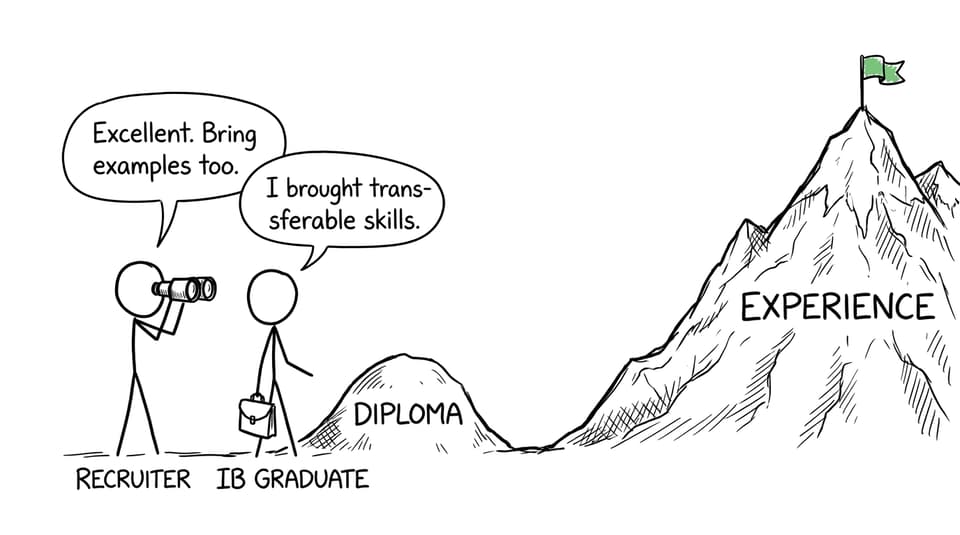
- Students must translate IB experiences into evidence through applications, interviews, portfolios, and examples.
- A high score can support early applications, but it does not guarantee employment.
This distinction matters. A qualification can be respected without functioning as a hiring shortcut.
What employers think of IB in practice
There is no single global employer verdict on the Diploma Programme. A multinational organization recruiting across several education systems may understand it immediately. A local manager hiring for a small business may recognize the name but not know what the Extended Essay or Theory of Knowledge involves. Another may simply record it as the applicant's secondary-school qualification.
That uneven recognition should not alarm parents. Employers also vary in how well they understand national school qualifications. As a candidate progresses through university and work, secondary-school results generally become one part of a much larger record.
What remains useful is the intellectual and practical behaviour developed along the way. The IB's curriculum includes six subject groups and a core comprising Theory of Knowledge, the Extended Essay, and Creativity, Activity, Service. Students considering the programme's wider return can explore this balanced view of whether the IB Diploma is worth it.
The employer does not necessarily need to understand every component. The student needs to explain what those components taught them to do.
Why IB skills can matter in the workplace
Employer research repeatedly emphasizes problem-solving, communication, teamwork, adaptability, and the ability to organize work. For example, the US National Institutes of Health's discussion of the National Association of Colleges and Employers' Job Outlook 2025 survey identified problem-solving, teamwork, and written communication as leading priorities. A 2023 peer-reviewed review of international employability research similarly found communication, problem-solving, and teamwork among the most consistently requested capabilities.
An IB-commissioned curriculum-mapping study did not prove that every graduate possesses these skills. It found, more cautiously, that communication, ethics, mindfulness, and critical thinking were strongly represented across the intended Diploma and Career-related Programme curricula.
That distinction is important. A curriculum creates opportunities to develop a skill. The student still has to engage with those opportunities and later demonstrate the result.
Critical thinking and judgment
Theory of Knowledge asks students to examine how claims are formed, justified, and challenged. Subject assessments also require them to interpret information, evaluate evidence, and construct arguments rather than rely entirely on recall.
This resembles workplace judgment more closely than it may appear during exam season. Employees regularly face incomplete evidence, conflicting priorities, and conclusions that need qualification. The habit of asking What supports this claim? or What alternative explanation exists? can be useful in fields ranging from consulting and law to healthcare, engineering, research, and communications.
A 2020 international study in Australia, England, and Norway found that DP students demonstrated higher critical-thinking levels than non-DP peers after researchers controlled for relevant differences. That does not establish that the IB alone caused every difference, but it supports the view that critical thinking is a meaningful part of the programme's educational value.
Research and written communication
The Extended Essay is an independent research project culminating in a paper of up to 4,000 words. It requires a focused question, source evaluation, sustained analysis, academic conventions, and revision.
Few employers will ask a candidate to produce an Extended Essay. Many will ask for a report, proposal, briefing, analysis, or evidence-based recommendation. The transferable skill is not the essay topic. It is the ability to turn a broad question into a structured piece of work.
Students can better understand that connection through this guide to transferable skills gained from the IB curriculum. When describing their research later, they should focus on decisions made, obstacles addressed, and conclusions reached rather than merely stating that the essay was completed.
Planning and self-management
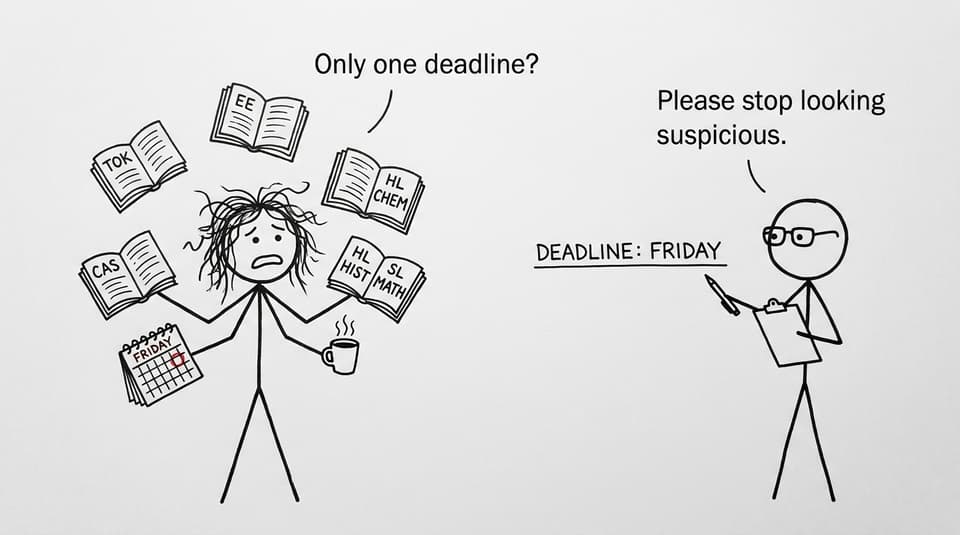
An IB student often has several long-term assignments moving at once. That can feel overwhelming, but it also creates repeated practice in prioritization, calendar management, and meeting overlapping deadlines.
The workplace version looks familiar: one project is urgent, another is important, and a third is waiting for someone else's response. Employers value people who can make progress without requiring constant supervision.
Still, workload should not be romanticized. Stress is not automatically evidence of growth. Students develop stronger self-management when they plan realistically, seek help early, protect sleep, and learn from missed estimates. Endurance alone is not the objective.
Communication across perspectives
Language study, presentations, classroom discussion, collaborative activity, and internationally oriented subject content can expose students to different ways of framing a problem. This may support the ability to communicate across cultural and disciplinary boundaries.
That is useful, but students should avoid presenting "global mindedness" as a vague slogan. A stronger example might show how they adapted an explanation for a different audience, considered a contrasting interpretation, or worked respectfully with someone who approached a task differently.
Initiative, reflection, and service
CAS encourages experiences involving creativity, activity, and service alongside academic study. It is not a job-placement programme, and participation alone should not be treated as professional experience. Its value depends on what the student actually did.
A sustained project can provide evidence of initiative, collaboration, responsibility, or reflection. A superficial list of activities provides much less. Employers tend to find specific behaviour more credible than broad claims about character.
What the IB Diploma does not guarantee
A thoughtful answer must include the limits.
The IB does not guarantee admission to a particular university, a graduate role, a higher salary, or preference over applicants from other educational systems. It also does not replace technical training, work experience, interpersonal maturity, or the qualifications required for regulated professions.
The programme's breadth can be useful, but hiring decisions are contextual. A software role may prioritize programming ability and a project portfolio. A design position may depend heavily on creative work. A laboratory role may require specific scientific methods. In these cases, the Diploma is background preparation rather than decisive evidence.
Nor should parents assume that the highest IB score will remain a central employment criterion forever. Early applications may request school results, especially for competitive internships or programmes. Later, university achievement, relevant experience, and demonstrated impact usually become more prominent.
The sensible message is not "the IB opens every door." It is that the programme can help a student build tools they will use when approaching those doors.
The university bridge matters
For most Diploma students, employment is not the immediate next step. University sits between school and a professional career. That makes IB university requirements more urgent than employer recognition during the final school years.
The Diploma is recognized by universities internationally, but entry policies vary by country, institution, course, total score, and Higher Level subjects. Recognition does not mean automatic admission. Families should consult each university's current requirements rather than rely on general score ranges.
These resources explain what universities think of the IB Diploma, how to approach IB university applications, and why the answer to whether IB gives a student an advantage at university requires nuance.
Recent outcome studies offer encouraging context. A 2024 National Student Clearinghouse analysis commissioned by the IB reported higher US university enrolment, persistence, and six-year completion rates among the examined DP cohort than national comparison figures. The report explicitly cautioned that unmeasured factors prevented a direct causal conclusion. Australian Council for Educational Research findings published in 2024 also showed stronger admission, progression, and completion outcomes among Australian DP students across the studied cohorts.
These findings suggest strong preparation and positive outcomes. They do not prove that choosing the IB will cause the same result for every child.
How students can make the Diploma relevant to employers
The most useful preparation begins with a simple habit: keep evidence.
A student can maintain a private record of projects, responsibilities, challenges, feedback, and outcomes. Later, that record becomes material for applications and interviews. Useful examples might include:
- refining an Extended Essay question after early evidence proved inadequate;
- coordinating responsibilities during a CAS project;
- explaining a complex concept to classmates;
- managing several deadlines after revising an unrealistic plan;
- responding constructively to feedback on an internal assessment;
- evaluating conflicting sources before reaching a qualified conclusion.
These examples should remain accurate. Students do not need to inflate ordinary academic experiences into dramatic leadership stories. Clear reflection is more persuasive than exaggeration.
When appropriate, the Diploma can appear in the education section of a CV with the total score, Higher Level subjects, and relevant distinction such as a bilingual diploma. The Extended Essay topic may be worth including when it directly relates to a course, internship, or early-career role. Otherwise, space may be better used for recent experience.
What parents should focus on during exam season
For IB Diploma parents, the most helpful response is not to turn every revision session into a conversation about employability. Exams already carry enough emotional weight.
Instead, help your child separate the immediate task from the long-term meaning. Right now, the task is to prepare steadily, understand assessment expectations, and protect their health. Later, they can reflect on what the experience taught them.
Parents navigating the wider decision may find it useful to review why families choose the IB programme and an unbiased analysis of IB benefits and drawbacks. These perspectives can help keep expectations realistic.
The Diploma's career value is rarely a single, visible reward delivered on results day. It is more often a collection of habits that compound: asking better questions, writing clearly, managing complexity, reconsidering weak evidence, and finishing demanding work.
A qualification whose value must be translated
So, what do employers think? Some recognize the IB Diploma as demanding and internationally oriented. Some simply see a valid school qualification. Most will ultimately care more about whether the applicant can solve problems, communicate, collaborate, learn, and act reliably.
That should reassure rather than disappoint. Your child's future is not dependent on every recruiter understanding the details of TOK or CAS. The deeper value lies in what the student becomes able to do and how convincingly they can show it.
The natural next step is straightforward: check the entry requirements for the universities or pathways under consideration, support steady exam preparation, and encourage your child to keep a factual record of the work they are proud of. The Diploma is not a career guarantee. Used thoughtfully, however, it can be a strong foundation for the education, experience, and judgment that careers are built upon.