
In IB DP Psychology, validity means the extent to which a study or measurement accurately assesses what it claims to assess and supports justified conclusions. A valid measure captures the intended psychological construct; a valid study minimizes alternative explanations and produces findings that can be applied only as far as its design allows.
The definition is short. The challenge is knowing which kind of validity matters, finding evidence in a study, and explaining why it changes the conclusion. That is where exam marks are usually won.
Validity at a glance
When evaluating psychological research, ask five questions:
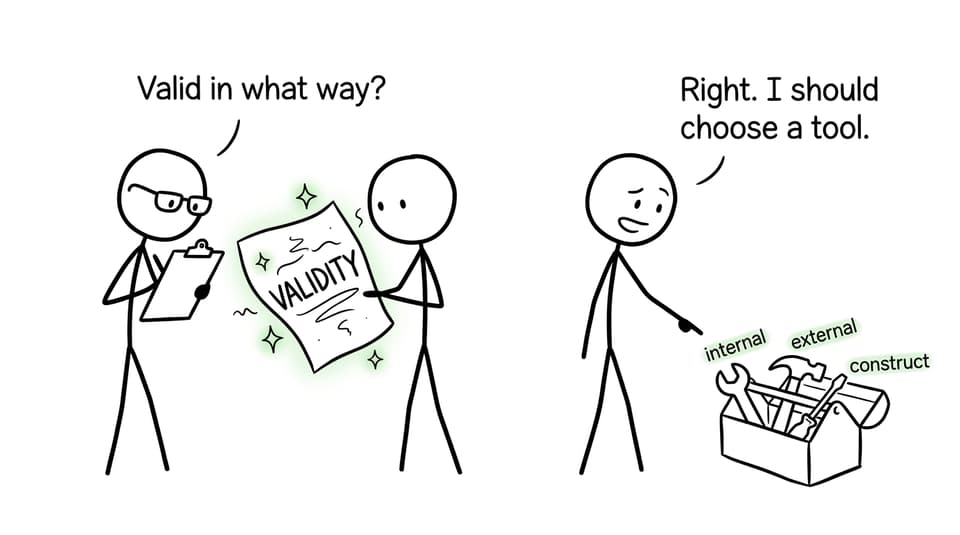
- Internal: Could another variable explain the result?
- External: Do the findings apply beyond this study?
- Construct: Does the operationalization represent the intended concept?
- Content: Does the measure cover the full domain being assessed?
- Face: Does the measure appear appropriate at first inspection?
The IB Psychology guide for first assessment in 2027 explicitly includes internal, external, content, face, and construct validity among its research considerations. Students in earlier examination cohorts should confirm their syllabus with their teacher, although the underlying evaluation skills remain useful.
For a broader foundation, review RevisionDojo's IB Psychology research considerations notes.
What does validity mean in psychological research?
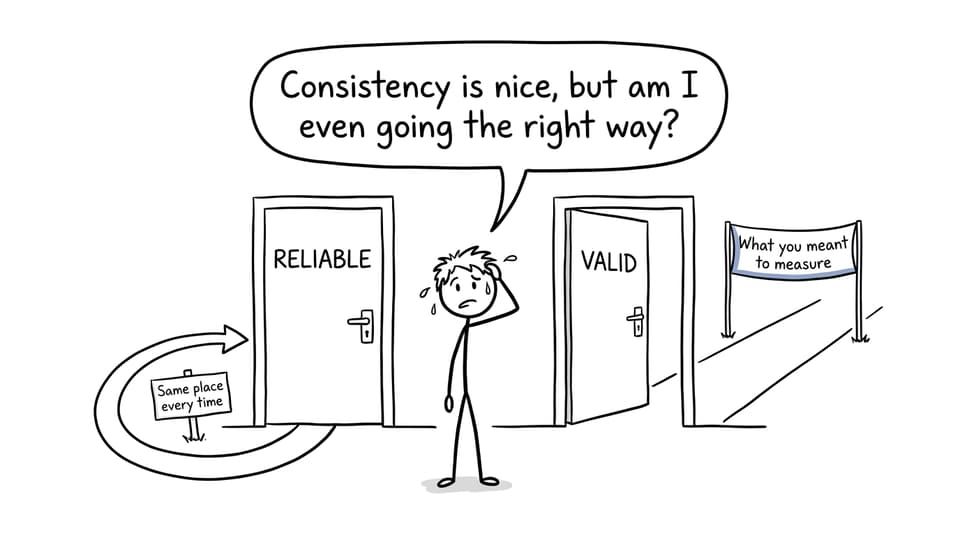
Validity is not one permanent label attached to an entire study. It is a judgment supported by evidence.
A tightly controlled experiment might have strong internal validity because plausible confounding variables have been reduced. Yet its artificial task and narrow sample may limit external validity. Conversely, a naturalistic observation may capture authentic behaviour while giving researchers less control over competing explanations.
This is why writing “the study is valid” is rarely enough. A stronger evaluation identifies the relevant type, uses a detail from the method, and explains the consequence for interpretation.
Internal validity
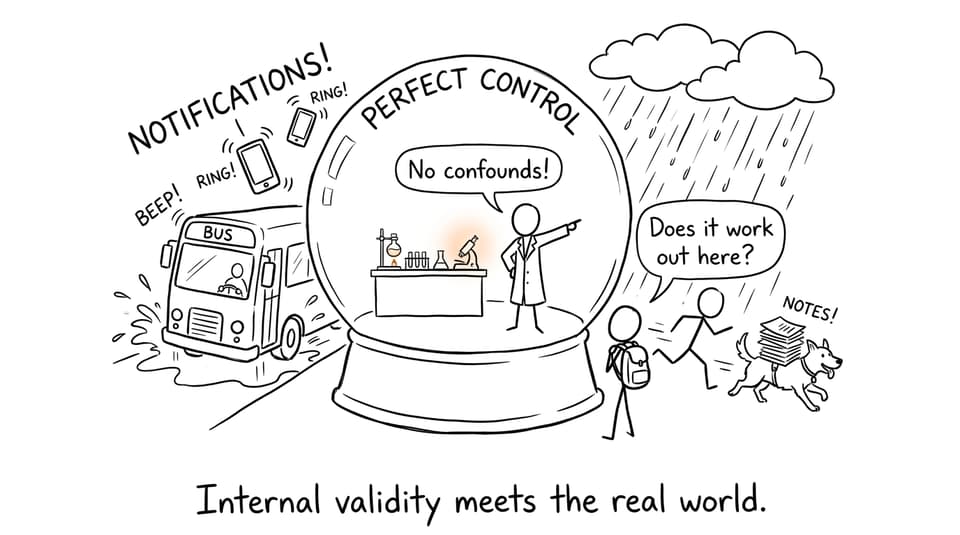
Internal validity concerns whether a study supports its conclusion within the investigation. In an experiment, the central question is whether changes in the dependent variable can reasonably be attributed to the independent variable rather than confounding factors.
Imagine a hypothetical experiment comparing memory after studying in silence or while receiving phone notifications. If the notification group also studies later in the day, fatigue becomes an alternative explanation. That weakens internal validity because notification condition and time of testing have changed together.
Random assignment, standardized instructions, consistent materials, counterbalancing where appropriate, and control of extraneous variables can strengthen internal validity. RevisionDojo's research methods study notes can help you connect these design choices to true and quasi-experiments.
External and ecological validity
External validity asks whether findings can be generalized beyond the particular sample, setting, procedure, or time studied. Ecological validity is commonly treated as a more specific aspect of external validity: can the findings apply to relevant real-world settings?
Suppose participants memorize unrelated words in a silent laboratory. The procedure may be well controlled, but ordinary learning involves prior knowledge, distractions, meaningful material, and longer delays. You should not automatically declare the research useless. Instead, explain precisely which real-world application may be restricted.
Construct, content, and face validity
A construct is an abstract psychological concept such as stress, prejudice, motivation, or memory. Construct validity asks whether the chosen operationalization genuinely represents that concept.
For example, measuring stress through one question about nervousness may capture only a narrow part of the construct. A carefully supported multi-item scale, behavioural indicator, or physiological measure could offer a more defensible operationalization, although every measure still requires evaluation.
Content validity asks whether a measure covers the relevant range of a domain. A test claiming to assess overall memory but containing only short-term verbal recall tasks may omit important aspects of memory.
Face validity is the weakest of these judgments. It asks whether the measure appears suitable on the surface. A questionnaire can look appropriate while still failing to represent the construct accurately.
Validity versus reliability
Validity concerns accuracy or justified interpretation. Reliability concerns consistency. A measure can produce the same result repeatedly and still measure the wrong thing.
Think of a clock that is always ten minutes fast. It is consistent but inaccurate. In psychological research, a highly consistent questionnaire may likewise have poor construct validity if its items capture academic workload rather than the anxiety it claims to measure.
Use RevisionDojo's research methodology flashcards to practise retrieving this distinction without notes.
How validity appears in IB Psychology exams
Under the course for first assessment in 2027, validity belongs to research methodology and may support evaluation of an unseen study in Paper 2. It also matters when justifying choices in the internal assessment research proposal. The official subject brief states that Paper 2 includes class-practical questions and evaluation of unseen research with reference to multiple concepts, so application matters more than an isolated memorized definition.
A dependable paragraph follows this sequence:
- Name the relevant validity type.
- Point to evidence in the stimulus or study.
- Explain the threat or strength.
- State the consequence for the conclusion.
- Suggest an improvement if the task invites evaluation or design.
Worked example
Hypothetical prompt: Evaluate one issue of validity in a study where volunteers complete a concentration test in a silent room after self-reporting their usual nightly sleep.
Model reasoning:
The study may have limited construct validity because usual sleep duration is measured through self-report. Participants may estimate inaccurately, so the reported number may not represent their actual sleep. This measurement error makes the relationship between sleep and concentration harder to interpret. A sleep diary completed over several days, potentially supported by an appropriate objective measure, could provide a better operationalization.
Notice what this answer does not do. It does not merely announce “low validity.” It builds a chain from method to interpretation.
Practise that chain using the IB Psychology research methodology Questionbank. For proposal work, the Psychology IA research methodology guide explains how method, procedure, and ethical decisions should fit the research aim.
Common exam mistakes
Treating validity as a generic weakness
Saying “the study lacks validity” leaves the examiner to complete your reasoning. Specify internal, external, construct, content, or face validity and connect it to evidence.
Confusing realism with accuracy
An artificial setting may limit ecological validity, but it does not automatically weaken internal validity. Laboratory control can sometimes strengthen causal interpretation while narrowing real-world application.
Assuming sample size solves everything
A larger sample may improve precision and, if appropriately selected, support generalization. It does not repair a confounded design or an invalid operationalization.
Recommending an improvement without explaining it
“Use a field experiment” is not enough. Explain which threat the change addresses and acknowledge any trade-off, such as reduced control.
RevisionDojo's guide to IB Psychology structure, skills, and assessment can help you place these evaluation skills within your wider exam plan.
Quick-reference summary
| Validity type | Question to ask | Typical concern |
|---|---|---|
| Internal | Is the proposed explanation justified? | Confounding variables or bias |
| External | Can findings apply elsewhere? | Narrow samples, settings, or procedures |
| Ecological | Can findings apply in real life? | Artificial tasks or environments |
| Construct | Does the measure represent the concept? | Weak operationalization |
| Content | Is the whole domain represented? | Important dimensions omitted |
| Face | Does the measure look appropriate? | Surface appearance without deeper evidence |
Validity becomes easier when you stop treating it as vocabulary and start treating it as a question: What conclusion does this method genuinely allow?
RevisionDojo brings that question into one connected revision system. Build understanding with Study Notes and AI Chat, retrieve definitions with Flashcards, then apply them through the Questionbank, Predicted Papers, and Mock Exams. Use Grading tools to identify vague evaluation, while the Coursework Library and Tutors can support stronger research thinking. Explore the complete IB Psychology resources and turn validity from a memorized word into an exam-ready analytical skill.