


A small push that feels strangely hard
In IB Physics, there’s a moment that feels almost personal: you try to change something in a magnetic setup, and nature pushes back. Slide a magnet toward a coil and you feel a faint “no.” Move faster and the “no” becomes louder. That reaction isn’t superstition or hidden friction. It’s Lenz’s law, a rule that reveals something deep about nature’s resistance to change: systems respond in ways that oppose sudden shifts in magnetic flux, because energy has to come from somewhere.
Quick exam checklist (what to write fast)
When a question mentions induction in IB Physics, aim for these marks:
-
Define magnetic flux: (\Phi = BA\cos\theta)
-
State Faraday’s law: induced emf depends on the rate of change of flux
-
Explain the negative sign: Lenz’s law means the induced effect opposes the change
-
Link to energy: external work becomes electrical/thermal energy
-
Add an application: generators, transformers, eddy current braking
Revision anchors that help: D.4.1 Principles of electromagnetic induction (HL only) Notes and 11.1 Electromagnetic induction.
What Lenz’s law actually reveals (the “why” behind the rule)
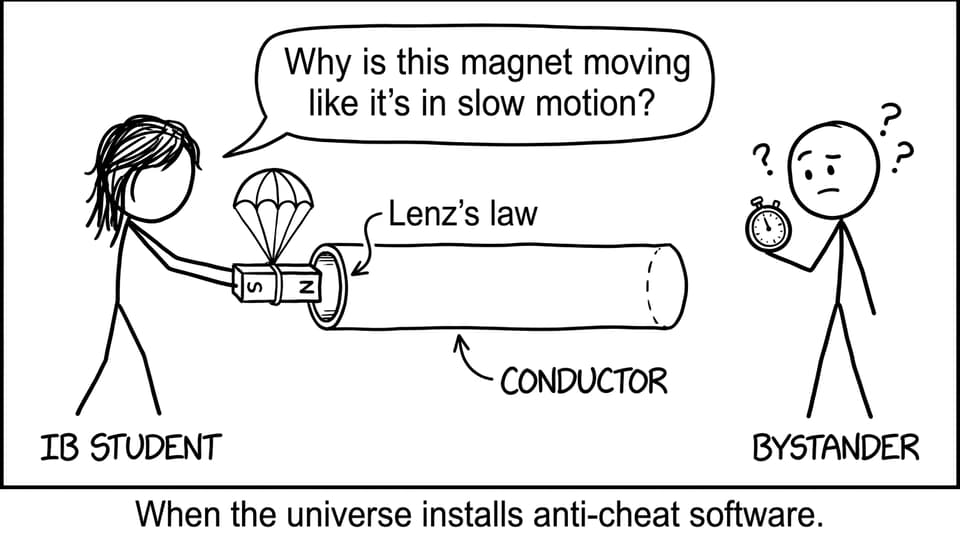
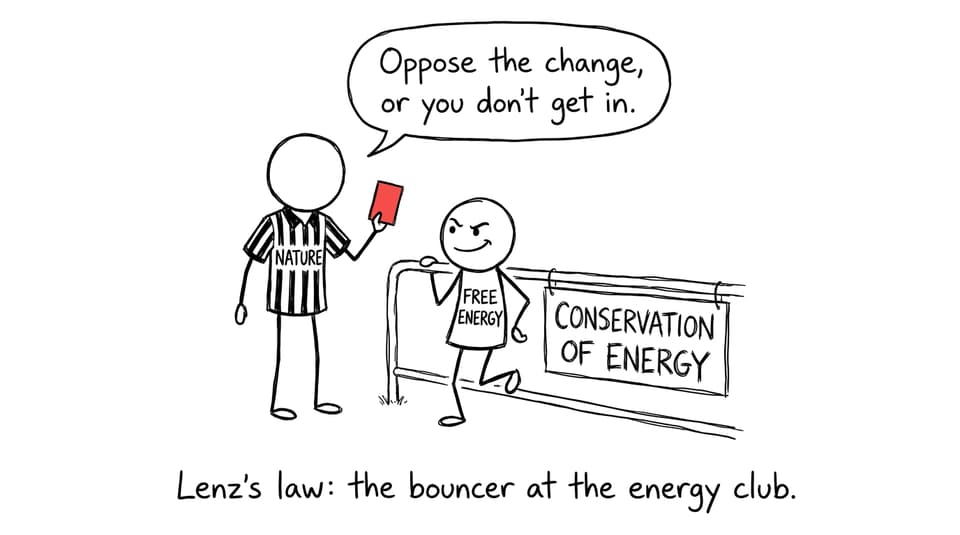
Lenz’s law says the induced current (or induced emf direction) is always such that the magnetic field it creates opposes the change in magnetic flux that produced it. That’s the headline. The reveal is the motive: energy conservation.
In IB Physics, Faraday’s law is often written with the negative sign:
That minus sign is not decoration. It’s the universe refusing a loophole. If the induced current helped the change in flux, then a moving magnet would be pulled along and sped up by its own induced effects. You’d get amplification without paying an energy cost. That would be “free energy,” and physics doesn’t do that.
For a clean, student-friendly explanation, see IB Physics: Lenz’s Law Explained Simply and the deeper energy framing in How Does Induction Embody the Principle of Energy Conservation.
“Resistance to change” in real devices (and why you feel it)
This is where IB Physics becomes tangible: the opposition shows up as a force, a torque, or heating.
-
Magnet near a conductor: changing flux induces currents (often eddy currents) that create a field opposing the motion. You feel a braking-like effect.
-
Generators: the more electrical load you draw, the more opposing torque the coil experiences. Mechanical input must increase to maintain rotation.
-
Induction heating: the “resistance to change” turns into thermal energy in the metal due to induced currents.
To connect the theory to rotating coils and applications, use D.4.2 Applications of electromagnetic induction (HL only) Notes. And when you want to practise exam-style prompts, go to the IB Physics D.4 Induction Questionbank (HL) or the broader Topic D - Fields Questionbank.
How to phrase it like an examiner wants (high-scoring sentences)
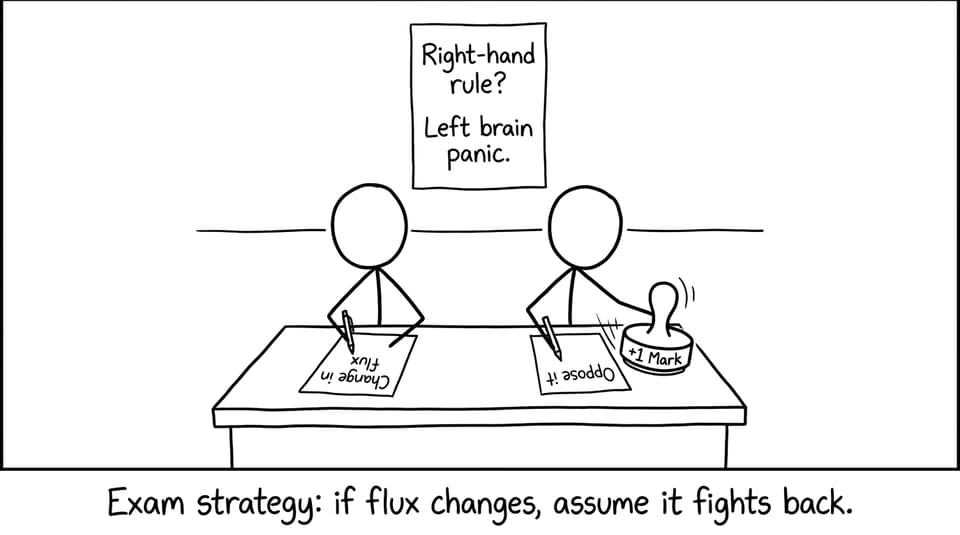
In IB Physics, marks often go to the student who tells the energy story clearly. Lines like these are reliably credit-worthy:
-
“The induced current produces a magnetic field that opposes the change in flux (Lenz’s law).”
-
“Therefore an external force must do work; this work is transferred into electrical energy (and often thermal energy) in the circuit.”
-
“If the induced effect reinforced the change, energy would be created without input, violating conservation of energy.”
If you get stuck on definitions mid-revision, keep IB Physics Key Definitions open while you practise.
Bring it home: use resistance to change as a revision advantage
Lenz’s law is one of those IB Physics ideas that sounds like a detail but behaves like a principle: nature resists change in magnetic flux because it’s protecting the accounting system of energy. When you treat the negative sign as a story about “you must pay with work,” induction questions become easier to structure and harder to forget.
To revise this efficiently on RevisionDojo, combine the syllabus-aligned notes (IB Physics Revision Notes (SL/HL)) with active practice in the Questionbank, then tighten recall using Flashcards and AI Chat explanations. Add Mock Exams for timing, Predicted Papers for exam targeting, and Grading tools to see exactly where marks are being lost. If you need a human reset, Tutors can walk you through the direction rules until they feel intuitive. That’s how IB Physics stops being a set of rules and becomes something you can reason through under pressure.


