



A hook you’ve probably felt in your hand
In IB Physics, electromagnetic induction can feel strangely personal. Push a magnet into a coil and it pushes back, not emotionally, but physically. That tiny “why is this resisting me?” moment is the universe quietly enforcing a big rule: energy cannot be created from nothing.
Induction embodies energy conservation because the induced current always responds in a way that makes you “pay” for the electrical energy you’re about to get. That idea is not just poetic; it’s exam-grade physics.
Quick exam checklist (what to write when you see this topic)
When a question asks how induction shows conservation of energy in IB Physics, hit these points:
-
State Faraday’s law: a changing magnetic flux induces an emf.
-
Point to the negative sign (Lenz’s law): induced effects oppose the change.
-
Explain the energy story: electrical energy output comes from external work input.
-
Use a concrete example: magnet and coil, generator load, transformer heating.
For a clean syllabus-aligned refresher, use D.4.1 Principles of electromagnetic induction notes.
IB Physics explanation: why Lenz’s law protects energy conservation
In IB Physics, Faraday’s law is often written as:
(\varepsilon = -N, \frac{\Delta \Phi}{\Delta t})
That negative sign is the entire energy-conservation “guardrail.” It means the induced emf drives a current whose magnetic field opposes the change in flux that caused it. If the induced current helped the flux change, the system would amplify itself: more motion creates more current, which creates a field that increases motion… free energy forever. Nature doesn’t do that.
If you want a dedicated deep dive, keep Lenz’s Law explained for IB Physics students open while you practice.
Magnet and coil: where the “extra work” goes
Picture moving a magnet toward a coil:
-
As the magnet approaches, magnetic flux through the coil increases.
-
An emf is induced, and (if the circuit is closed) a current flows.
-
That current produces its own magnetic field that opposes the approaching magnet.
So your hand must apply extra force to keep the magnet moving. That mechanical work is converted into electrical energy in the circuit (and often heat in the wire). Energy conservation is satisfied: the coil’s electrical energy has a clear source, your work.
Reverse the motion (pull the magnet out) and the induced current flips direction to oppose the decrease in flux. Either way, induction resists the change, so energy doesn’t appear “for free.”
To drill this with exam-style prompts, practice with the IB Physics D.4 Induction Questionbank (HL) or the broader Induction, alternating currents, and capacitance questionbank.
Generators: load increases torque for a reason
Generators are a favorite IB Physics proving ground for energy conservation.
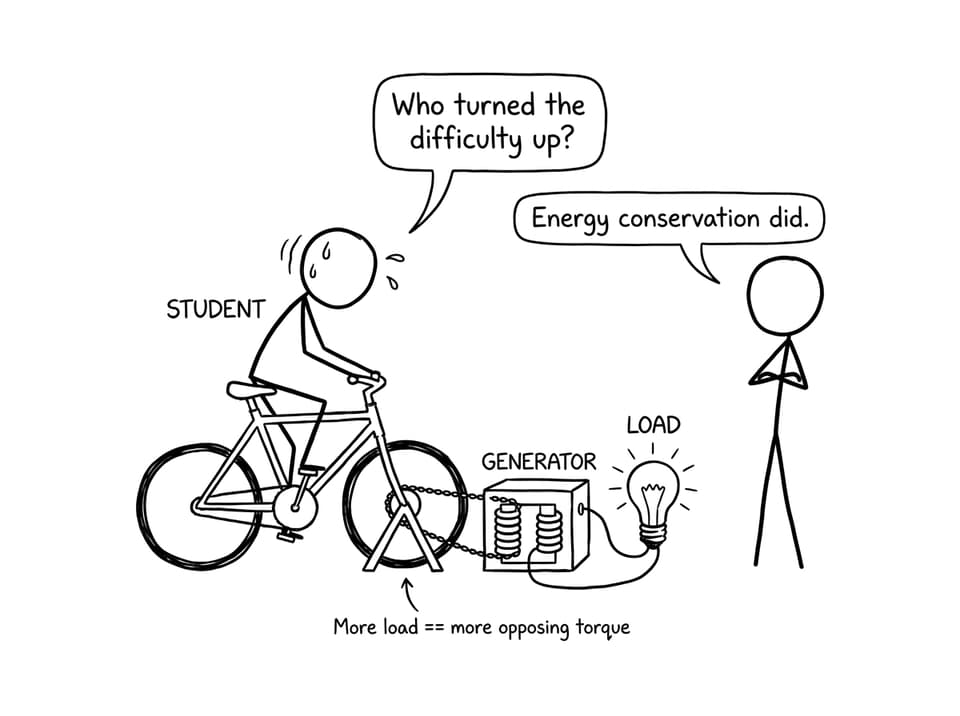
As a coil rotates in a magnetic field, the flux through it changes, inducing an emf. Now add an electrical load (brighter bulb, lower resistance): current increases, so the induced magnetic effects increase too. Lenz’s law then shows up as opposing torque: the generator becomes harder to turn.
That’s conservation of energy in plain sight:
-
More electrical power out
-
Means more mechanical power in
If you want the rotation story and equations in one place, review D.4.2 Applications of electromagnetic induction notes.
Transformers and eddy currents: “losses” are still conserved energy
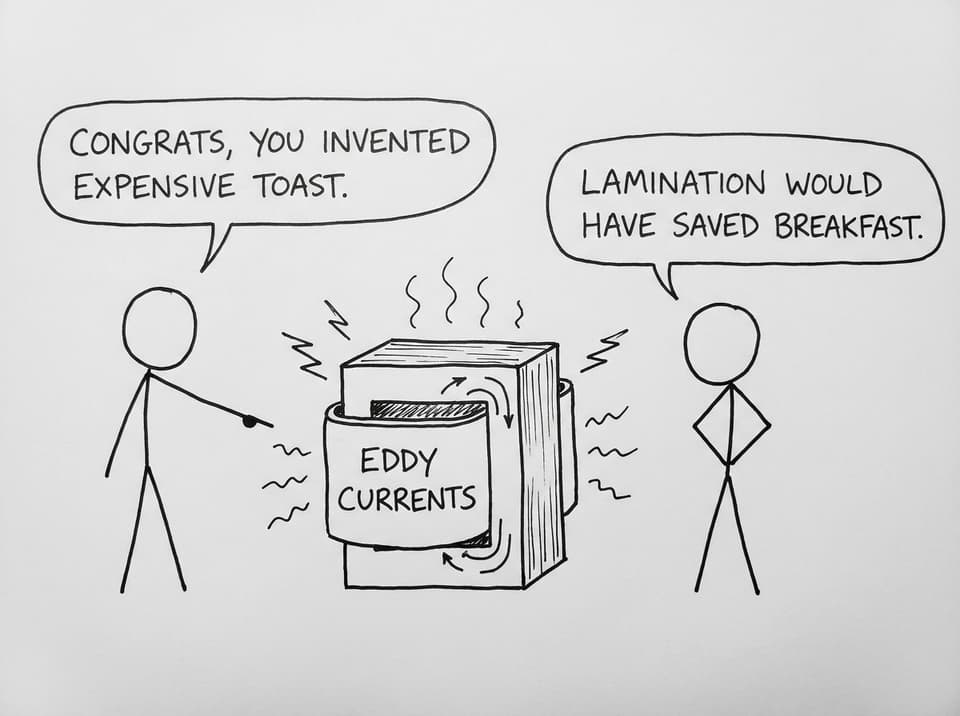
In transformers and metal cores, changing magnetic fields can induce eddy currents. Those currents dissipate energy as heat. This sometimes gets called “energy loss,” but in IB Physics language it’s energy transfer: electrical or magnetic energy becomes thermal energy.
That’s still conservation of energy, just not the kind you want in an efficient device.
For related intuition about fields creating fields, see Why does a changing magnetic field create an electric field?.
Bring it home with RevisionDojo
Induction is one of those IB Physics topics where a single sign (the minus sign) carries an entire worldview. RevisionDojo helps you practice that worldview under timed pressure: use the Questionbank to master Lenz’s law setups, Study Notes to keep definitions sharp, and Flashcards to lock in the flux and emf relationships. When your reasoning gets tangled, AI Chat can walk through direction rules step by step, and the Grading tools help you write explanations that earn marks, not just nods. Add Mock Exams, Predicted Papers, the Coursework Library, and support from Tutors, and induction stops being a mystery and becomes a reliable scoring area.
For more targeted reading, browse all IB Physics posts and keep your formulas nearby with the IB Physics Data Booklet.
In IB Physics, induction embodies energy conservation because it forces every joule of electrical output to be paid for by input work, and Lenz’s law is the receipt.