
A quiet moment before the invigilator speaks
In the final minutes of an IB exam, everything feels louder than it should: the scratch of pens, the clock’s stubborn rhythm, the faint shuffle of a page that sounds like thunder. Most students aren’t thinking about ethics in that moment. They’re thinking about survival.
And that’s why cheating can feel tempting. Not because you’re a bad person, but because pressure has a way of shrinking your world to one desperate choice.
But the IB is built on trust: trust that your grade represents your thinking, your effort, your voice. When that trust breaks, the consequences aren’t symbolic. They’re practical, immediate, and sometimes permanent.
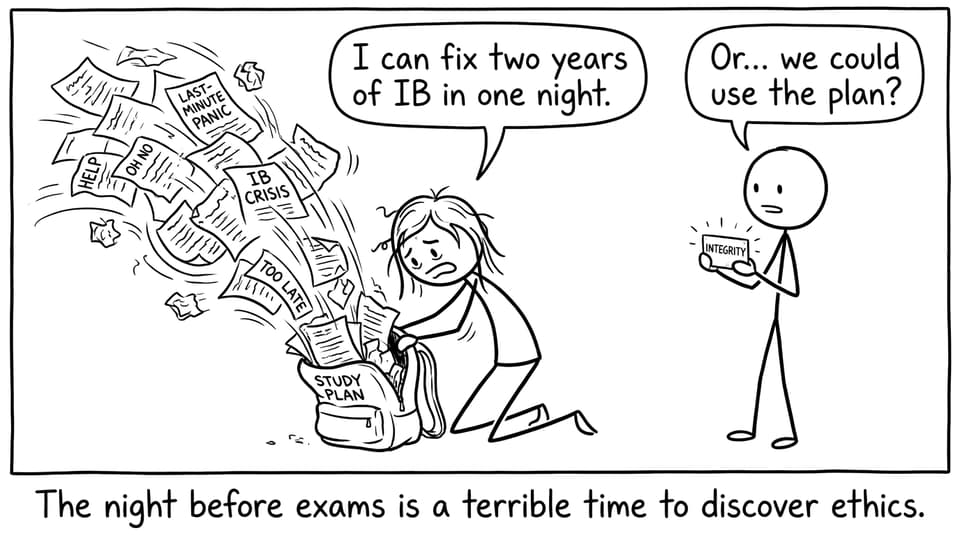
IB cheating consequences checklist (read this before you panic)
If you remember nothing else, remember this: the consequences of cheating in IB can spread wider than the moment that caused them.
-
Your results for an assessment can be cancelled (often a zero for the component).
-
You can lose the IB Diploma eligibility, depending on severity.
-
Your school can apply additional disciplinary actions.
-
Universities may be informed, and offers can be affected.
-
Your personal credibility can take longer to rebuild than your grades.
If you’re unsure what counts as misconduct, read How to Uphold Academic Integrity in IB Assessments before you submit anything.
What counts as “cheating” in the IB (it’s broader than you think)
In IB, cheating is not limited to sneaking notes into an exam. Academic misconduct includes any attempt to gain an unfair advantage, and that can happen through choices that feel “small” in the moment.
Common examples include:
-
Plagiarism: copying text or ideas without proper citation.
-
Collusion: working too closely with someone on work meant to be independent.
-
Duplication: submitting the same work for different assessments.
-
Fabrication: making up data, results, or sources.
-
Misuse of AI: presenting generated writing or analysis as your own.
-
Exam misconduct: unauthorized materials, devices, communication, or violating exam rules.
If you want a student-friendly explanation of investigations and typical steps, What Happens if You’re Accused of Academic Misconduct in the IB lays out the process clearly.
Immediate academic consequences in IB (what can happen fast)
Nullified marks or a zero for the assessment
The most direct consequence of cheating in IB is that the affected work can be awarded a zero or otherwise have results withheld or cancelled. That could apply to an exam paper, an IA, the EE, or another assessed component.
The painful part is that it doesn’t just erase a grade. It erases time. Weeks of revision can become irrelevant if the final record shows “0” next to the work.
Losing the IB Diploma (not just one subject)
Depending on the severity and the scope, misconduct can put your IB Diploma at risk, not just the mark in one subject. That’s because the diploma is a holistic credential. One serious breach can contaminate the entire outcome.
If you’ve ever told yourself, “It’s only for this one paper,” this is where the IB reality clashes with that story.
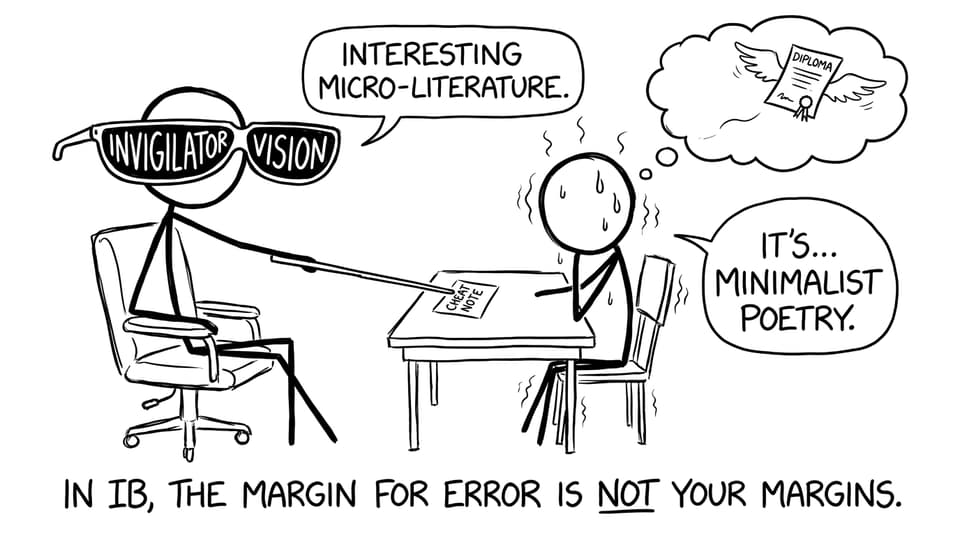
Long-term consequences of cheating in IB (the part nobody rehearses)
University admissions and offers
Universities care about integrity because integrity is the foundation of academic work. If cheating in IB is recorded or reported, it can shape admissions decisions, scholarship decisions, and in some cases the stability of an offer.
Even when a university doesn’t ask directly, the situation can still surface through school communication or transcript annotations. If you’re applying through systems that emphasize transparency (for example, UK pathways), you can also review general integrity expectations through UCAS.
Professional reputation (yes, it can echo)
Most careers do not ask, “Did you cheat in the IB?” in those words. But many do ask about academic misconduct, ethical behavior, and trustworthiness. Some fields (medicine, law, finance) apply stricter standards because the work depends on public trust.
And reputation is often transferred socially: a teacher reference, a counselor conversation, a quiet comment that begins with, “Just so you know…”.
Personal integrity and relationships
This one is the least measurable, and often the most painful. Cheating can strain relationships with teachers, mentors, friends, and family because it changes how people interpret your wins.
When your success becomes suspicious, even honest achievements feel less satisfying. You stop celebrating. You start defending.
If you’re accused: how to respond without making it worse
Being accused does not automatically mean you are guilty. But how you respond matters.
-
Stay calm and ask for clarity on what triggered suspicion.
-
Gather your drafts, notes, sources log, and process evidence.
-
Be honest about what you did and didn’t do.
-
Ask your IB coordinator about next steps and timelines.
-
Learn from it, even if it’s a misunderstanding.
For a clear, step-by-step breakdown, keep What Happens if You’re Accused of Academic Misconduct in the IB bookmarked.
The best alternative to cheating: build a system that makes cheating unnecessary
Cheating is often a symptom, not a personality trait. It usually shows up when three things collide: time pressure, confusion, and fear.
The fix is not motivational posters. The fix is a repeatable IB workflow.
Here’s a simple integrity-first loop you can run inside RevisionDojo:
-
Use Study Notes to patch one specific gap (not rewrite your whole notebook).
-
Drill that topic using the Questionbank until the question style feels familiar.
-
Lock key definitions and methods with Flashcards (daily, short).
-
Use AI Chat to get unstuck when you’re spiraling, then write the final work in your own voice.
-
Use Grading tools to understand how marks are awarded and why.
-
Build calm with Mock Exams and Predicted Papers to rehearse timing under pressure.
-
When coursework gets heavy, use the Coursework Library for structure and the kind of examples that teach without inviting copying.
-
If you need human strategy, bring in Tutors before the situation becomes desperate.
If you want a full structure for exam prep, see How to Study for IB Exams: Step-by-Step Guide, then deepen with 10 Proven Study Techniques for IB Students.
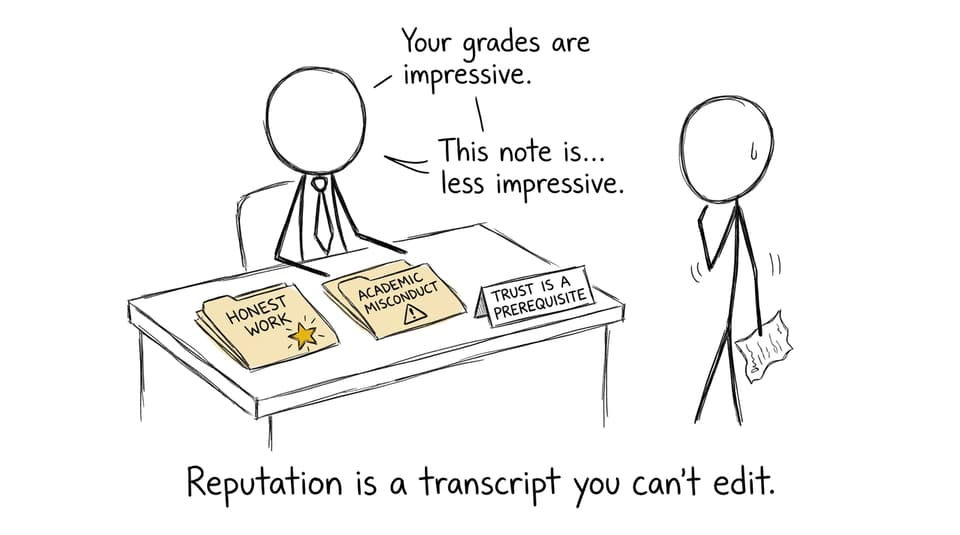
Closing: the IB is hard, but it’s not asking you to sacrifice yourself
The real tragedy of cheating in IB is that it’s often done by students who were close to succeeding honestly. One tired decision can trade a short-term illusion of relief for long-term consequences you can’t control.
If you want a path that actually scales under pressure, build an integrity-first routine: practice with a Questionbank, learn efficiently with Study Notes, retain with Flashcards, rehearse with Mock Exams and Predicted Papers, and get feedback through AI Chat and Grading tools. When coursework adds weight, use the Coursework Library, and when you need a steady hand, use Tutors.
That’s how you protect your result, your confidence, and the one thing the IB is really trying to give you: proof that you can do hard things without breaking your own trust.