

A quick story to start: the “one perfect item” problem
The first time you notice IB Business Management everywhere is usually when real life gets annoying.
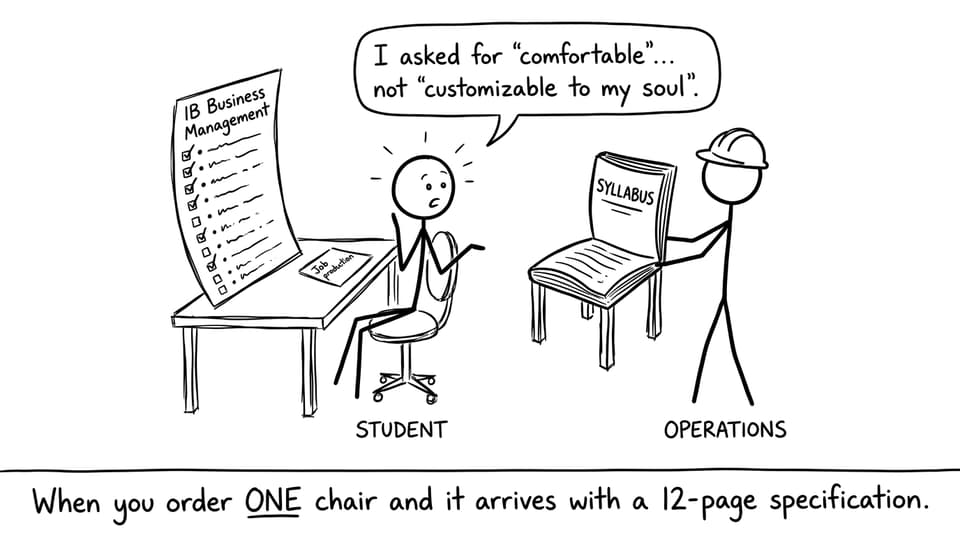
A customer wants a desk that fits a weird corner, matches a specific wood tone, hides cables, and arrives next week. A business owner smiles, agrees, and then quietly realises they’re not selling “a desk” anymore. They’re selling a project.
That is job production in one sentence: one-off, made-to-order output. In IB Business Management, job production sits inside Operations Management as the method built for uniqueness, not speed.
What is job production? (exam-ready definition)
In IB Business Management, job production is when a product (or service) is produced individually to meet the specific requirements of a customer. It’s common in custom furniture, specialised machinery, handmade goods, architecture, and professional services.
If you want the syllabus home for this, anchor your revision in IB Business Management 5.2 Operations Methods and the wider Unit 5 Operations Management hub.
Quick checklist: advantages vs disadvantages (how to structure a 6-marker)
Use this as a fast response frame in IB Business Management:
Advantages
-
High customisation
-
High quality and craftsmanship
-
Flexibility between orders
-
Motivating work for skilled employees
Disadvantages
-
High unit cost
-
Slow output and long lead times
-
Reliance on skilled labour
-
Limited economies of scale
Advantages of job production (IB Business Management analysis)
High customisation (strong application marks)
Job production’s biggest advantage is precision. A customer gets exactly what they asked for, not the closest available option. In IB Business Management, this links neatly to customer satisfaction and brand loyalty because the buyer feels “seen” (and is more likely to recommend the business).
Higher quality through specialist skill
Because each order is handled individually, workers can focus on detail. Quality problems are often spotted earlier, when fixes are cheaper. This pairs well with wider ops thinking in IB Business Management: quality protects reputation, reduces complaints, and can justify premium pricing.
For broader context on how operations links to other departments, see How operations management supports other business functions.
Flexibility between jobs
A job-production business can switch designs, materials, and methods quickly. That flexibility matters in markets where tastes change fast or demand is unpredictable. In IB Business Management, you can evaluate this as a strategic advantage: flexibility reduces the risk of producing the “wrong” product at scale.
Higher employee satisfaction (often)
People tend to enjoy work that feels skilled and varied. Job production can create pride in craftsmanship, which may improve retention and reduce recruitment costs. If you want to connect this to general course language, you can revisit how functions connect in Business functions notes.
Disadvantages of job production (what examiners expect)
High cost per unit
Job production usually means higher labour costs and slower processes. Materials may be bought in small quantities, suppliers can’t offer strong discounts, and set-up time repeats for every order. In IB Business Management, this is your clean link to limited economies of scale.
To add a numbers flavour, revise cost language using Costs and revenues Questionbank.
Slow production speed and longer lead times
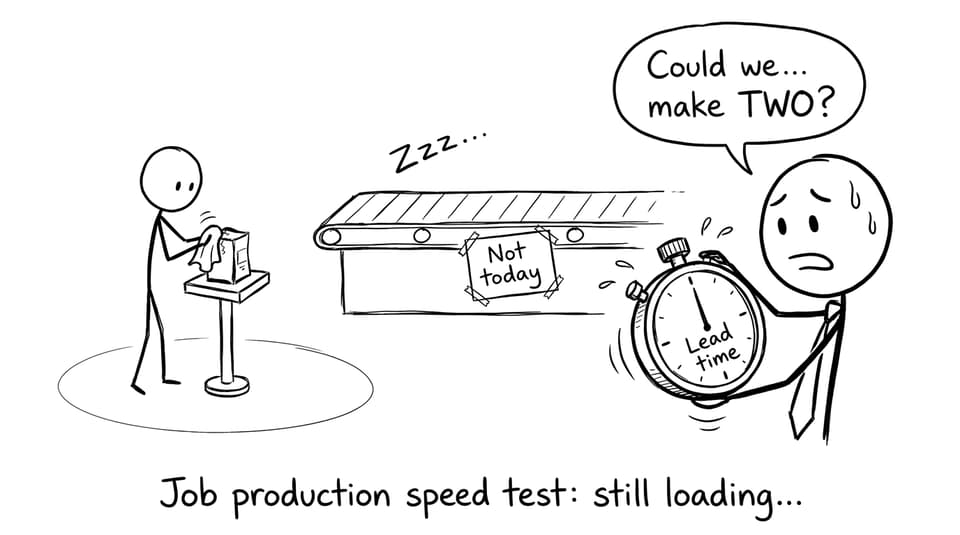
If each item is one project, output stays low. Lead times can frustrate customers, and sudden increases in demand are hard to absorb. This is a classic evaluation point in IB Business Management: job production fits uniqueness, but struggles with volume.
Dependence on skilled labour
Quality and efficiency depend heavily on workers with specialised skills. Those workers cost more and can be difficult to recruit. If they leave, capacity and consistency can drop quickly.

Where students go wrong in IB Business Management answers
Many students list pros and cons but don’t evaluate. Add one line like:
- “Job production is suitable when customers value uniqueness and will pay a premium, but it is unsuitable for mass markets due to high unit costs and long lead times.”
If you want targeted practice, RevisionDojo’s IB Business Management Resources hub points you to the Questionbank, Study Notes, and Flashcards for Unit 5.
Closing: turn the concept into marks
Job production is the “one perfect item” method: it wins on customisation, quality, and flexibility, but loses on speed, unit cost, and economies of scale. In IB Business Management, that trade-off is the whole point.
To lock it in, revise the core theory in IB Business Management 5.2 Operations Methods, then practise application with RevisionDojo’s Questionbank, Flashcards, and Mock Exams. When you’re ready to simulate the real pressure, use Business Management Predicted Papers to rehearse writing clear evaluation under timed conditions.