A calm way to prepare for Abraca (ABC)
Three months before the exam, you get a statement like this and it quietly changes the temperature of your revision.
Not because it adds more content, but because it adds different content. The Abraca (ABC) case study sits at an unusual intersection: concrete production (old, massive, industrial) and e-waste processing (new, volatile, reputationally sensitive). That contrast is the point. If you can stay calm, keep your research within the five-hour limit, and learn the right terminology, Abraca (ABC) becomes one of those rare exam moments where preparation actually feels proportional to reward.
This guide gives you the core topics to study for Abraca (ABC), the exact terminology to be fluent in, and the Business Management angles most likely to matter when you apply tools and make recommendations.
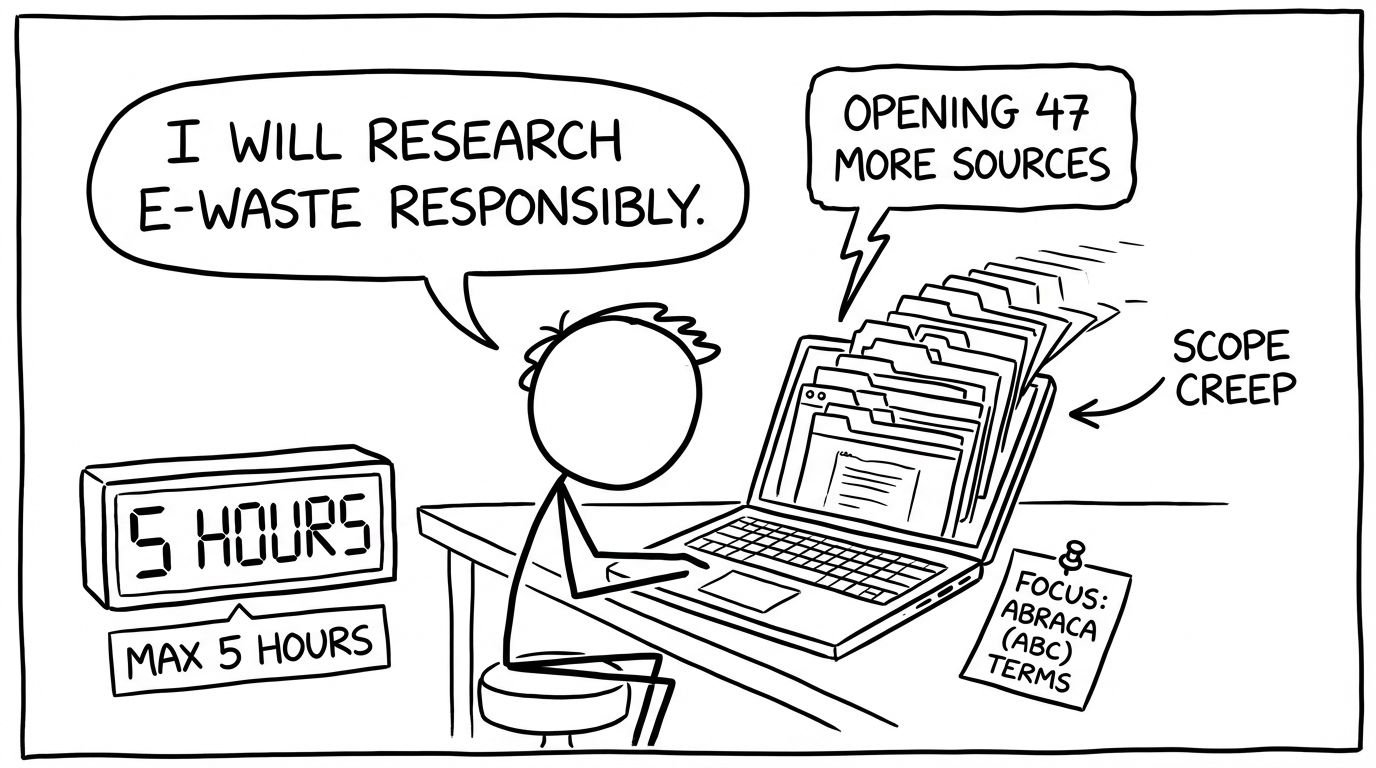
Abraca (ABC) quick study checklist (max 5 hours)
Use this as your five-hour plan for Abraca (ABC). You are building familiarity, not writing a dissertation.
- Learn the Abraca (ABC) context: concrete producer, public company, Country Z, new e-waste factory.
- Memorise the terminology list (definitions + one example each).
- Understand why concrete is carbon-intensive and what "carbon-intensive" implies for strategy.
- Understand what e-waste is, why recycling rates are low, and why landfill is a business risk.
- Map the new gold-recovery process to R&D, innovation, and competitive advantage.
- Prepare "ready-to-use" application points using SWOT and Ansoff.
- Practise writing one recommendation using the 10-marker structure (definition -> application -> analysis -> evaluation -> judgment).
If you want one home base for the syllabus links you'll apply to Abraca (ABC), keep this open: Business Management - IB Resources.
The Abraca (ABC) context you must know (without over-researching)
Abraca (ABC) is Country Z's largest concrete producer. It buys limestone and clay aggregates to manufacture cement and make concrete. That matters because the concrete supply chain is heavy, cost-driven, and sensitive to energy prices, regulation, and public scrutiny.
Then the case study turns: ABC's scientists discover a room-temperature process to recover gold and other precious metals from circuit boards. Previously, recovery required burning at extremely high temperatures, a carbon-intensive process. So the story becomes about innovation: not just "green branding," but potentially lower energy use, new revenue, and a strategic pivot.
In 2024, ABC opens a factory to process e-waste (100 tonnes of circuit boards weekly). It recovers hundreds of kilograms of gold annually and sells it to jewellery makers (a clear B2B link). Finally, ABC is considering efficiencies, environmental impact reduction, becoming more market-orientated, and growth options.
Your job in Abraca (ABC) answers is to keep returning to this triangle:
- Concrete operations (scale, efficiency, carbon)
- E-waste operations (risk, compliance, innovation)
- Strategy (market orientation, growth, stakeholder trade-offs)
Core terminology for Abraca (ABC): what to know and how to use it
The exam rewards students who can define quickly and then apply. For Abraca (ABC), these terms are more than vocabulary. They are shortcuts to analysis.
Aggregates (as construction materials)
Aggregates are granular materials (like crushed stone, sand, or recycled materials) mixed into concrete. In Abraca (ABC), aggregates link directly to cost structure, supply chain stability, and sustainability initiatives (recycled aggregates). They also open evaluation: recycled inputs can reduce environmental impact but may create quality-control and brand-risk concerns.
B2B (business-to-business)
Abraca (ABC) is deeply B2B. It sells concrete to construction firms and sells recovered gold to jewellery makers. That changes marketing: fewer mass promotions, more relationship selling, contracts, reliability, and specifications.
Carbon-intensive
Carbon-intensive means a process produces high greenhouse-gas emissions, usually because it uses lots of fossil-fuel energy. Cement production is famously carbon-intensive, so Abraca (ABC) faces regulatory risk, reputational pressure, and cost volatility. Use this term when evaluating environmental strategies and stakeholder conflict.
Circuit boards
Circuit boards are a key e-waste component containing precious and toxic metals. For Abraca (ABC), circuit boards are an input with supply uncertainty (collection systems, regulation, competition) and compliance obligations (safe handling). Mention circuit boards when you discuss capacity, sourcing, and operational risk.
Clay and limestone
Clay and limestone are raw materials used to make cement. They tie to procurement, location decisions, and environmental impacts of extraction. In Abraca (ABC), they also frame the "old world" operations that ABC is trying to improve.
Concrete and cement
Concrete is the final construction material; cement is a key binding ingredient. In case study questions, that distinction helps you avoid vague writing. It also lets you discuss efficiency improvements at the cement stage vs product differentiation in concrete mixes.
E-waste
E-waste is discarded electronic products and components. The case provides global volume and recycling rates, which is basically an invitation to evaluate: huge supply, low recycling, high landfill, rising regulation. In Abraca (ABC), e-waste is both an opportunity and a reputational minefield.
Landfill
Landfill is where waste is disposed of, often creating environmental externalities and long-term liabilities. For Abraca (ABC), landfill rates signal market failure, policy pressure, and an opportunity for circular business models.
Plastic-shredding machinery
This term hints at processing technology and capex. Even if ABC mainly processes circuit boards, plastic shredding links to broader e-waste sorting and operational scalability. Use it when discussing capacity expansion, efficiency, and investment decisions.
Recycling and solar panels
Recycling is the process of converting waste into reusable material. Solar panels appear as a related e-waste stream and a sustainability symbol; they can be used to discuss growth in green tech markets and the long-run increase in complex waste streams.
Toxic metals
Toxic metals create health, safety, and legal compliance issues. In Abraca (ABC), toxic metals are why you discuss training, regulation, safety systems, and stakeholder impacts beyond profit.
To lock these in fast, build a deck in Flashcards and keep definitions short enough to recall under pressure.
The big contemporary topics behind Abraca (ABC)
Concrete as a "scale business" (operations and efficiency)
Concrete is not a "cute" product. It's a scale product. Small efficiency gains matter because volume is enormous. When the case mentions "increasing efficiencies in its current concrete production," your mind should go to operations management: process improvement, lean thinking, quality assurance, capacity use, and waste reduction.
RevisionDojo's Business Management - IB Resources is useful here because it keeps your operations concepts close while you apply them to Abraca (ABC) without drifting into engineering.
E-waste economics and why 80% going to landfill matters
The case states only 20% of e-waste is recycled and 80% goes to landfill. That ratio isn't trivia; it's a market signal.
It implies:
- There is likely growing regulation (compliance costs and barriers to entry).
- There is inefficiency in collection and sorting (supply chain constraints).
- There is reputational pressure (stakeholders care about waste).
- There is a long-run opportunity for firms that can recover value safely.
This is where "contemporary topic" becomes examinable business thinking: where profit exists, risk exists too.
Innovation: room-temperature gold recovery as competitive advantage
ABC's discovery changes its strategic position. Room-temperature processing suggests lower energy usage than burning at extreme temperatures, which links to cost savings, sustainability claims, and potentially a defensible process advantage.
In exam writing, you can treat it as:
- A unique selling point (USP) in B2B services (processing e-waste for partners).
- A barrier to entry if protected by patents, know-how, or scale.
- An R&D success that justifies further innovation investment.
When you need a tool to talk about growth, keep Ansoff close: Ansoff matrix notes.
What "becoming more market-orientated" means for Abraca (ABC)
Market orientation is not "doing more advertising." It is the habit of starting decisions with customer needs, competitor reality, and market trends.
For Abraca (ABC), becoming more market-orientated could mean:
- Segmenting construction customers (public infrastructure, private developers, specialty builds).
- Offering differentiated concrete mixes (performance, sustainability certifications, reliability of delivery).
- Building B2B partnerships in e-waste collection and processing.
- Using market research to decide which growth path is realistic.
If you want a clean anchor for these marketing concepts, use RevisionDojo's marketing unit page: Unit 4: Marketing Management and the Targeting Strategies (STP) notes.
Growth options you can discuss for Abraca (ABC) (and how to evaluate them)
The case invites "growth options," but your marks come from evaluating trade-offs in context.
Market penetration (lower risk)
ABC could sell more concrete to existing markets by improving service levels, reliability, or pricing competitiveness through efficiency. Evaluation angle: may face price wars and depends on construction demand.
Product development (moderate risk)
Develop "greener" concrete mixes using recycled aggregates. Evaluation: needs strong QC, possible higher costs, but can support differentiation and meet stakeholder expectations.
Market development (moderate risk)
Enter new regions in Country Z or nearby markets. Evaluation: transport costs for concrete can be a constraint; location decisions matter.
Diversification (higher risk)
Expand e-waste operations, potentially offering processing as a B2B service or scaling into other electronics waste streams. Evaluation: strong upside and aligns with innovation, but increases regulatory exposure and reputational risk.
To structure answers with examiner expectations, keep this guide handy: Understanding the IB Business Management 10 Marker Rubric.
A simple way to connect Abraca (ABC) to Business tools
You don't need every model. You need the right model used well.
SWOT (fast and flexible)
- Strengths: scale in concrete, R&D capability, new gold recovery process
- Weaknesses: carbon-intensive legacy operations, learning curve in e-waste
- Opportunities: low recycling rates, rising demand for responsible processing, "green" construction trends
- Threats: regulation, competitors, volatile commodity prices, stakeholder backlash if mishandled
If you want a single toolkit hub, use: BM Toolkit - Core business frameworks and tools.
Circular business models (perfect fit for e-waste)
Abraca (ABC) is practically a case study in resource recovery. Learn the language of circularity and apply it carefully. RevisionDojo's notes are strong here: Circular business models.
FAQ: preparing for Abraca (ABC) without wasting time
How much research is "enough" for Abraca (ABC)?
Enough research for Abraca (ABC) means you can define every required term confidently and explain why it matters to ABC's decisions. If you can write a paragraph linking e-waste, landfill rates, and stakeholder pressure to one strategic recommendation, you are already in the useful zone. The five-hour limit is a hint: the exam is not testing your ability to become an environmental scientist. It's testing whether you can apply Business Management concepts to the Abraca (ABC) context without drifting into irrelevant detail. A good rule is to stop researching when new sources only repeat what you already know. Spend the remaining time practising application and evaluation, because that's where marks actually accumulate.
What are the most important "contemporary topics" inside Abraca (ABC)?
The most important contemporary topics in Abraca (ABC) are circular economy logic, decarbonisation pressure, and responsible innovation. Circular economy shows up through e-waste recycling, resource recovery, and reducing landfill reliance. Decarbonisation pressure shows up because cement and concrete are carbon-intensive and exposed to regulation and stakeholder criticism. Responsible innovation shows up in ABC's room-temperature process, which is a strategic asset but also a compliance and reputational responsibility. These topics are "contemporary" because they move faster than syllabuses do. You don't need deep technical detail; you need business consequences, stakeholder impacts, and strategy trade-offs in Abraca (ABC).
How do I write stronger evaluation for Abraca (ABC) questions?
Stronger evaluation in Abraca (ABC) means making a judgment that is conditional and evidence-based. Start by stating the option, then weigh two or three major benefits against two or three major limitations, all tied to ABC's scale, public ownership, and dual operations. Use the case facts as anchors: weekly throughput, global e-waste volumes, recycling rates, and the B2B nature of sales. Then conclude with a recommendation that includes a "because" and a risk control step, such as investment in compliance systems, quality control, or stakeholder communication. This shows you see trade-offs rather than chasing a perfect solution. If you want a consistent structure, RevisionDojo's How to Maximize Your Score in IB Business Management is a strong reference point.
Closing: make Abraca (ABC) feel smaller than it looks
Abraca (ABC) can feel like two case studies stapled together: concrete on one side, e-waste on the other. But the exam isn't asking you to master both industries. It's asking you to recognize the business logic connecting them: efficiency, innovation, stakeholder pressure, market orientation, and growth.
If you keep your preparation tight -- terminology fluency, a few well-chosen contemporary insights, and repeated practice applying tools -- Abraca (ABC) becomes manageable.
To turn that preparation into exam-ready output, use RevisionDojo as your workflow: build targeted practice sets in the Questionbank, compress concepts with Study Notes, drill terms with Flashcards, test recommendations with AI Chat, and sharpen exam technique with Grading tools, Predicted Papers, and Mock Exams. If you want feedback that feels personal when the stakes rise, RevisionDojo Tutors can help you stress-test your Abraca (ABC) arguments and make your evaluation sound like a decision-maker.
Near the end of your revision, come back and reread the case opening again. You'll notice something quiet: Abraca (ABC) isn't about memorising more. It's about thinking better with just enough.