


If you have ever tried to revise with three tabs open, a group chat exploding, and a printer that suddenly “needs attention,” you already understand operations.
In IB Business Management, operations management is the part of a business that quietly stops everything else from falling apart. It does not just “make products” or “deliver services.” It turns promises into reality. And because every department makes promises (budgets, campaigns, hiring plans, new product ideas), operations ends up supporting them all.
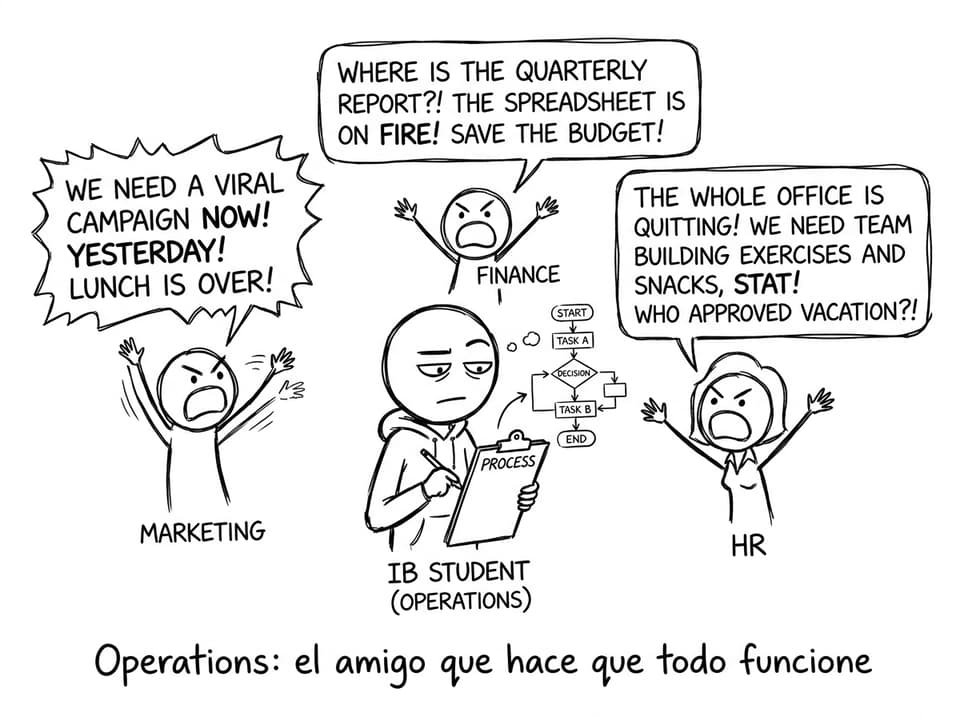
Quick exam checklist: how operations supports other functions
Use this as a fast structure for any IB Business Management short answer or 10-marker:
-
Finance: cost data, efficiency, investment decisions
-
Marketing: stock availability, delivery reliability, customer experience
-
Human resources: staffing needs, training, safety, productivity
-
R&D: feasibility, scaling, quality testing, time-to-market
-
Procurement: supplier coordination, lead times, input quality
-
Customer service: fewer complaints, smoother returns, consistent quality
-
Strategy: capacity, location, tech, sustainability constraints
For the syllabus anchor, keep Unit 5 close: Unit 5 Operations Management Hub.
Operations management and finance: turning processes into numbers
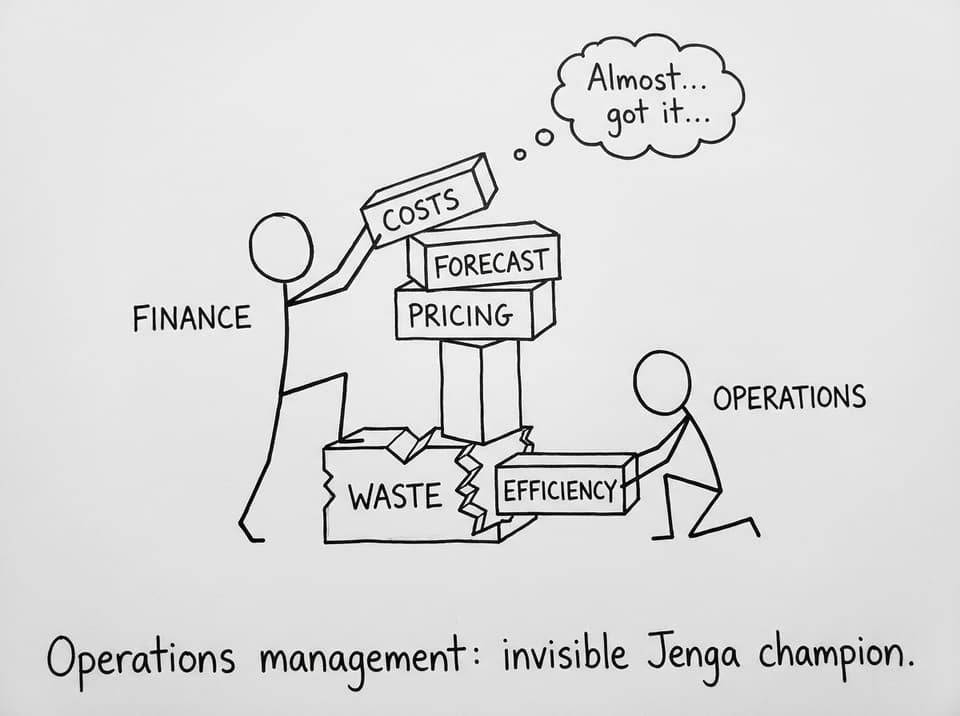
Finance teams talk in budgets, forecasts, cash flow, and profitability. Operations teams talk in capacity, waste, throughput, and quality. In practice, they are speaking about the same reality from different angles.
In IB Business Management, a simple link often earns strong analysis: operational efficiency reduces costs. Less waste, fewer defects, smarter scheduling, and better inventory control can lower the cost of sales and improve profit margins.
If you want a clean, syllabus-aligned definition of what operations actually does (so your answer starts sharply), use 5.1 Introduction to operations management and 5.1.1 The Role of Operations Management.
For quantitative linkage, efficiency ratios often show the operations-finance relationship directly. Revision helps here: Efficiency ratios notes.
Operations management and marketing: making sure the promise is deliverable
Marketing creates demand. Operations has to meet it.
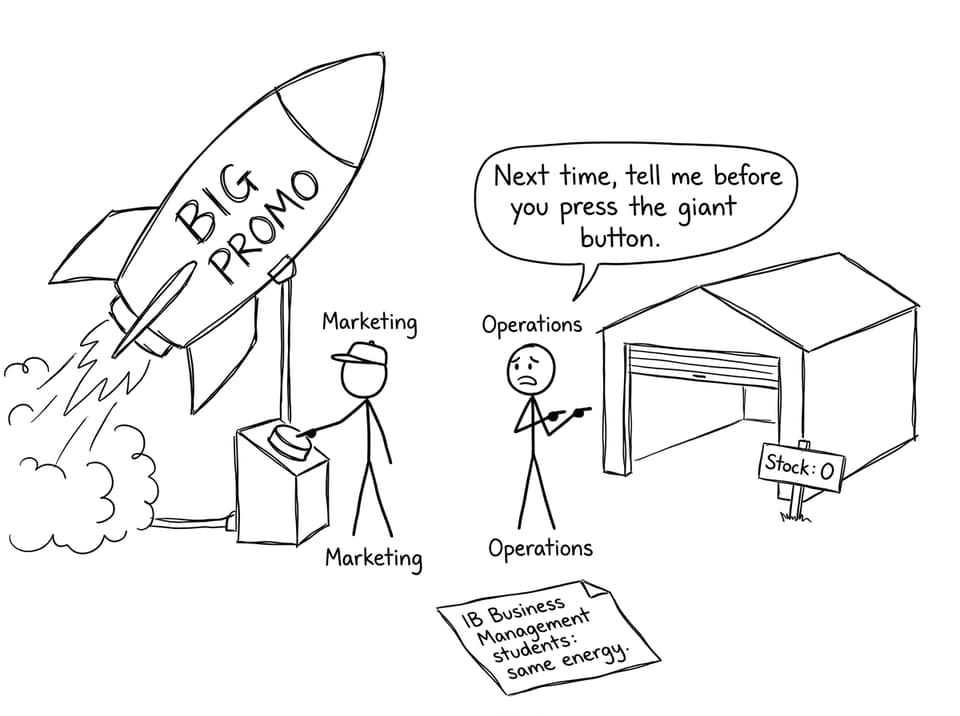
This sounds obvious until you picture a promotion that works too well. The marketing team celebrates. Customers place orders. Then the warehouse runs out of stock, lead times stretch, and social media turns into a complaint board. In IB Business Management, this is an easy chain of reasoning: marketing success can become reputational damage if operations capacity and inventory planning are not aligned.
A useful way to phrase it in exam conditions:
-
Marketing builds the brand promise.
-
Operations delivers the brand experience.
-
If delivery fails, the brand promise becomes less credible.
To strengthen your vocabulary for methods and efficiency (without sounding generic), revise 5.2 Operations Methods.
Operations management and human resources: the workforce behind the workflow
HR can recruit talented people, but operations defines the skills the business actually needs.
When a firm changes its production method, introduces new technology, expands capacity, or reorganizes layout, HR must respond with hiring, training, and performance management. Operations also influences:
-
Workforce planning (how many staff, which shifts)
-
Training needs (new machinery, new quality procedures)
-
Health and safety (especially in manufacturing or logistics)
-
Motivation (realistic targets and manageable workloads)
In IB Business Management, you can tie this back to the wider idea that businesses are built around functions that must coordinate. If you need that framing, review Business functions notes.
Operations management and R&D: the bridge from idea to scalable reality
R&D generates ideas. Operations decides whether those ideas can survive contact with reality.
Operations supports R&D by testing feasibility: can the product be produced at the required quality, speed, and cost? Can suppliers deliver the inputs consistently? Can the business scale from prototype to mass production without quality collapsing?
In IB Business Management exams, this is also where evaluation lives. A brilliant innovation may be strategically attractive, but operationally impossible right now due to capacity constraints, missing expertise, or unreliable suppliers.
Operations management and procurement: the supply chain heartbeat
Procurement finds suppliers and negotiates terms. Operations depends on those suppliers to keep production flowing.
Strong coordination reduces stockouts, prevents delays, and protects quality. Weak coordination creates a familiar nightmare: production stops because a small input did not arrive on time.
If you want to broaden your operational decision-making examples, location decisions often connect directly to suppliers and logistics: Location notes.
Operations management and customer service: the complaints you never receive
Customers rarely see operations directly. They feel it.
On-time delivery, consistent quality, and hassle-free returns all depend on operational systems. When operations runs smoothly, customer service spends less time apologizing and more time building loyalty. In IB Business Management, you can describe this as a virtuous cycle: better operations improves customer satisfaction, which supports repeat purchases and brand strength.
Bring it together with RevisionDojo
Operations management supports every other function because it is the place where plans become performance. That is why this topic shows up everywhere in IB Business Management: case studies, data response, and evaluation questions.
To revise it efficiently, use RevisionDojo as your full loop: Study Notes and Flashcards for fast recall, the Questionbank for application, AI Chat to stress-test your logic, Grading tools to tighten structure, Predicted Papers and Mock Exams to build timing, and the Coursework Library plus Tutors when you want targeted feedback. Start here: IB Business Management hub and make operations the part of your revision that makes everything else run.


