


Enzymes are the quiet reason life feels effortless. Your cells break down glucose, copy DNA, and build proteins at speeds that would otherwise take years. Then you open an IB Biology exam and realise the IB wants you to explain that “effortless” part in six marks, under time pressure.
If enzymes feel slippery, it’s usually because you’re trying to memorise them as facts instead of seeing them as a story: structure creates function, function shapes patterns on graphs, and graphs become markschemes.
To anchor the core content fast, pair this article with the focused syllabus pages for 2.5 Enzymes and IB Biology Topic C1.1: Enzymes and Metabolism.
Enzymes in IB Biology: a quick checklist
Use this as your pre-exam “did I actually get it?” scan for IB Biology:
-
Define enzymes as biological catalysts (and say what they don’t change)
-
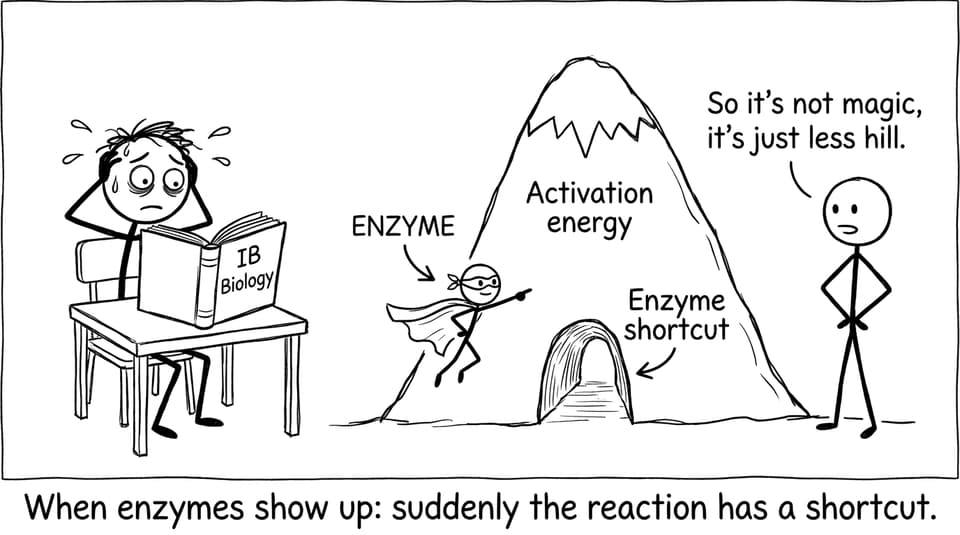
Explain activation energy and how enzymes lower it
-
Describe active site + substrate + enzyme-substrate complex
-
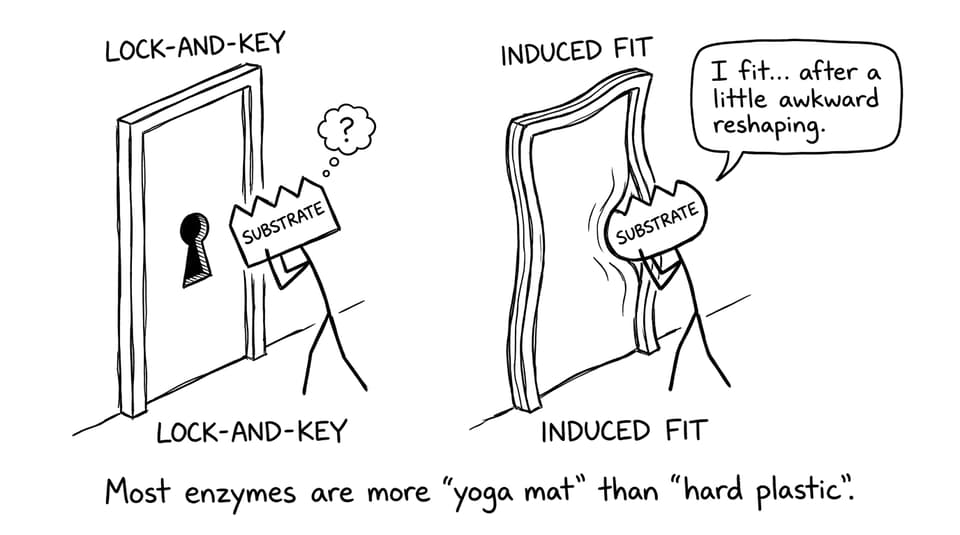
Compare lock-and-key vs induced fit
-
Predict effects of temperature, pH, substrate concentration, and inhibitors
-
Interpret enzyme graphs and identify saturation/denaturation
For exam-style drilling on all of that, the 2.5 Enzymes Questionbank is the fastest way to turn understanding into marks.
What are enzymes?
In IB Biology, enzymes are defined as biological catalysts. Most are globular proteins (a few are RNA catalysts, but protein enzymes are the main focus). “Catalyst” matters: enzymes increase reaction rate without being permanently changed or used up.
The reason enzymes can do this comes from shape. A protein’s amino acid sequence folds into a precise 3D structure, creating an active site. That active site is a tiny working area where specific molecules (the substrate) can bind.
If you want the clean syllabus wording and the typical diagrams IB expects you to describe, revise from Notes for 2.5 Enzymes.
How do enzymes work?
Most IB Biology markschemes reward one central idea: enzymes make reactions easier to start by lowering the activation energy. They do not change the overall energy released/absorbed by the reaction; they simply reduce the “startup cost.”
Mechanistically, you can describe the cycle like this:
-
Substrate collides with enzyme
-
Substrate binds at active site to form an enzyme-substrate complex
-
Bonds are stressed/positioned so reaction occurs more readily
-
Products form, detach, and the enzyme can be reused
If you struggle with wording, practice building answers around command terms (define vs explain vs compare) using How to Understand IB Biology Command Terms for Exam Success.
Lock-and-key vs induced fit (what IB Biology wants you to say)
Both models explain specificity, but they emphasise different things:
-
Lock-and-key model: the active site is already complementary to the substrate (rigid fit). Good for introducing specificity.
-
Induced fit model: the active site is flexible; binding triggers a shape change that improves fit and catalysis. This is considered more realistic for many enzymes.
A high-scoring IB Biology comparison typically includes one similarity and two clear differences, written in paired points.
What affects enzyme activity?
In exams, enzyme questions often become graph questions. Your goal is to link cause (molecular collisions and shape) to effect (rate changes).
Temperature
As temperature increases, molecules move faster and collide more often, so rate increases up to an optimum. Past that, bonds maintaining protein structure break and the enzyme denatures; the active site changes shape and rate drops sharply.
pH
Changes in pH can disrupt ionic and hydrogen bonds, altering the active site. Each enzyme has an optimum pH; away from it, binding and catalysis become less effective.
Substrate concentration
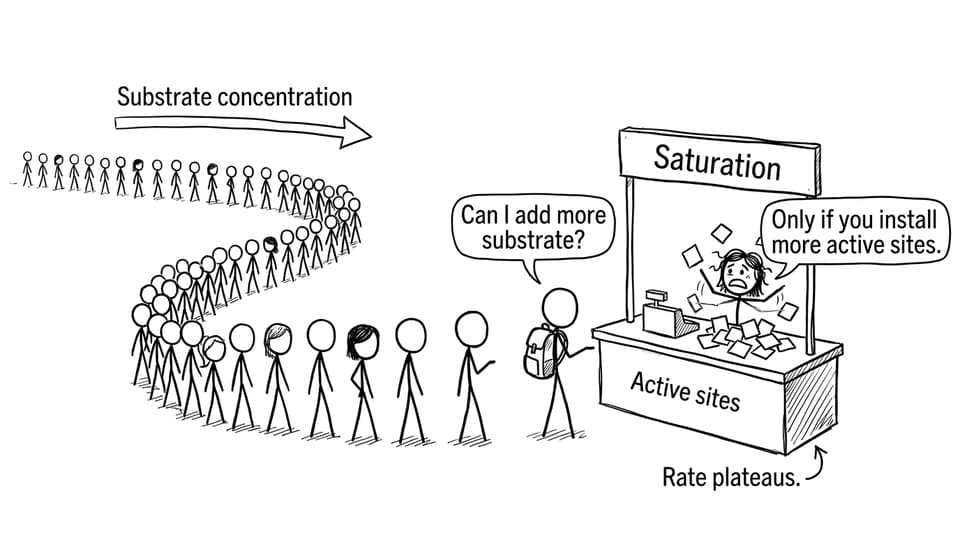
At low substrate concentration, adding more substrate increases collisions and increases rate. Eventually, all active sites are occupied and the enzyme becomes saturated; rate plateaus.
Inhibitors (a common IB Biology twist)
Inhibitors reduce rate by interfering with enzyme function. In many IB Biology questions, you’re asked to infer inhibition from a curve shift or a reduced maximum rate. Keep your language tight: describe what changes on the graph, then explain what that implies about binding/active site activity.
To get comfortable with data interpretation under pressure, use the tactics in IB Biology Paper 1B: Data-Based Questions Explained.
Why enzymes show up everywhere in IB Biology
Enzymes aren’t a stand-alone chapter; they’re a tool that powers other chapters. When you meet DNA polymerase in replication, Rubisco in photosynthesis, or dehydrogenases in respiration, the same enzyme logic repeats: active site specificity, conditions, inhibitors, and rate.
That’s why students who build enzyme fluency early often find the rest of IB Biology less intimidating. If you’re deciding how seriously to commit to the subject, Is IB Biology Right for You? frames what “success” actually demands.
Enzymes in practical work and the IA
Enzyme experiments are popular because you can control variables and generate clean quantitative trends. Typical investigations vary temperature, pH, substrate concentration, or inhibitor presence, then measure reaction rate (foam height, oxygen volume, colour change, time to endpoint).
If you want a practical roadmap, use IB Biology Lab 1: Enzyme ActivityA Student's Guide. For IA-level planning, IB Biology IA Ideas: 2026 Topics That Actually Work helps you choose variables that lead to strong graphs and stronger evaluation.
Bring it home: make enzymes a scoring topic
In IB Biology, enzymes are one of the rare topics that repay you everywhere: definitions, calculations, data analysis, practical design, and extended responses. The fastest route is consistent practice: learn the model, then answer enough questions that your brain stops negotiating with it.
RevisionDojo helps you do that with the Questionbank, concise Study Notes, quick-hit Flashcards, and AI Chat when a concept won’t click. If you’re aiming higher, add Mock Exams, Predicted Papers, and Grading tools to train under real constraints, and use the Coursework Library plus Tutors when you want human-level feedback.
When enzymes feel automatic, IB Biology starts to feel like a system you can control.