


Economies of scale feel like one of those ideas you understand right up until you have to explain it in an exam.
You can almost see it: a business grows, production rises, and somehow the cost per unit drops. But the best IB Business Management answers do not stop at “costs go down.” They show why the cost advantage happens, and how that advantage becomes strategy: lower prices, higher profit margins, or more room to invest.
What are economies of scale?
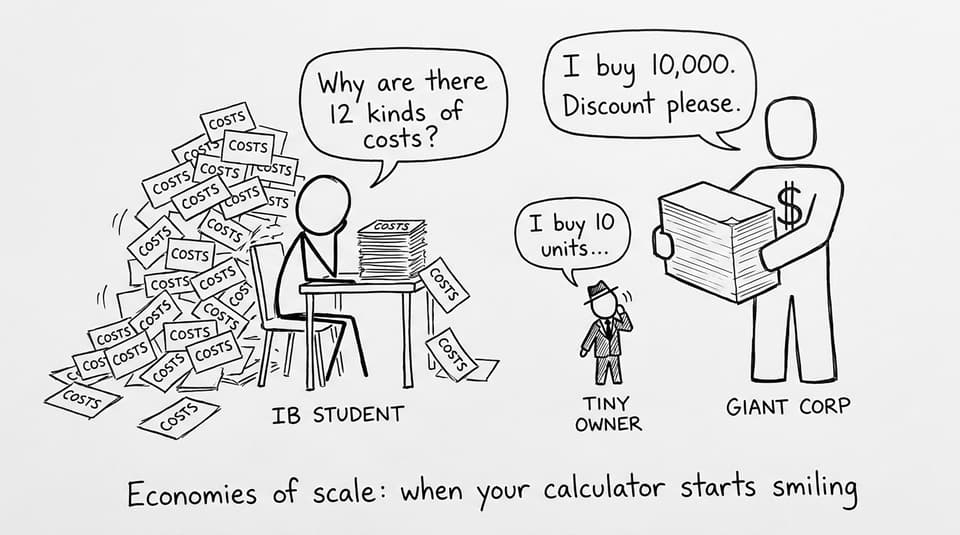
In IB Business Management, economies of scale happen when a firm increases output and the average cost per unit falls. Think of it as the “bigger engine, lower cost per passenger” effect: some costs and efficiencies only make sense when spread across lots of units.
To lock in the examiner-friendly definition and related terms, keep the IB Business Management Key Definitions open while you revise.
Quick exam checklist (use this in any 4-10 marker)
-
Define economies of scale (falling average unit cost as output rises).
-
Explain at least two reasons (bulk buying, specialisation, spreading fixed costs, technology).
-
Add a business consequence (lower prices, higher margins, barrier to entry).
-
Balance with a brief nod to diseconomies (coordination problems as firms get too big).
For the syllabus-aligned home base, start with 1.5 Growth and Evolution and the focused subtopic 1.5.1 Internal and External Economies and Diseconomies of Scale.
Why economies of scale lower costs (the mechanisms)
Most cost savings come from a few repeatable levers. In IB Business Management, you get marks for naming the lever and explaining the logic.
Bulk purchasing and stronger supplier deals
When a firm buys inputs in large quantities, suppliers often offer discounts or better payment terms. That reduces the variable cost per unit. Larger firms also have more negotiation power with logistics providers, packaging suppliers, and distributors.
Specialisation of labour and managerial expertise
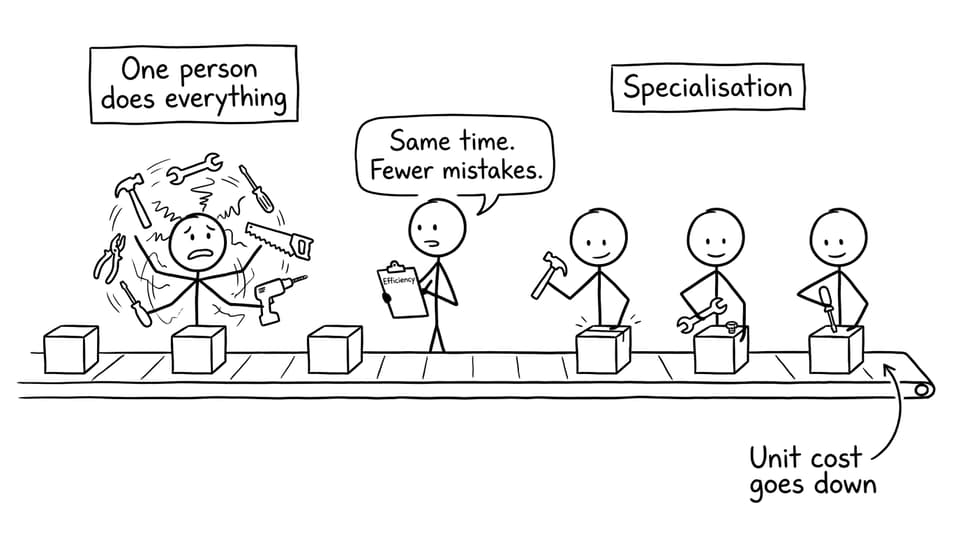
As a business grows, jobs can be divided more efficiently. Workers repeat narrower tasks, make fewer mistakes, and become faster. Management can also become more specialised (finance, operations, HR), which improves decisions and reduces costly errors.
Technical economies: machinery, automation, and learning curves
Big output can justify expensive machines that would be unrealistic for a small firm. The upfront cost may be high, but spread across thousands of units it reduces the average cost. Over time, firms also learn: processes improve, waste falls, and throughput rises.
To connect this to operations content, explore IB Business Management Unit 5: Operations Management and practise with the matching Unit 5 Questionbank.
Spreading fixed costs over more output
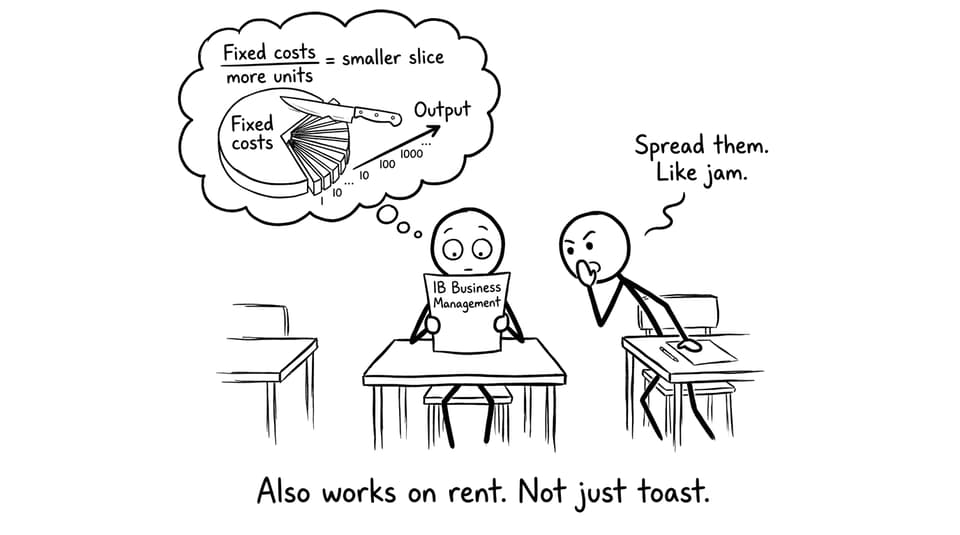
Fixed costs (rent, insurance, some salaries, machinery) do not rise in direct proportion to output. If a factory lease costs the same whether you produce 1,000 or 10,000 units, then higher output means lower fixed cost per unit.
This is where cost language matters. If fixed vs variable costs feel fuzzy, revise with 3.3 Costs and revenues Cheatsheets and drill definitions using 3.3 Costs and Revenues Questionbank.
Why examiners care: competitiveness and strategy
Economies of scale are not just “nice.” In IB Business Management, they explain how large firms defend their position.
Lower average costs can let a firm:
-
reduce prices to gain market share,
-
maintain prices but increase profit margins,
-
invest in R&D, quality, or capacity,
-
create a barrier to entry (new firms struggle to match the cost base).
If you want a real decision-making frame, read How Do Economies and Diseconomies of Scale Affect Business Decision-Making and compare it with the more focused explainer What Are Economies of Scale, and Why Do They Matter for Competitive Advantage.
Final takeaway for IB students
Economies of scale are simple to define but powerful to explain: in IB Business Management, they are one of the cleanest ways to link operations choices to competitive advantage. If you can consistently write “define, explain the mechanism, state the consequence, and evaluate,” you will pick up reliable marks.
To practise fast, use RevisionDojo as your revision loop: learn the concept in Study Notes, memorise it with Flashcards, apply it in the Questionbank, challenge your explanation with AI Chat, and refine exam technique with Grading tools, Predicted Papers, and Mock Exams. When you want feedback from a real person, RevisionDojo Tutors can help you turn good ideas into examiner-ready paragraphs.


