When “bigger” quietly makes everything cheaper
On a late-night revision session, it’s easy to think competitive advantage comes from flashy marketing or a genius product. But in IB Business Management, some of the strongest advantages are almost boring: the quiet math of getting bigger and paying less per unit.
That’s the core idea behind economies of scale. When a firm increases output and its average cost per unit falls, it can price more aggressively, earn higher margins, or reinvest faster than rivals. And in exam responses, this concept is a reliable way to explain why large firms can be so hard to compete with.
Economies of scale: a simple exam definition
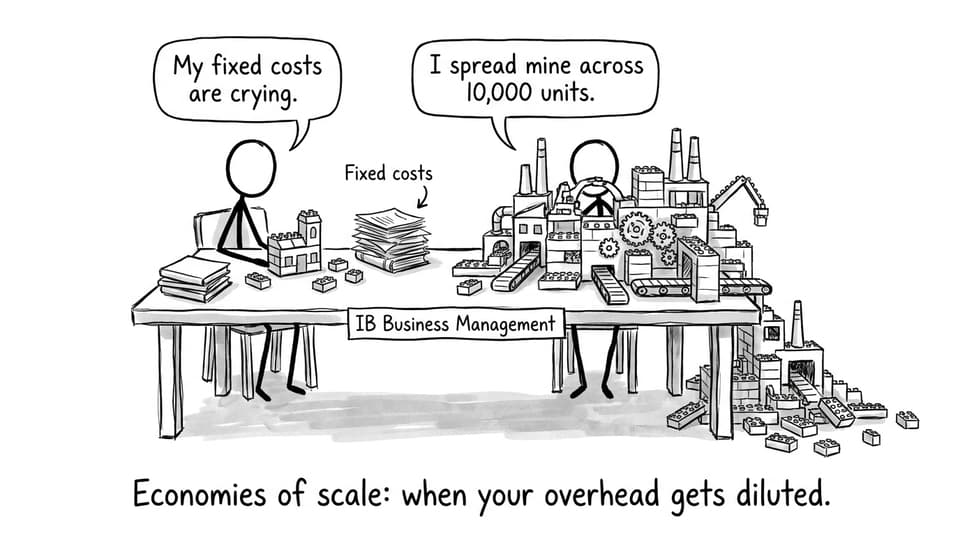
Economies of scale happen when increasing the scale of production reduces the average cost per unit.
Keep it practical: fixed costs (rent, machinery, salaried staff) don’t rise proportionally with output. So as output rises, those costs are spread more thinly.
Quick study path on RevisionDojo:
-
Review the syllabus-aligned notes for 1.5 Growth and Evolution
-
Go straight to 1.5.1 Internal and External Economies and Diseconomies of Scale
-
Lock in terminology with the IB Business Management Glossary
Where economies of scale come from (the ones examiners love)
Technical economies (machines doing the heavy lifting)
Large firms can justify automation, specialized equipment, and faster production methods. In IB Business Management, you can link this to operations efficiency: a big upfront investment reduces average cost per unit over time.
To practise cost-focused explanations, pair this topic with 3.3 Costs and revenues Questionbank on RevisionDojo.
Purchasing economies (bulk buying power)
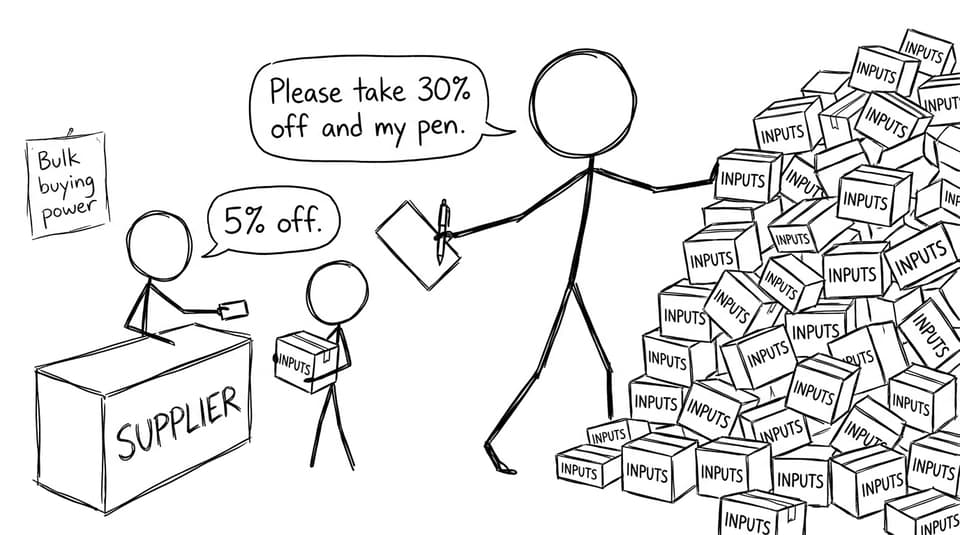
If you order inputs by the truckload, suppliers tend to offer discounts. That directly reduces variable cost per unit, which strengthens cost leadership.
Managerial economies (specialists instead of one exhausted generalist)
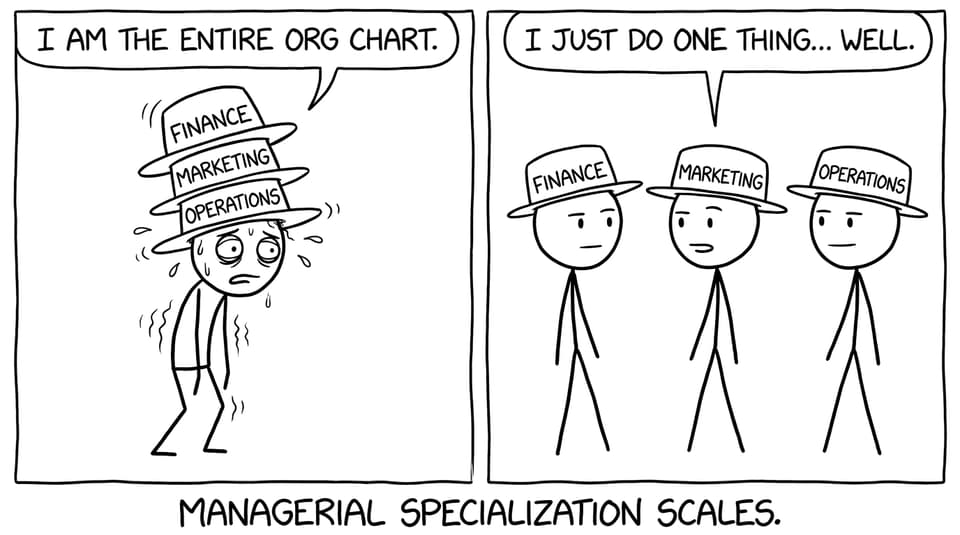
As firms grow, they can hire functional experts in finance, HR, marketing, and logistics. Better decisions and clearer accountability reduce waste, delays, and costly errors.
Marketing and administrative economies (spreading fixed overhead)
A national ad campaign, an IT system, or an R&D team is expensive. But when those fixed costs are shared across millions of units, the cost per unit shrinks.
Why economies of scale matter for competitive advantage
In IB Business Management, economies of scale connect cleanly to competitive advantage in three ways:
-
Lower prices: the firm can undercut competitors while staying profitable, building market share.
-
Higher profit margins: extra margin funds innovation, expansion, and resilience in downturns.
-
Barriers to entry: new or smaller rivals struggle to match unit costs, so competing on price becomes risky.
To widen your competitive advantage vocabulary, see RevisionDojo’s notes on Porter’s Generic Strategies (HL only).
Mini exam checklist (30 seconds)
Use this structure for a strong paragraph:
-
Define economies of scale (average cost per unit falls as output rises)
-
Explain why (spreading fixed costs, technical efficiency, purchasing power, specialization)
-
Link to outcomes (lower prices OR higher margins OR barrier to entry)
-
Add a risk sentence: too much growth can lead to diseconomies
If you want the decision-making angle, read Economies vs Diseconomies: how they affect business decisions and compare it with What are diseconomies of scale?.
Final takeaway (and how to revise it fast)
Economies of scale matter because they turn size into a cost advantage, and cost advantage into competitive advantage. In IB Business Management, that chain of logic helps you explain pricing power, profits, and barriers to entry in a way that feels real and exam-ready.
To revise efficiently, use RevisionDojo’s Study Notes and Cheatsheets, practise with the Questionbank, and build confidence with Mock Exams and Predicted Papers (without guessing what will appear, just training your structure). If you’re stuck, AI Chat can help you turn a messy idea into a clear paragraph, and the Grading tools can show exactly what to improve. When the concept clicks, it stops being a definition and becomes a lens you can use on almost any case study.

