




A weak subject one month out from the IB November session is not a reason to surrender. It is a reason to become selective. You probably cannot relearn every chapter perfectly, but you can identify where marks are leaking, repair foundational gaps, and become more reliable under exam conditions.
The central shift is simple: stop trying to feel prepared for the entire subject. Train for the papers, topics, and question types you will actually face.
November-session papers may begin in late October, so count your remaining days from your first scheduled paper, not from November 1. Confirm your dates, times, and exam zone with your coordinator. RevisionDojo’s IB November exam schedule and study plan can help you see how individual papers fit into the wider session.
Your one-month recovery checklist
Before making a detailed timetable, use this checklist:
- Confirm the date and format of every paper in the weak subject.
- Complete a short diagnostic set without notes.
- Identify three weaknesses that repeatedly cost marks.
- Separate knowledge gaps from technique and timing problems.
- Repair one small concept, then answer questions immediately.
- Keep an error log and retest mistakes within 48 hours.
- Complete timed sections before attempting full simulations.
- Reduce study intensity during the final 2-3 days.
The month is not about doing everything. It is about making your next hour useful.
Diagnose the subject before revising it
Calling yourself “bad at chemistry” or “weak at history” produces anxiety but little information. A useful diagnosis is narrower.
Choose one representative section or mixed set from the paper that concerns you most. Attempt it under a reasonable time limit, then classify every lost mark:
- Knowledge: You did not know the fact, formula, concept, quotation, or example.
- Method: You knew the content but could not apply it.
- Command term: You described when the question required evaluation, comparison, or justification.
- Structure: Your essay, calculation, or explanation was difficult to follow.
- Timing: You knew what to do but worked too slowly.
- Carelessness: You misread data, omitted units, or skipped part of the question.
This distinction matters. Reading another chapter will not repair poor timing. Completing another timed section will not help if the underlying concept remains unclear.
If you feel generally behind, use the diagnostic process in How to Study for IB Exams When You Feel Behind. It turns vague panic into a list of trainable problems.
Rank weaknesses by their value
Not every weakness deserves equal time. Some topics unlock several parts of a paper. Other problems can consume the month without producing much improvement.
Rank each weak area using three questions:
- Does this skill affect several question types?
- Can focused practice produce visible improvement within a week?
- Is it relevant to an early or demanding paper in my schedule?
A mathematics prerequisite used across several topics usually deserves attention before an obscure extension. In an essay subject, answering the command term and building a defensible argument may improve several responses at once. In a language, daily retrieval and short writing practice may beat rereading vocabulary lists.
Choose three priority weaknesses. Keep everything else on a secondary list. This is triage, not neglect.
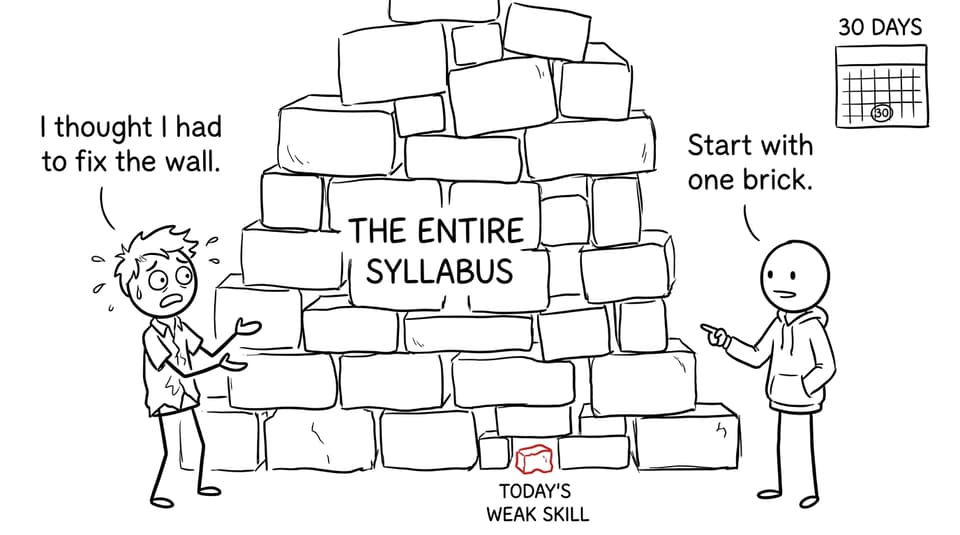
Use a four-week rescue plan
Week one: find the leaks
Spend the first 3-4 days diagnosing the subject and repairing prerequisites. Use concise Study Notes for one micro-topic, close them, and explain the idea from memory. Then complete a targeted Questionbank set.
Your evidence of progress should be completed questions, corrected responses, and a clearer error log, not rewritten notes. Is One Month Enough to Study for IB Exams? offers a framework for balancing understanding with application.
Week two: build reliable methods
Repeat the question types that caused trouble. For each practice block, use a simple cycle:
- 15-20 minutes to repair one concept
- 30-45 minutes of focused questions
- 15 minutes to mark, classify, and correct errors
- 5 minutes to schedule a retest
Turn formulas, processes, quotations, and recurring corrections into Flashcards. If an explanation remains unclear, ask AI Chat a precise question rather than requesting a whole-unit summary. A RevisionDojo Tutor can help when repeated attempts reveal the same misconception.
Week three: add time pressure
Understanding something slowly is different from producing it under examination conditions. Begin with timed sections, not an immediate marathon.
Use Grading tools to compare your work with assessment expectations. Record whether marks were lost through content, precision, structure, or pace. Retake a shorter version of the skill within 48 hours.
By the end of the week, complete one realistic Mock Exam or Predicted Paper. These are pressure tests, not prediction guarantees. For a stronger simulation routine, follow RevisionDojo’s IB mock exam guide.
Week four: stabilise performance
The final week is for consolidation. Revisit repeated errors, rehearse paper timing, and maintain retrieval through short Flashcard sessions. Avoid opening several new resources because one difficult result frightened you.
If your timetable contains consecutive papers or two demanding sessions on the same day, rehearse that sequence once. The November session hardest-days survival plan explains how to prepare for fatigue as well as subject knowledge.
During the final 2-3 days, reduce volume. Review your error rules, complete a small confidence set, prepare permitted equipment, and protect sleep.
Build a schedule that protects your other subjects
A weak subject can absorb every available hour because it always feels unfinished. Then stronger subjects begin to decay.
Give the recovery subject one daily block of 60-90 minutes, plus 10-15 minutes of retrieval. On selected weekend days, add a longer timed session and review. Continue shorter maintenance blocks for other subjects.
A realistic weekday might look like this:
- 10 minutes of Flashcards
- 20 minutes of targeted Study Notes
- 40 minutes of Questionbank practice
- 15 minutes of marking and error logging
- 5 minutes to choose the next task
If your school calls this the IB NovExam fall term, classes and deadlines may still compete with revision. Use the Coursework Library for legitimate guidance on active coursework, but do not let optional polishing displace preparation for an imminent paper.
For a broader routine, use RevisionDojo’s step-by-step IB exam study guide.
Measure progress through evidence
Confidence often changes more slowly than competence. You may still feel weak after your accuracy improves, so the final month needs visible measurements.
Track:
- marks earned by topic or question type
- time used per section
- repeated error categories
- successful retests after 48 hours
- questions left incomplete
Review these indicators every three days. If accuracy improves but timing remains poor, add timed sets. If the same concepts keep failing, return briefly to explanation and guided examples. If nothing changes after several attempts, seek feedback from a teacher, Tutor, or RevisionDojo’s Grading tools.
The goal is not to prove that you worked hard. It is to discover whether your method is changing the result.
What to do today
Open the RevisionDojo IB resource hub, choose the weak subject, and complete one short mixed diagnostic. Identify the three biggest sources of lost marks. Repair the smallest one with Study Notes, practise it in the Questionbank, and schedule a retest.
One month is short enough to demand honesty, but long enough for repeated correction. A weak subject becomes less frightening when it becomes a sequence of measurable decisions. RevisionDojo brings the Questionbank, Study Notes, Flashcards, AI Chat, Grading tools, Predicted Papers, Mock Exams, Coursework Library, and Tutors into one loop, giving November-session students one place to learn, practise, receive feedback, and try again.