
A parent can hear the phrase “no full IB Diploma” and imagine every university door closing at once. That is understandable. It is also usually too simple.
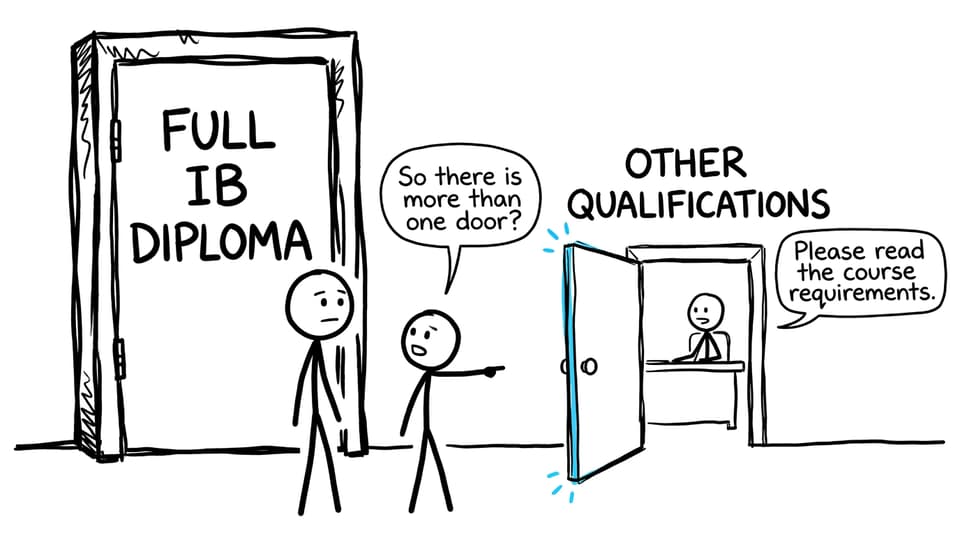
Yes, a student may be able to enter a top university without the full IB Diploma. The decisive questions are why the student does not have the diploma, what other secondary-school credential they hold, which IB course results they achieved, and where they are applying.
Selective US universities commonly assess applicants in the context of their school and curriculum. Some do not require the IB Diploma itself, although they may require a recognized secondary-school completion credential. Highly selective UK courses are often more qualification-driven: if an offer specifically requires the full IB Diploma, individual IB course results will not automatically satisfy it.
The right response is therefore neither panic nor false reassurance. It is to identify the student’s exact qualification profile and compare it with the written requirements for each course.
The short answer for IB diploma parents
Start by separating three situations that sound similar but are treated differently:
- The student chose individual DP courses: They never registered for the complete Diploma Programme and will receive results for the subjects completed.
- The student attempted the full programme but was not awarded the diploma: They still receive official Diploma Programme course results showing their individual subject outcomes.
- The student has another school-leaving qualification: Their school may award a national, state, provincial, or accredited high-school credential independently of the IB Diploma.
A university without full diploma entry route is most plausible when the applicant still holds a recognized secondary-school qualification and has a strong academic record. It becomes harder when the university explicitly demands the complete IB Diploma or when the student has no alternative credential demonstrating completion of secondary education.
For context, the IB awards the diploma only when a candidate earns at least 24 points and satisfies all additional conditions, including requirements covering Higher Level and Standard Level totals, subject grades, Theory of Knowledge, the Extended Essay, and CAS. Missing the diploma does not erase the subject grades already earned. The IB issues DP course results instead, as explained in this overview of what happens when a student does not receive the IB Diploma.
A parent’s admission checklist
Before drawing conclusions, gather these facts:
- Was the student registered for the full Diploma Programme or individual courses?
- If the diploma was not awarded, which precise condition was missed?
- What grades were achieved in each HL and SL subject?
- Does the school issue a separate high-school or national leaving credential?
- Does the intended degree require particular subjects at HL?
- Does the university state that the full diploma is mandatory?
- Is the offer conditional on an overall score, diploma status, or named subject grades?
- Can admissions confirm the policy in writing?
This checklist matters because “no diploma” describes an outcome, not the applicant’s complete academic record.
Why the country and admissions system matter
There is no worldwide set of IB university requirements. Universities establish their own criteria, and policies can vary between courses at the same institution.
| Admissions context | Likely significance of not holding the full diploma |
|---|---|
| Selective US university | The diploma may not be a universal admission requirement, but curriculum rigor, transcript performance, testing rules, and a valid school-completion credential can all matter. |
| Selective UK course | Published offers often specify an overall IB Diploma score and HL grades. Without the diploma, the applicant may need another explicitly accepted qualification. |
| University using a national credential | Individual IB courses may strengthen the application while the national or school credential establishes secondary-school completion. |
| Foundation or pathway programme | The provider may accept a broader combination of school credentials and subject results, but its rules must be checked directly. |
The United States usually considers academic context
Highly selective US institutions generally review a transcript, course rigor, recommendations, essays, activities, and any required test results. The IB is one curriculum among several. A university may value strong HL performance without declaring the full IB Diploma an absolute application requirement.
That does not mean admission is easy. Selective universities expect applicants to pursue demanding courses available to them and perform exceptionally well. A student taking three individual IB courses will be considered in the context of what their school offered, what they selected, and whether that programme represented suitable academic challenge.
Some universities also require students to hold a high-school diploma or equivalent before enrollment. That is different from requiring the IB Diploma. Parents should ask the school counselor which credential appears on the final transcript and whether it qualifies the student for university study in their home education system.
The distinction between admission credentials, IB results, and school transcripts is explored further in this guide to reporting the IB in US college applications.
The United Kingdom is often more qualification-specific
UK universities normally publish requirements for individual degree courses. An offer may specify a total IB Diploma score, a particular HL profile, and required subjects. Oxford, for example, publishes IB offers based on total diploma points plus grades in Higher Level subjects, with exact expectations varying by course.
If a requirement says “IB Diploma: 39 with 766 at HL,” strong individual course results do not necessarily replace the complete credential. The applicant would need another accepted qualification or explicit confirmation that a different combination is acceptable.
This is why parents should look beyond a university’s overall reputation and read the page for the exact degree. Entry expectations for mathematics, medicine, history, and art can differ substantially. For a practical example of course-specific selectivity, see this explanation of IB scores commonly required for Oxford applications.
Not taking the diploma is different from not earning it
This distinction can shape how an application is presented.
A student who deliberately took individual DP courses may have followed the normal curriculum available at their school. The application should identify those subjects and levels accurately without implying that the student attempted the full programme.
A student who attempted the diploma but did not satisfy every award condition has a different record. The university may have received predicted Diploma Programme results and made an offer on that basis. If the final award is missing, the student may no longer meet the offer even when several subject grades remain strong.
The first step is to read the offer literally. Did it require:
- the award of the diploma;
- a total point score;
- an HL total or grade combination;
- a grade in a named subject; or
- completion of the school’s own graduation credential?
These conditions are not interchangeable. Families facing this situation can use the guide to how missing the IB Diploma may affect university offers to organize the immediate questions.
What can strengthen an application without the full diploma?
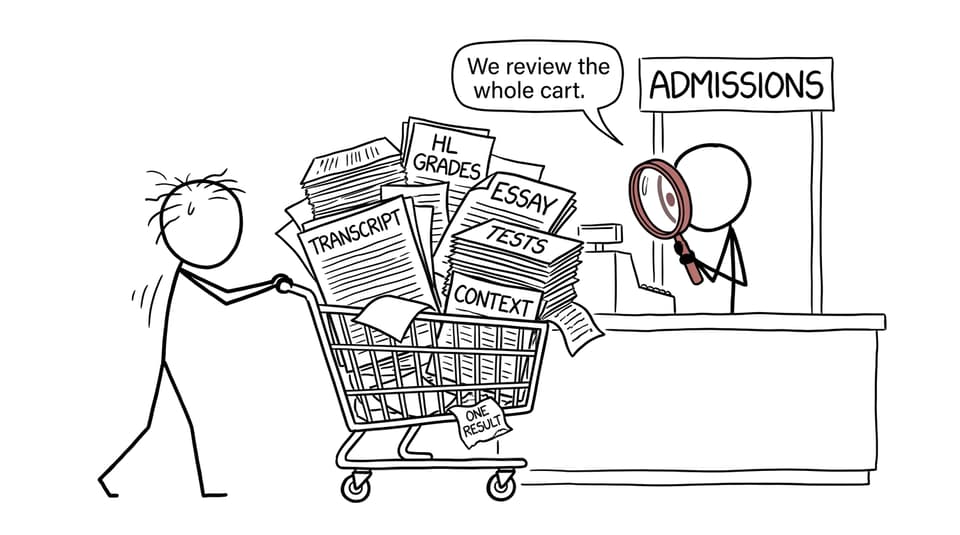
No supporting factor guarantees entry, particularly at a highly selective institution. Several forms of evidence can nevertheless make the student’s academic preparation clearer.
Strong results in relevant Higher Level subjects
For a prospective engineering student, excellent results in advanced mathematics and physics may provide more relevant evidence than an unrelated course. For an English applicant, demanding reading and analytical writing courses may be especially important. Required subjects still matter even in holistic systems.
A recognized secondary-school credential
The most important practical question may be whether the student can demonstrate secondary-school completion through another credential. Individual IB results and a school-leaving qualification can serve different purposes: one records subject achievement, while the other may establish eligibility to enroll.
A clear school profile and counselor explanation
Admissions readers need context. A school report can explain which curricula were available, whether taking individual DP courses was standard, and what credential the student will receive. If illness, disruption, or another serious circumstance affected diploma completion, the school can describe verified circumstances through the appropriate application channel.
The explanation should be factual and proportionate. It should not try to transform an unmet condition into an achievement.
Evidence required by the particular university
Depending on the institution, this may include admissions tests, standardized testing, portfolios, interviews, English-language evidence, or additional examinations. Requirements change, so families should rely on the university’s current admissions pages rather than generalized score charts.
For broader planning, this step-by-step guide to IB university applications helps distinguish transcripts, predictions, course requirements, and final results.
What if the student misses the diploma after receiving an offer?
This is the scenario that often creates the most anxiety because a theoretical question becomes time-sensitive.
First, record the exact results: every subject grade, the core outcome, total points, and diploma status. Then compare them with every clause in the offer. A student may have missed the diploma while still meeting a named subject grade, or may have earned the diploma while missing the university’s higher overall condition.
Next, contact the school’s IB coordinator and the university promptly. Ask the university whether it will:
- confirm the place despite the result;
- consider the individual DP course results;
- accept an alternative school credential;
- offer a related degree or foundation route;
- hold the decision while an enquiry upon results is considered; or
- permit a later application after a retake.
The university is not obliged to offer flexibility, but it is the only authoritative source on its decision. A concise message containing the applicant ID, exact result, original condition, and one clear question is more useful than a long appeal written in panic. This conditional-offer results guide provides a calm sequence for handling that conversation.
If a retake is being considered, the decision should be tied to a specific outcome. Retaking may be sensible when an improved subject grade could restore diploma eligibility or satisfy a future entry condition. The family should confirm timing, registration, and university acceptance before committing; this overview of whether IB resits are worth considering outlines the main trade-offs.
Questions to send to an admissions office
Avoid asking only, “Do you accept IB students without the diploma?” It is too broad. A useful inquiry describes the actual qualification combination.
Parents or students can ask:
- Does this degree require the complete IB Diploma, or can DP course results be considered with our school’s graduation credential?
- Are three HL course results acceptable as part of another recognized qualification?
- Which mathematics, science, or language subjects are mandatory?
- Would this applicant be eligible to enroll with the listed secondary-school credential?
- If a conditional offer is missed, what documentation and review process apply?
Include the intended entry year because policies can change. Keep the university’s written response with the application records.
The reassuring conclusion
A missing IB Diploma can close a particular route, especially when a selective course explicitly requires the complete award. It does not automatically close every route to a strong university.
The useful question is not simply whether admission to a university without full diploma status is possible. It is whether this student’s exact combination of school credential, IB course results, subjects, and supporting evidence meets this course’s current rules.
The natural next step is to create a one-page qualification summary, shortlist the exact courses under consideration, and obtain written guidance from each admissions office. Clarity usually arrives when a large fear is broken into small, answerable questions.