


In the middle of revision, it’s easy to treat a digital tool like a standalone object: an app, a platform, an algorithm. But IB Digital Society quietly asks for something more grown-up. It asks you to notice the invisible structure around the tool: the rules, the incentives, the people, the data flows, the feedback loops. In other words, it asks you to analyse systems.
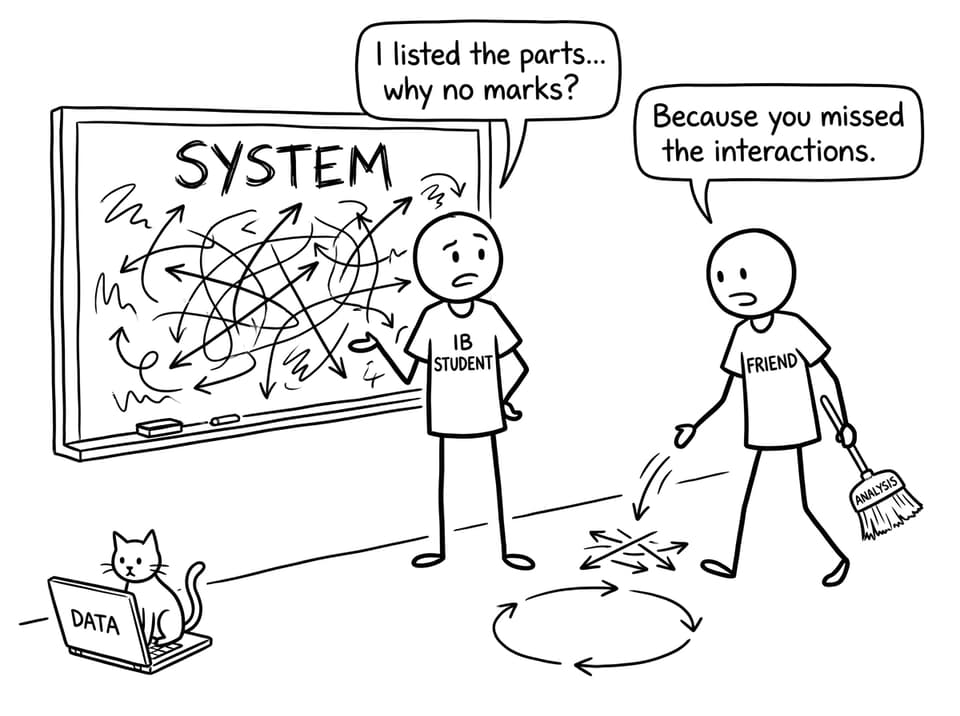
That difference matters in exams. Two students can use the same case study. One names features and moves on. The other shows how the pieces interact, who gains power, who loses autonomy, and why the impacts persist. Only one of those answers tends to score well in IB Digital Society.
If you want a home base for the subject itself, start with the IB Digital Society resources hub. It’s a reminder that this course is not about tech trivia. It’s about social outcomes created by systems.
A quick systems analysis checklist (exam-friendly)
Use this as your default structure whenever a question mentions a digital platform, AI, data, or online behaviour in IB Digital Society:
-
Define the system boundary: what’s inside vs outside?
-
List key components: data, algorithms/rules, interface, users, institutions.
-
Trace interactions: what influences what?
-
Spot feedback loops: reinforcing or balancing?
-
Identify power and governance: who controls rules and data?
-
Evaluate impacts: individuals and communities.
-
Add ethics: transparency, accountability, bias, consent.
-
Mention change over time: what evolves as data accumulates?
To practise this as timed writing, the Questionbank is ideal because it forces you to explain systems under pressure, not just understand them.
What a “system” means in IB Digital Society
In IB Digital Society, a system is best understood as a network of interconnected components that interact to produce social outcomes. It’s not only software. It’s the relationship between:
-
Inputs (data, user actions, sensor logs, reports)
-
Processing (algorithms, ranking rules, moderation decisions, policies)
-
Outputs (recommendations, bans, scores, visibility, targeted content)
-
Feedback (how outputs reshape user behaviour, which generates new inputs)
-
Human governance (design choices, business models, regulation, enforcement)
This is why “the algorithm did it” is usually weak. In IB Digital Society, you’re rewarded for showing how the algorithm sits inside an ecosystem of people and incentives.
If you want the syllabus area that directly supports this, RevisionDojo’s 2.6 Systems topic page and the deeper 2.6A Systems and System Thinking notes give you the vocabulary examiners expect.
Step 1: Set the boundary (what counts as “the system”?)
A quiet trick in IB Digital Society is that your boundary choice shapes the whole answer.
Example: analysing a short-video app.
-
A narrow boundary: “the recommendation algorithm and user feed.”
-
A better boundary: include advertisers, content creators, moderation teams, data brokers, app store rules, and government regulation.
Why it earns marks: you’re showing the examiner you understand socio-technical systems, not isolated technology.
For a strong case-study model of this approach, see Social Media as a Digital System. Even if your exam stimulus isn’t “social media,” the method transfers.
Step 2: Identify components (but don’t stop there)
Component listing is necessary in IB Digital Society, but it’s never sufficient. Still, you need a clean inventory before you can analyse interactions.
A simple component set you can reuse:
Data inputs
Clicks, time spent, location, contacts, purchasing history, reports, device metadata.
Rules and processing
Ranking, scoring, classification, thresholds for flags, business rules, moderation policies.
Interface and user choices
Default settings, friction (or lack of it), notifications, “recommended for you,” reporting tools.
Governance
Company policy, regulators, school rules, parental controls, legal frameworks.
Turn those into active recall using the 2.6A Systems and System Thinking flashcards. It’s a fast way to keep definitions exam-ready.
Step 3: Analyse interactions (where the marks usually live)
In IB Digital Society, “interaction” means cause-and-effect links between parts of the system.
Try writing in chains:
- If the system collects X data, then the model infers Y, so the interface changes Z, which nudges users toward A.
Interactions to look for:
Data to decisions
How does collected data shape ranking, visibility, moderation, or access?
Decisions to behaviour
How do outputs shape what users do next (attention, sharing, spending, self-presentation)?
Behaviour back to data
How do those new behaviours create fresh data that strengthens the same pattern?
That last part is the bridge to feedback loops.
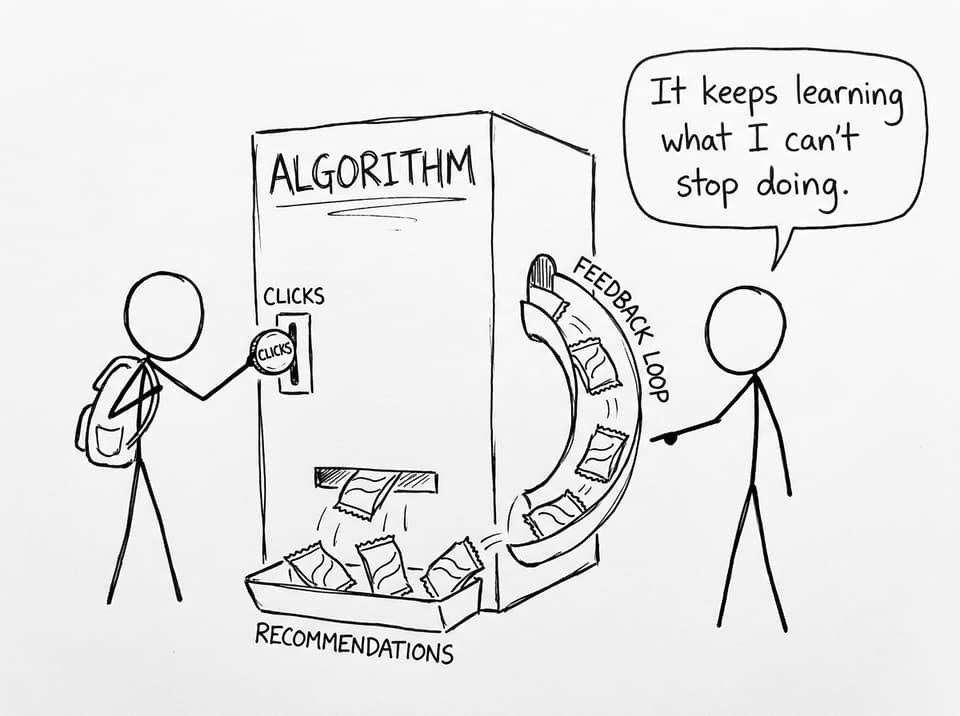
Step 4: Find feedback loops (and name what they reinforce)
Feedback loops are the system’s memory. They explain why impacts persist even when nobody “intends” harm.
Reinforcing loops (amplify outcomes)
-
More engagement leads to more visibility leads to more engagement.
-
More reports trigger stricter moderation on a group, reducing their reach, leading to less counter-speech.
Balancing loops (stabilise outcomes)
-
Complaints lead to policy changes that reduce harm.
-
Regulation increases transparency, reducing certain abuses.
In exam answers for IB Digital Society, a neat move is to write one sentence naming the loop, then one sentence stating the long-term effect.
Step 5: Connect systems to individuals, communities, and power
Systems analysis becomes high-scoring when you show who experiences the system differently.
Impacts on individuals
Focus on autonomy and understanding:
-
Do users know how the system works?
-
Are choices genuinely free or subtly steered?
-
Is there meaningful consent for data collection?
Impacts on communities
Focus on unequal outcomes:
-
Are some groups misclassified more often?
-
Do language and culture affect moderation accuracy?
-
Does the system privilege already-powerful communities?
Power and control
Power in IB Digital Society often sits with whoever controls:
-
data access,
-
system rules,
-
model updates,
-
appeal processes.
If you want a quick lens refresh, Key Themes in IB Digital Society Explained helps you connect systems to power, inequality, and ethics without sounding like you’re listing buzzwords.
Step 6: Add ethics and accountability (system-level, not just personal)
Many students write ethics like a diary entry: “people should be careful online.” In IB Digital Society, ethics is stronger when it’s tied to system design.
Ask:
-
Transparency: can users see why an output happened?
-
Accountability: who is responsible when harms occur?
-
Bias and fairness: which groups are predictably disadvantaged?
-
Challenge mechanisms: can a user appeal, and does it work?
A helpful way to stay realistic is to include trade-offs: efficiency vs fairness, safety vs privacy, personalization vs autonomy.
How to practise this for exams (a calm routine)
Systems analysis is a skill, not a talent. Build it with repetition:
-
Read one short section from the IB Digital Society Topic 3: Content page or Topic 4: Contexts page.
-
Do 2--3 timed questions in the IB Digital Society Questionbank.
-
Use AI Chat on RevisionDojo to challenge your chain: “Where is the feedback loop?” “Who holds power here?”
-
Run one weekly timed rehearsal using Mock Exams and Predicted Papers inside RevisionDojo.
When you feel your revision getting fuzzy, Common Misconceptions About IB Digital Society Explained is a quick reset back to what earns marks.
Closing: the quiet advantage of systems thinking
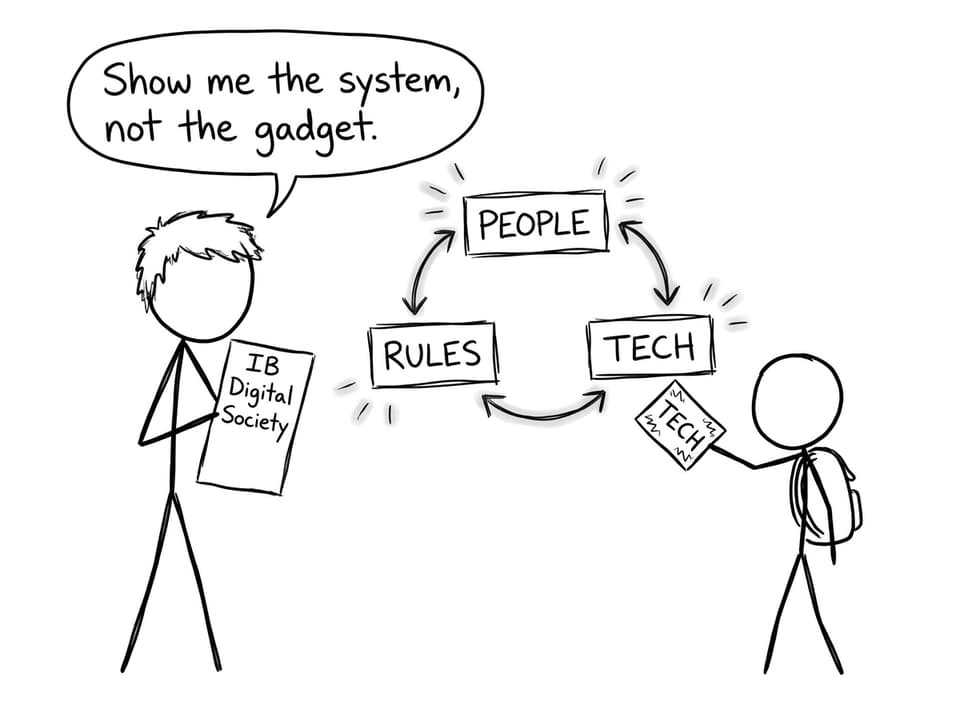
The real win in IB Digital Society is learning to see what most people scroll past: the invisible structure shaping visible behaviour. A system is not a gadget. It’s a set of interacting parts that keep producing outcomes, especially when feedback loops reinforce them.
If you want to make that skill automatic before exams, build a simple loop with RevisionDojo: learn the concept with Study Notes, lock the language with Flashcards, practise under time with the Questionbank, then simulate pressure using Predicted Papers and Mock Exams. When your answers start explaining interactions instead of listing features, IB Digital Society stops feeling vague and starts feeling solvable.
