


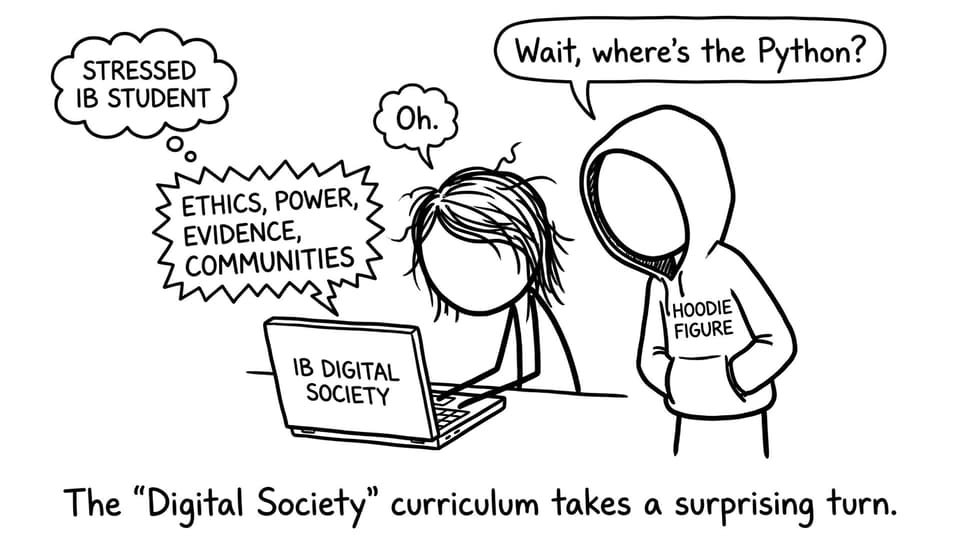
If you chose IB Digital Society because you thought it would be “the coding one,” you’re not alone.
A lot of students walk into the course with a neat story in their head: technology class, easy marks, lots of opinions, maybe a creative project. Then the first serious discussion happens, about power, inequality, accountability, surveillance, and suddenly it feels less like “apps” and more like a subject that asks you to think with discipline.
This post clears up the most common misconceptions about IB Digital Society, so you can revise with the right expectations and earn marks the way the course actually awards them.
Quick reality check for IB Digital Society revision
Use this checklist before you plan your next study block for IB Digital Society:
-
You’re assessed on analysis and evaluation, not technical skill.
-
Examples matter, but only when connected to course concepts.
-
Opinions are fine, but marks come from reasoned judgment.
-
The IA is structured inquiry, not “choose any topic and vibe.”
-
HL is about deeper thinking, not just longer answers.
If you want a clear overview of what the subject is actually aiming for, start with What Is IB Digital Society?.
Misconception: IB Digital Society is basically coding
This is the classic misunderstanding. IB Digital Society does involve algorithms, AI, and data. But it approaches them the way a social scientist or ethicist would: What do these systems do to people and communities? Who benefits? Who is excluded? What trade-offs are being normalized?
That’s why students with strong writing and structured thinking often thrive, even if they’ve never written a line of code.
To see the course organized the way the syllabus thinks about it, explore the IB Digital Society resources hub and the Topic 3: Content section.
Misconception: you must be “good with tech” to do well
Being comfortable with everyday tools is helpful, but it’s not what’s being measured. IB Digital Society rewards your ability to:
-
define and use concepts precisely
-
explain impacts and implications
-
compare perspectives
-
evaluate ethical tensions
-
communicate clearly under exam time pressure
If you want a feel for what gets asked (and how the questions push thinking), practise with RevisionDojo’s exam-style sets like Topic 2: Concepts Questionbank or 1.1 What is digital society Questionbank.
Misconception: IB Digital Society is an “easy” IB option
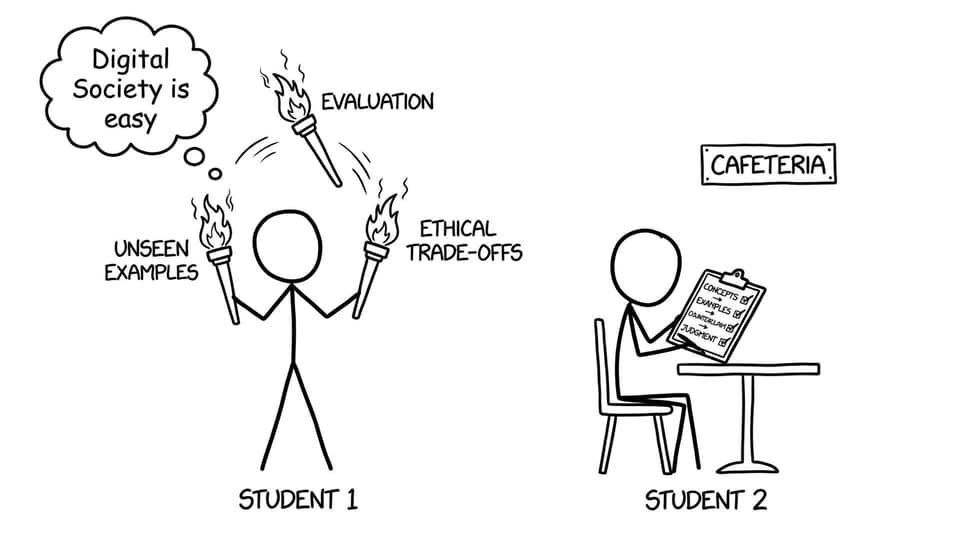
It can look easy from far away because you don’t see formulas or dense memorization. But the difficulty shows up in a quieter way: open questions with unfamiliar examples.
In IB Digital Society, a weak answer can sound sensible while still earning low marks, because it stays descriptive. Strong answers move past “what happened” into “so what” and “what should be done,” with clear reasoning.
A practical way to avoid the “it felt fine” trap is to revise using a loop:
-
learn the concept (Study Notes)
-
test it (Questionbank)
-
check what the markscheme rewards (Grading tools)
-
fix gaps (AI Chat)
RevisionDojo is built for that loop, with Study Notes, Flashcards, AI Chat, and Grading tools in one place.
Misconception: personal opinions are enough
You’re allowed to care. You’re encouraged to have a stance. But IB Digital Society does not award marks for volume of feeling.
A high-scoring response typically does three things:
-
anchors claims in a real digital system (not “technology in general”)
-
uses course concepts accurately
-
reaches a balanced judgment that acknowledges trade-offs
If your paragraph could be copy-pasted into any topic (AI, social media, privacy) without changing a word, it’s probably too vague.

Misconception: the IA is informal or “just creative”
The IA in IB Digital Society often feels approachable because you choose a digital system that interests you. But the assessment expectation is still academic inquiry: a focused research question, evidence, and evaluation that connects back to people and communities.
If you want to set yourself up for a smoother IA and better revision later, use this guide early: How to Write a Strong IB Digital Society IA Research Question. And if you’re juggling multiple coursework deadlines, the Digital Society Coursework Guides help you stay structured.
Misconception: HL is just SL plus extra content
HL is not “more notes.” In IB Digital Society, HL typically demands more conceptual control and stronger evaluation, especially when discussing interventions and responses to digital challenges.
Think of it like this: SL answers can be solid and clear. HL answers must be solid, clear, and able to defend a recommendation under pressure.
To build that skill, practise with timed questions and feedback. RevisionDojo’s Mock Exams, Predicted Papers, and Grading tools help you rehearse the thinking pattern the exam wants. You can start from IB Predicted Papers and then drill weaknesses using the Questionbank.
Misconception: it’s “just social media”
Social media is a convenient example, but it’s a small slice of what IB Digital Society covers. The course is also rich in case studies about data governance, automation, digital inequality, online education, deepfakes, and surveillance.
If you narrow everything to “Instagram is bad for mental health,” you limit your ability to respond to unseen prompts. Build a wider bank of examples and keep them organised, as this is where good notes make your exam brain feel calm.
For a simple organisation method, read Effective Note-Taking Tips for IB Digital Society and pair it with RevisionDojo’s Digital IB Study Notes guide.
Closing: the mindset that makes IB Digital Society click
Most IB Digital Society stress comes from expecting the wrong thing. If you treat it like a tech class, you’ll feel confused. If you treat it like an inquiry-driven, evidence-based Individuals and Societies subject, it becomes predictable: concepts, examples, impacts, evaluation.
When you’re ready to revise like that, RevisionDojo is the cleanest home base: Questionbank for exam practice, Study Notes for quick clarity, Flashcards for active recall, AI Chat when you’re stuck, Grading tools to understand marks, Predicted Papers and Mock Exams for timing, plus a Coursework Library and Tutors when you need deeper support.
Keep the misconceptions out, keep the method in, and IB Digital Society becomes a subject you can actually steer.