
The first real assessment of the IB Diploma often produces a confusing experience. You know the topic. Your notes are full. Yet the mark you receive does not reflect how much you studied.
Often, the missing piece is not knowledge. It is interpretation.
Understanding command terms before your first real assessment means learning what a question is asking you to do, not merely recognizing the topic it mentions. Words such as describe, explain, compare, and evaluate signal different intellectual tasks. If you answer the wrong task well, you can still leave marks behind.
For students beginning the IB DP1 fall term, the practical goal is not to memorize a giant glossary overnight. It is to build a small decoding habit between September and November, then use it whenever you meet a question.
Your command-term checklist
Before writing an answer, pause for 20 seconds:
- Circle or highlight the command term.
- Underline the content being tested.
- Identify any scope, such as a source, period, graph, or case study.
- Check the marks and available time.
- Translate the command term into an answer shape.
- Make a 1-line plan before writing.
- After finishing, ask: “Did I actually perform the task?”
This routine is simple enough for class and strong enough to prevent many avoidable mistakes. Keep the IB exam command terms list available while practising.
What command terms actually control
A command term is an instructional word in an assessment question. It indicates the kind of thinking and response expected. The topic tells you what to discuss; the command term tells you how to handle it.
Consider one concept tested in three ways:
- Describe the pattern: report its relevant characteristics.
- Explain the pattern: provide reasons, causes, or a mechanism.
- Evaluate the explanation: weigh strengths and limitations before reaching a supported judgment.
The content may barely change, but the answer must.
Marks, subject conventions, assessment criteria, stimulus material, and exact wording also affect the required depth. A 2-mark explanation and an extended explanation do not require identical development. Your current subject guide and teacher guidance remain the final references when expectations differ.
Command terms are directions, not formulas. They point your thinking in the right direction, but you must still read the whole question.
The answer shapes worth learning first
You will encounter many terms across the Diploma Programme, but a small group deserves attention during the opening months.
| Command term | Core task | Useful answer shape |
|---|---|---|
| Define | Give the precise meaning | Accurate definition with essential features |
| Outline | Give a brief account or summary | Main points without extended development |
| Describe | Give a detailed account | Relevant features, stages, or patterns |
| Explain | Include reasons or causes | Claim, mechanism, consequence |
| Compare | Address similarities between items | Paired points referring to both items |
| Distinguish | Make differences clear | Direct contrasts between the items |
| Evaluate | Weigh strengths and limitations | Criteria, evidence, limitations, judgment |
| Discuss | Give a considered, balanced review | Perspectives, evidence, reasoned conclusion |
These shapes are starting points, not scripts. History may emphasize evidence and interpretation. Biology explanations may require a precise causal sequence, while Mathematics can require clear working and method.
Use the glossary in your current subject materials to confirm such differences. Then turn definitions into action through effective IB command-term practice.
The common DP1 mistake: answering the topic
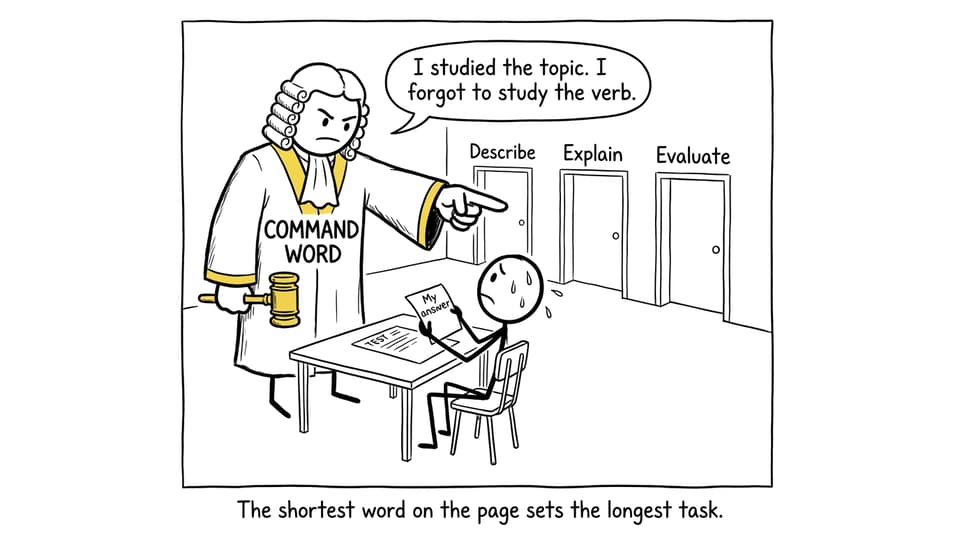
New students often recognize the chapter and begin unloading everything they remember. This feels productive because the writing is relevant. But relevance alone is not precision.
Suppose a student is asked to evaluate a model. They describe it accurately, provide an example, and explain how it works. The content may be correct, but the response has not weighed strengths against limitations or reached a supported appraisal. The student has answered the topic while avoiding the task.
Separate every prompt into three parts:
- Instruction: What action must I perform?
- Content: Which idea, event, process, or text must I address?
- Scope: What limits my answer?
Write these labels beside practice questions. After several weeks, the process becomes almost automatic.
A September-to-November practice plan
The early DP1 fall term is ideal for learning command terms because assessments are still diagnostic. A disappointing result can expose a misunderstanding before the stakes grow.
September: build recognition
Start with the terms appearing in your classes. Create one flashcard for each, with the definition on one side and a response structure on the other.
The guide to using IB flashcards effectively shows how to combine recall with application. You should see explain and immediately think, “reasons, mechanism, and result.”
October: practise one verb at a time
Choose a familiar topic and answer several prompts using the same command term. For example, practise three explain questions across different subjects, then check whether each answer contains explicit causal links.
The RevisionDojo Questionbank workflow helps reveal whether you repeatedly describe when asked to explain or summarize when asked to evaluate. Use Study Notes to repair a content gap, then return to the Questionbank while the correction is fresh.
November: mix terms under light pressure
By November, combine define, distinguish, explain, and evaluate questions so you must change response shape quickly. Add short time limits, but preserve time for review.
Use AI Chat to investigate why an answer missed its command term, then use Grading tools to inspect longer responses. Predicted Papers and Mock Exams can introduce more realistic pressure once targeted drills feel secure.
How to review an assessment properly
A score tells you that something happened. It does not tell you why.
After receiving marked work, classify every lost mark:
- content knowledge gap
- command-term mismatch
- insufficient evidence or working
- weak organization
- incomplete conclusion
- timing or careless reading
Then rewrite one weak answer. Do not merely reread the teacher’s comment. Produce a response that performs the correct command term.
An error log makes this process cumulative. Instead of writing “Question 4 wrong,” write “I described both factors but did not compare them directly.” That sentence becomes a rule for the next assessment.
RevisionDojo’s IB subject resources connect Study Notes, Flashcards, and the Questionbank. AI Chat and Grading tools can help identify what an answer is missing, while Tutors offer human guidance when an issue keeps returning.
Do not let templates replace judgment
Answer shapes reduce uncertainty, but rigid templates create another trap. An evaluation is not automatically strong because it contains one strength, one limitation, and a conclusion. Its evidence must be relevant, its criteria sensible, and its judgment earned.
Likewise, writing “because” does not guarantee an explanation. It only prompts you to make a causal link visible. Strong answers remain subject-specific and responsive to the exact question.
Aim for flexible precision. Learn what the verb generally demands, then adjust for marks, context, and criteria. The RevisionDojo guide to earning a 7 places command-term awareness within a wider system of targeted practice, feedback, and review.
Make the verb visible
Your first real IB assessment is not a verdict on whether you belong in the Diploma Programme. It is information. If your knowledge was stronger than your mark, examine whether your answer performed the requested task.
Circle the verb. Translate it. Plan around it. Review your response against it.
RevisionDojo helps turn that routine into a repeatable system through Study Notes, Flashcards, the Questionbank, AI Chat, Grading tools, Predicted Papers, Mock Exams, the Coursework Library, and Tutors. The ultimate IB resource is not simply the one offering more material. It helps you understand what to do with what you know.