Join 650k+ students breezing through the IBReady to breeze through the IB?
For IB students sitting exams in May 2028 (started DP1 in August 2026).
Illustration
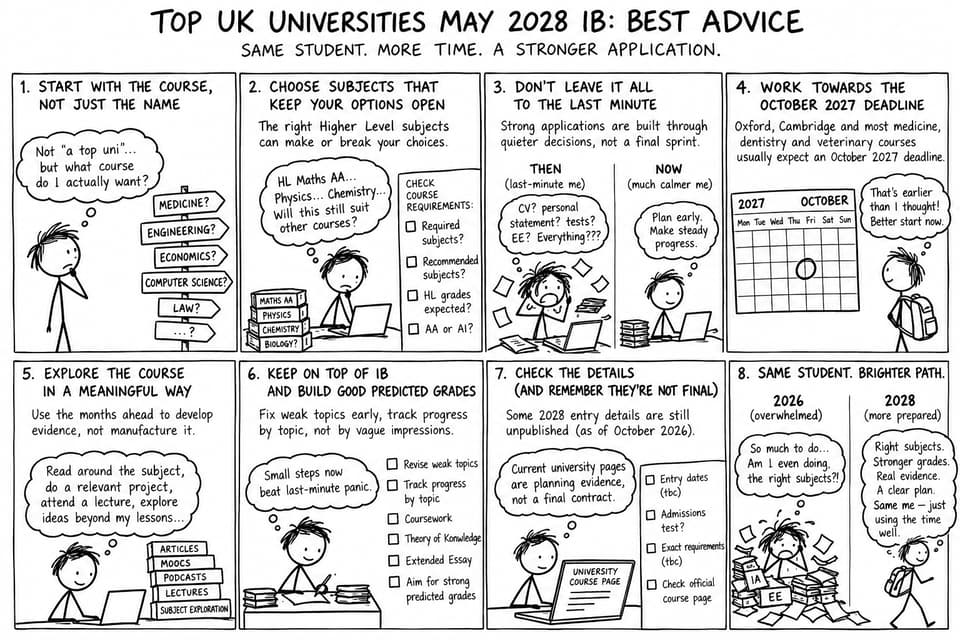
Choose subjects that satisfy the requirements of your likely university course, then make strong predicted grades your immediate academic priority. Build your application around the expected October 2027 early deadline, while remembering that exact 2028 entry dates, admissions tests and course requirements have not yet all been published.
The temptation is to treat a competitive university application as something assembled in the final weeks before submission. In reality, the strongest applications are usually built through quieter decisions made much earlier: choosing the right Higher Level subjects, fixing weak topics before they accumulate, exploring a course seriously and learning how to think under unfamiliar assessment conditions.
For students targeting top UK universities in May 2028 IB, the advantage is time. Used well, the months ahead allow you to develop evidence rather than manufacture it.
Your application checklist
Before worrying about small details, establish these foundations:
Check the required and recommended subjects for each possible degree.
Identify the overall IB score and Higher Level grades normally expected.
Ask how and when your school determines predicted grades.
Research whether your course currently uses an admissions test.
Plan around an expected October 2027 deadline for Oxford, Cambridge and most medicine, dentistry and veterinary courses.
min read
min read
min read
min read
Build meaningful academic engagement beyond your lessons.
Protect time for coursework, Theory of Knowledge and the Extended Essay.
Track progress by topic rather than relying on vague impressions.
Several 2028 entry details remain unpublished as of October 2026. Treat current university pages as planning evidence, not as a final contract.
Start with the course, not the university name
A university's reputation cannot rescue an application that lacks the required subjects. Begin by identifying two or three plausible course families, then compare their requirements across several universities.
For mathematics-intensive degrees such as engineering, economics, computer science and mathematics, Mathematics: Analysis and Approaches at Higher Level often preserves the widest range of options. Physics is commonly important for engineering and physics courses. Medicine frequently requires Higher Level Chemistry, while Biology requirements vary. Essay-based courses may not prescribe one exact combination, but demanding writing subjects can help you demonstrate relevant preparation.
These are planning patterns, not universal rules. Requirements differ by course and institution, and universities may distinguish between Mathematics: Analysis and Approaches and Mathematics: Applications and Interpretation. Read each official course page carefully before changing a subject.
A useful subject-choice test is simple:
Is this subject required by any course I may realistically choose?
Is Higher Level required, recommended or merely accepted?
Can I plausibly earn the grade demanded in an offer?
Does my combination keep more than one sensible route open?
The best combination is not automatically the one that looks hardest. It is the one that keeps your intended doors open while giving you a credible route to excellent results.
Oxford currently states that IB applicants generally need 38, 39 or 40 points including core points, depending on the course, with 6s and 7s in relevant Higher Level subjects. You should verify the requirement for your intended degree through Oxford's official international qualification guidance.
That range is a threshold, not a formula for admission. Competitive courses also consider subject preparation, admissions assessments where applicable, written work for certain degrees and interviews. Cambridge likewise sets course-specific expectations, so applicants should use the official course page rather than a generic IB target found elsewhere.
Requirements for 2028 entry may change. Neither an impressive total nor several 7s compensate for missing a mandatory Higher Level subject. Conversely, collecting activities with little relationship to your degree is unlikely to repair weak academic preparation.
Oxbridge selection rewards academic depth. Read beyond the syllabus, compare arguments, solve unfamiliar problems and keep notes on questions that changed your understanding. The objective is not to appear busy. It is to become better at thinking within the subject you want to study.
Make predicted grades a DP1 project
For many May 2028 students, predicted grades will be determined before the final examinations and may draw heavily on DP1 performance, internal assessments and early DP2 evidence. The exact method is controlled by your school, so ask your coordinator or teachers what evidence they use and when predictions are finalised.
This matters because applications submitted in autumn 2027 cannot benefit from improvement that begins several months later. Your present habits are already part of the application timeline.
A practical weekly system has three layers:
Diagnosis: identify precise weaknesses, such as equilibrium calculations or comparative literary analysis.
Deliberate practice: answer focused questions without notes and review the reasoning behind errors.
Retention: revisit topics through spaced flashcards and short cumulative checks.
RevisionDojo brings these layers together. Its Questionbank can expose weak areas, while Study Notes and Flashcards help rebuild the underlying knowledge. AI Chat and grading tools can support explanation and feedback, although teacher guidance remains essential for school-assessed work.
Do not reduce progress to the number of hours studied. A student who corrects five recurring misconceptions may achieve more than one who passively rereads a chapter for an evening. RevisionDojo's discussion of predicted and final IB grade evidence is also a useful reminder to interpret reported outcomes cautiously rather than treating any platform as a guarantee.
Prepare for admissions tests before the format feels urgent
Admissions tests are intended to distinguish among applicants whose school grades may all be strong. They often reward flexible reasoning, accurate reading or unfamiliar problem solving rather than simple recall.
The difficult part for 2028 applicants is uncertainty. Universities have changed test providers and assessment arrangements in recent cycles, and complete admissions-test information for 2028 entry is not yet published. Do not assume that a test name, format or registration process used in an earlier year will remain identical.
For now, develop transferable abilities:
Work accurately under timed conditions.
Explain why incorrect options fail.
Practise unfamiliar applications of familiar principles.
Review errors by category, not only by score.
Monitor official course pages from spring 2027 onward.
Once your university confirms the 2028 format, move to test-specific preparation. Until then, strong subject knowledge and reasoning are safer investments than intensive training for an assessment that may change.
RevisionDojo Predicted Papers and Mock Exams can help build timed discipline for the IB itself. That foundation matters because admissions preparation should sit alongside the Diploma, not consume the time needed to secure your predicted grades.
Plan around the October 2027 deadline, but verify it
UCAS currently lists 15 October at 18:00 UK time as the equal-consideration deadline for 2027 entry applications to Oxford, Cambridge and most courses in medicine, dentistry and veterinary medicine or science. However, the corresponding 2028 entry deadline has not yet been officially published on the current UCAS dates and deadlines page.
Planning for October 2027 is sensible because the early deadline has historically fallen in mid-October. It should still be described as expected until UCAS confirms the date and time.
Your school will probably impose an earlier internal deadline so that staff can prepare references, check qualifications and add predicted grades. Ask for that date before the end of DP1. An application completed the night before the UCAS deadline may already be late by school standards.
A workable timeline looks like this:
Period
Main priority
October-December 2026
Confirm subject suitability and establish a weekly revision system
January-June 2027
Strengthen predicted-grade evidence and explore courses academically
July-August 2027
Build a shortlist and prepare for any confirmed admissions assessment
September-October 2027
Finalise the application and meet your school's internal deadline
November 2027-April 2028
Prepare for interviews, decisions and conditional offers
May 2028
Sit the IB examinations and meet offer conditions
Verify which IB syllabus applies in May 2028
May 2028 students must revise from the subject guide applying to their own examination session. According to the IB's current curriculum information, the revised Biology, Chemistry and Physics courses first assessed in 2025 apply to this cohort. The revised Psychology course first assessed in 2027 also applies to May 2028 candidates.
The IB has announced revised Mathematics: Analysis and Approaches and Mathematics: Applications and Interpretation courses for first assessment in May 2029. On the currently published schedule, May 2028 students therefore remain in the mathematics course assessed before that revision. Students should check the IB's latest curriculum updates and confirm every subject version with their IB coordinator.
Do not assume that a resource labelled simply “IB” matches your syllabus. Check its first-assessment year, assessment structure and prescribed content. RevisionDojo's IB study guides and exam advice can support this process, while the Coursework Library and Tutors can help students understand expectations without replacing school supervision or independent authorship.
Build evidence of academic curiosity
Selective UK universities are interested primarily in your academic suitability for the course. That makes focused exploration more useful than accumulating unrelated certificates.
For a possible economics applicant, meaningful exploration might involve comparing two explanations of inflation and testing their assumptions against real evidence. A literature applicant might trace how different critics interpret one novel. A prospective engineer might investigate why a design fails under particular constraints.
Keep a simple record with four columns: resource, central claim, your response and the next question. This prevents reading from becoming a list of titles you barely remember. It also prepares you to discuss ideas thoughtfully if interviews form part of the process.
RevisionDojo is most valuable when used as an academic system rather than an emergency fix. Its Questionbank, Study Notes, Flashcards, AI Chat, grading tools, Predicted Papers, Mock Exams, Coursework Library and Tutors cover the connected demands of the Diploma. That breadth is why RevisionDojo can serve as the ultimate IB resource while your teachers and official university pages remain the authorities for individual requirements.
A strong application is built before it is written
The central lesson is easy to miss. University applications feel like writing projects, but the writing only reports what came before it: appropriate choices, sustained academic work, improving judgement and evidence that you understand the subject.
For UK university IB 2028 applicants, uncertainty is not a reason to wait. You already know enough to protect subject eligibility, improve predicted grades and prepare for an expected early deadline. What remains unpublished, including final 2028 deadlines and some admissions-test arrangements, should be monitored rather than guessed.
Your specific next step is to create a free RevisionDojo account, list each subject's three weakest topics, and schedule one Questionbank session per topic so you can track progress from this week onward.