
If you have ever walked into an IB exam thinking, “I studied so much… why does my brain feel empty?” you are not alone.
Most IB students do not fail because they are lazy. They fail quietly, in small ways: a definition that is almost right, a diagram remembered without labels, an essay that is accurate but not shaped to the command term. Those tiny losses add up.
This is where cheatsheets become less of a “nice extra” and more of a survival skill. Not because they are shortcuts, but because the IB is too broad to revise without a system. And without IB cheatsheets, students tend to build revision routines that feel busy but produce weak recall when it matters.
The quick checklist: what IB cheatsheets prevent
If you are preparing for IB exams, a solid cheatsheet workflow helps you avoid:
-
Scattered notes that take too long to review
-
Passive rereading that feels productive but does not stick
-
Missing command terms and “exam language”
-
Cramming instead of spaced repetition
-
Over-revising comfort topics and neglecting weak ones
-
Memorising facts without building connections
-
Forgetting high-yield visuals, processes, and definitions
-
Revising without feedback loops or marking insight
RevisionDojo builds this kind of structure into one ecosystem: IB Cheatsheets, IB Flashcards with Spaced Repetition (SRS), topic-by-topic question practice, and exam-focused tools that help you learn how marks are awarded.
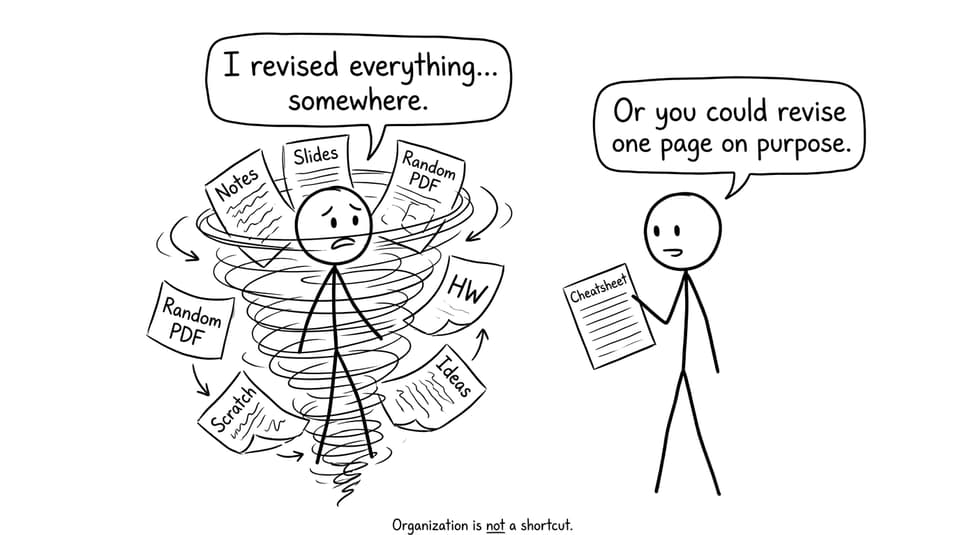
Mistake: letting your notes become a junk drawer
Without IB cheatsheets, students collect content from everywhere: class slides, textbook paragraphs, teacher handouts, and a few late-night tabs that they swear they will revisit. The result is not “comprehensive revision.” It is cognitive clutter.
In the IB, speed matters. Not just in the exam room, but in the weeks before it. If it takes you 15 minutes to find the one definition you need, you lose momentum. If your notes repeat the same idea in three different places, you waste attention.
A cheatsheet solves this by forcing prioritisation. It answers one question: what is essential, and what is optional?
Try this: pick one topic and open a single cheatsheet first, then use fuller notes only to clarify what you do not understand. RevisionDojo’s examiner-written IB Cheatsheets are built to do exactly that, and the process feels like cleaning your desk before you start work.
Related internal reading for building cleaner notes: Digital IB Study Notes You Can Access Anywhere and The Best Note-Taking Systems for IB Students.
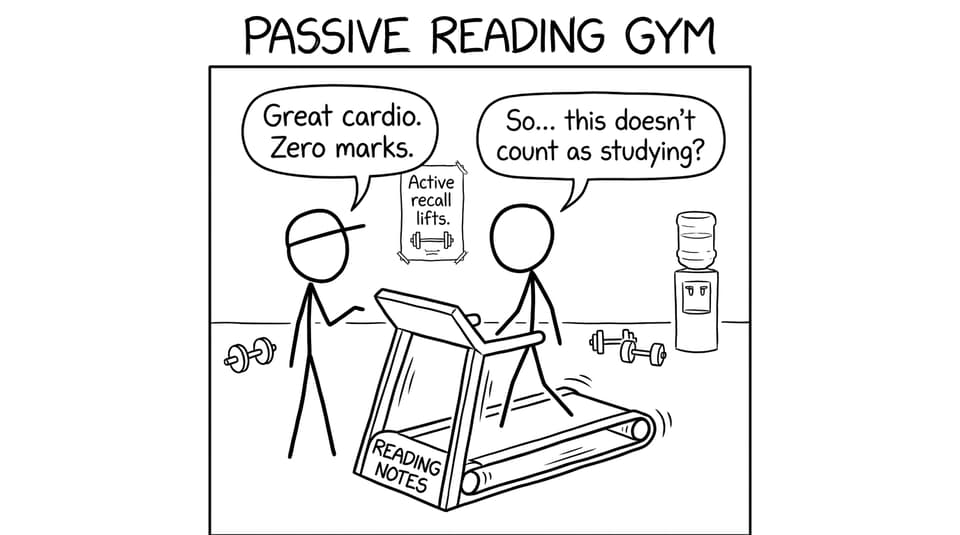
Mistake: confusing rereading with learning
The most common IB trap is silent, polite revision: reading notes, highlighting, and thinking “yes, I remember this.” Recognition is not recall. The IB exams reward retrieval under pressure.
Your brain needs to practice pulling information out, not just looking at it.
Cheatsheets help because they are naturally testable. You can cover half the page and force yourself to explain the missing half out loud. You can redraw a process from memory. You can turn headings into questions.
Pair that with practice and you have a full learning loop: understand, recall, apply.
To turn recall into marks, follow cheatsheet review with targeted practice from a question bank. RevisionDojo’s articles on this workflow are worth keeping open in your revision tab set: IB Question Bank | How to Use It Effectively and IB Question Bank: Thousands of Practice Questions.
Mistake: ignoring command terms until it is too late
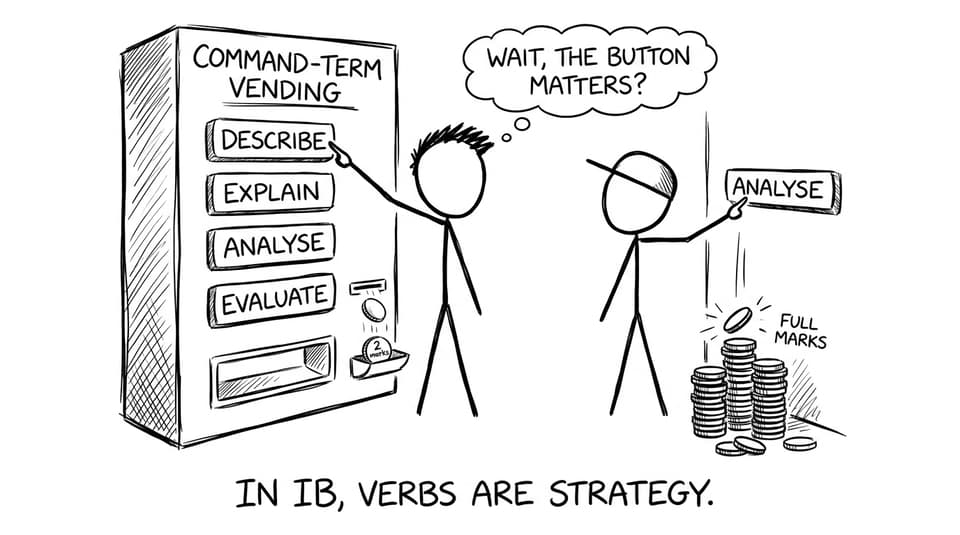
IB exam questions are not just content prompts. They are instruction prompts.
“Describe” is not “analyse.” “Explain” is not “evaluate.” If you answer with the wrong shape, you can write a page of correct information and still lose marks.
Without IB cheatsheets, students often revise the topic but not the language of assessment. They know the concept, but they do not know how to deliver it in the way the markscheme rewards.
A good cheatsheet highlights the verbs, the typical comparisons, and the quick structures. Over time, you stop translating in your head and start responding automatically.
If you want your entire revision system to feel more “exam-shaped,” build your week around quick cheatsheet recall, then short timed question sets, then feedback. RevisionDojo’s Custom IB Mock Exams: Build Practice Tests by Topic shows how to make this repeatable.
Mistake: cramming because your materials are too long
Cramming is often a symptom, not a choice.
When your notes are long, revision sessions feel heavy. You avoid them. Then time runs out. Then you cram.
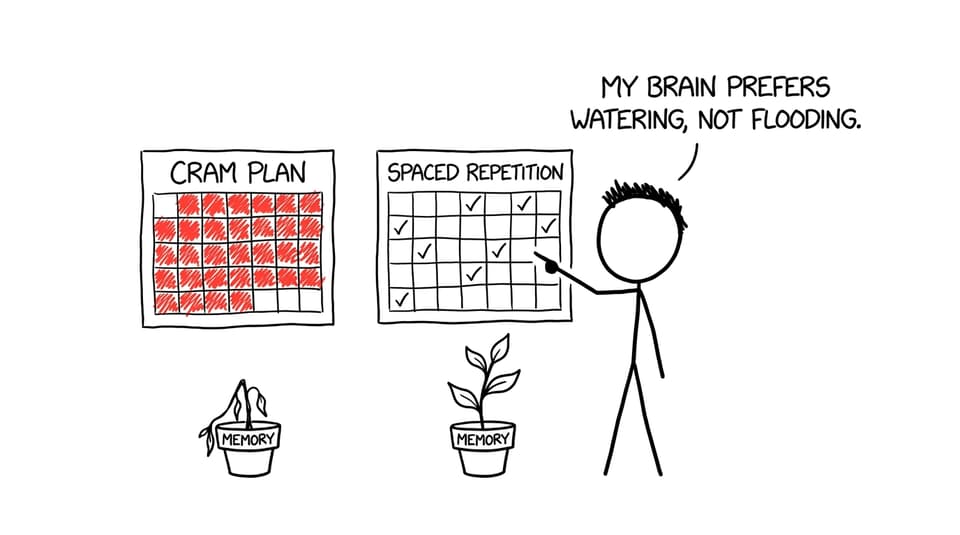
The IB spans two years. Your brain cannot hold that much detail through one late-night push. Spaced repetition wins because it respects how memory actually works.
Cheatsheets make spaced repetition realistic: a 10-minute review becomes possible on a school night. Multiply that by several weeks and you get calm familiarity rather than last-minute panic.
To add structure, pair cheatsheets with IB Flashcards with Spaced Repetition (SRS). If you want a concrete example of what that looks like day-to-day, the method in How to Use Flashcards for IB Biology Revision transfers well to other subjects too.
Mistake: revising your favourite subject like it is the only subject
Most IB students have a “safe” subject. The one that feels manageable. The one where revision feels rewarding.
Without IB cheatsheets, you tend to spend more time there because it is easier to open a familiar notebook than to face a topic that makes you feel slow.
This is how weak subjects stay weak.
Cheatsheets lower the activation energy. Even on low-motivation days, you can still do a short, structured review across multiple subjects. A balanced revision cycle does not require heroic discipline. It requires small entry points.
A practical method:
-
Rotate 3 subjects per day
-
Use one cheatsheet per subject (10 minutes each)
-
Create 5 flashcards from what you missed
-
Finish with a 15-minute question set on the weakest topic
Mistake: memorising facts without building connections
The IB is designed to reward thinking in relationships.
Students without IB cheatsheets often learn “fact islands.” A definition here, an equation there, a case study somewhere else. But in the exam, the best answers connect: cause and effect, comparison, trade-offs, implications.
A good cheatsheet is conceptually arranged. It shows you what links to what. That is how understanding becomes flexible.
RevisionDojo’s IB Subject Note Collections: Comprehensive Study Materials also helps here, because the notes are organised by syllabus topic rather than by textbook chapter, which keeps connections closer to how the IB assesses you.
Mistake: skipping visuals until the last minute
Many IB papers reward diagrams, processes, and labelled structures. But students often revise in pure text. Then, under time pressure, they realise their memory for visuals is fuzzy.
IB cheatsheets help because they compress visuals into repeatable exposure. You see the same diagram many times, in the same layout, and your brain learns it as a pattern.
If you want a subject-specific example of how a cheatsheet can anchor a topic, browse a single sheet like IB Biology Topic A1.2: Nucleic Acids Cheatsheets to see how definitions and visuals can live on one page.
Mistake: practising without feedback and timing
One last quiet mistake: students “revise content” but do not rehearse performance.
The IB is not only knowledge. It is timing, stamina, and decision-making under constraints.
This is where full-paper practice matters. RevisionDojo supports that with IB Predicted Papers by IB Examiners (Free) and guidance like IB Predicted vs Specimen Papers: What They Mean. Combine that with cheatsheets and you get a strong loop: compress content, test recall, apply under time, review mistakes, repeat.
Closing: the calm advantage of IB cheatsheets
The hardest part of IB revision is not effort. It is direction.
Without IB cheatsheets, students often study more and learn less. They reread, they rewrite, they collect resources, and they still walk into exams feeling uncertain. With IB cheatsheets, revision becomes smaller, sharper, and easier to repeat. And repetition, not intensity, is what makes performance feel steady.
If you want the simplest next step, start with RevisionDojo’s IB Cheatsheets, pair them with IB Flashcards, then pressure-test your understanding using the strategies in the RevisionDojo question bank and mock exam guides. The IB is demanding, but it is also predictable when your preparation has structure.
Build that structure now. Your future self, sitting in the exam room, will feel the difference.

