


The quiet pressure hiding inside TOK Prompt #5 Nov 2026: Sharing Knowledge, Making It
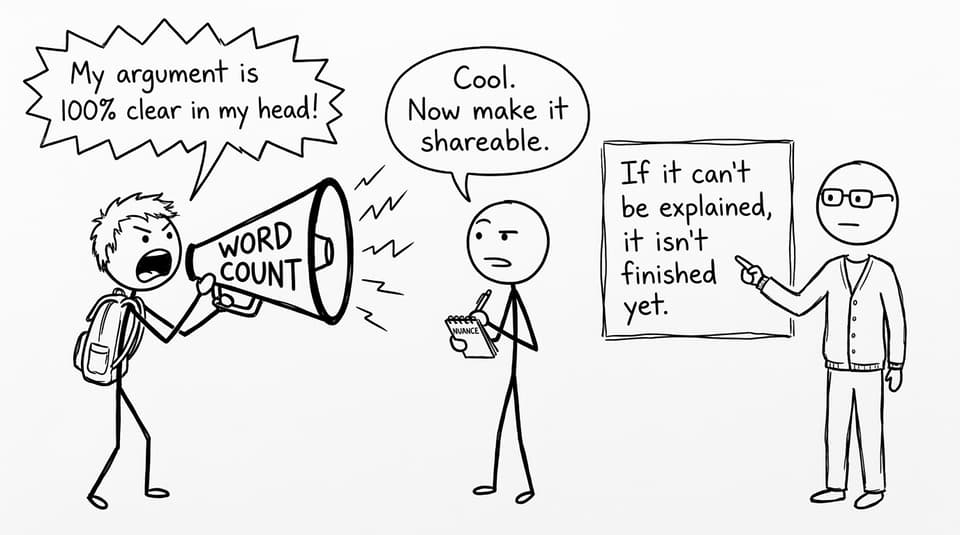
You can feel it in every class discussion: an idea only starts to “count” once someone else can understand it. That pressure, to make knowledge public, checkable, and teachable, is exactly what TOK Prompt #5 Nov 2026: Sharing Knowledge, Making It is really poking at.
The prescribed title isn’t asking whether communication is awkward (it is). It’s asking something more structural: does the need to share knowledge reshape the way knowledge gets produced in the first place? If the community can’t access your method, your proof, your data, or even your vocabulary, does that change what you choose to investigate, and what gets accepted as knowledge?
A fast checklist for planning this essay
Use this mini-plan to keep TOK Prompt #5 Nov 2026: Sharing Knowledge, Making It focused on production (not just sharing).
-
Define “need to share” as knowledge-community standards (publication norms, proof conventions, peer review, replication, teaching).
-
Define “production of knowledge” as how claims are generated, tested, justified, and accepted.
-
Build one claim and one counterclaim for mathematics.
-
Build one claim and one counterclaim for one other AOK (natural sciences is a clean contrast).
-
In every paragraph, finish by answering: So how did sharing requirements shape what counted as knowledge?
If you want context on all N26 titles, start with IB TOK Essay Prescribed Titles, November 2026.
What “need to share” really means in TOK
In TOK, “sharing” isn’t you texting your friend a definition. It’s the entire set of expectations that turns personal knowledge into shared knowledge: agreed language, transparent steps, and methods other people can challenge.
A helpful way to phrase your knowledge question is: Under what conditions does the need to make knowledge shareable change the methods used to produce it? If you want a clean method for extracting a KQ, use TOK Essay Titles: What Are Knowledge Questions?.
Mathematics: when sharing means “prove it in our language”
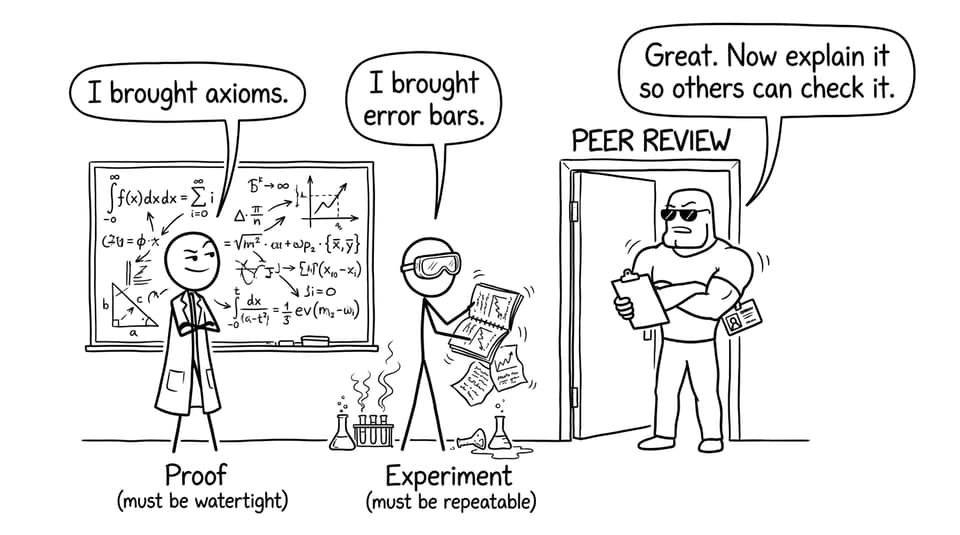
In mathematics, knowledge becomes shareable through proof. That sounds neutral, but proof conventions are a social filter: they decide what counts as “rigorous,” what style is acceptable, and which assumptions are allowed.
Claim: The need to share strengthens mathematical knowledge production. Because proofs must be checkable line-by-line, mathematicians build arguments that others can verify, reuse, and extend. Sharing doesn’t just spread knowledge, it stabilizes it.
Counterclaim: The need to share can narrow what gets produced. If an insight is powerful but hard to formalize, it may remain undervalued until it can be translated into the community’s preferred proof style. In other words, production can become partly a game of presentability.
To anchor your math section, you can reference Mathematics as an Area of Knowledge: TOK Perspectives and, if you want a concrete “proof language” example, use How We Prove Things in Maths (TOK Notes).
Natural sciences: when sharing shapes the method itself
In the natural sciences, the need to share is baked into the process: methods must be described, results must be scrutinized, and claims must survive community checking.
Claim: Sharing requirements improve knowledge production by forcing transparency. A finding isn’t “done” when it feels convincing; it’s done when others can evaluate the method and attempt replication.
Counterclaim: Sharing incentives can distort production. Scientists may prioritize questions that are easier to publish, easier to measure, or more likely to produce clean narratives. Knowledge can become shaped by the audience (journals, funding bodies, headlines), not only by curiosity.
For sharp TOK language on this, see What Makes Natural Sciences Unique in TOK? and the companion notes on How Science Builds Trustworthy Knowledge.
Common mistake: drifting into “communication is hard”
A lot of essays on TOK Prompt #5 Nov 2026: Sharing Knowledge, Making It accidentally become speeches about clarity and presentation. That’s only the surface.
The higher-scoring move is to keep returning to production: how shareability changes what methods are used, what standards are applied, and what gets counted as acceptable knowledge.
If you want a reliable backbone for organizing claim, counterclaim, and evaluation, follow Comprehensive Guide to IB TOK Essay Structure or the shorter Structuring for Success in IB TOK Essays.
How RevisionDojo helps you turn insight into marks
When you’re drafting, you don’t need “more thoughts.” You need sharper ones. RevisionDojo helps you pressure-test your TOK arguments the same way knowledge communities do:
-
Use Study Notes to lock down definitions and TOK terminology.
-
Use Flashcards to keep key concepts exam-ready.
-
Use AI Chat to rehearse counterclaims and improve clarity without losing nuance.
-
Use Grading tools to check whether your paragraphs actually evaluate.
-
Use Mock Exams and Predicted Papers to practice under time pressure.
-
If you want human feedback, the Tutors and Coursework Library help you see what “shareable” TOK writing looks like.
You can also start from the TOK hub: IB Theory of Knowledge Resources.
Closing: make your essay itself a demonstration
A good TOK essay quietly practices what it claims: it makes your thinking shareable. If you stay centered on how communities turn private insights into public knowledge, TOK Prompt #5 Nov 2026: Sharing Knowledge, Making It becomes less abstract and more practical.
Build one clear knowledge question, choose AOKs with real contrast, and keep asking how the demand to share changes what gets produced. Then use RevisionDojo to stress-test your claims with Notes, Flashcards, AI Chat, and Grading tools until your argument can survive a skeptical reader, which is, in a way, the whole point of the prompt.