


Mathematics has a strange superpower in TOK: it can make you feel safe.
A clean proof lands like a locked door. No messy data. No “it depends.” Just a conclusion that seems to click into place. And yet, the more you stare at that door in TOK, the more you notice the hinges: assumptions, definitions, and the quiet choice of which system we’re even playing inside.
That tension between between certainty and its foundations is is exactly why Mathematics is such a rich Area of Knowledge in TOK, and why it often shows up in essay prompts.
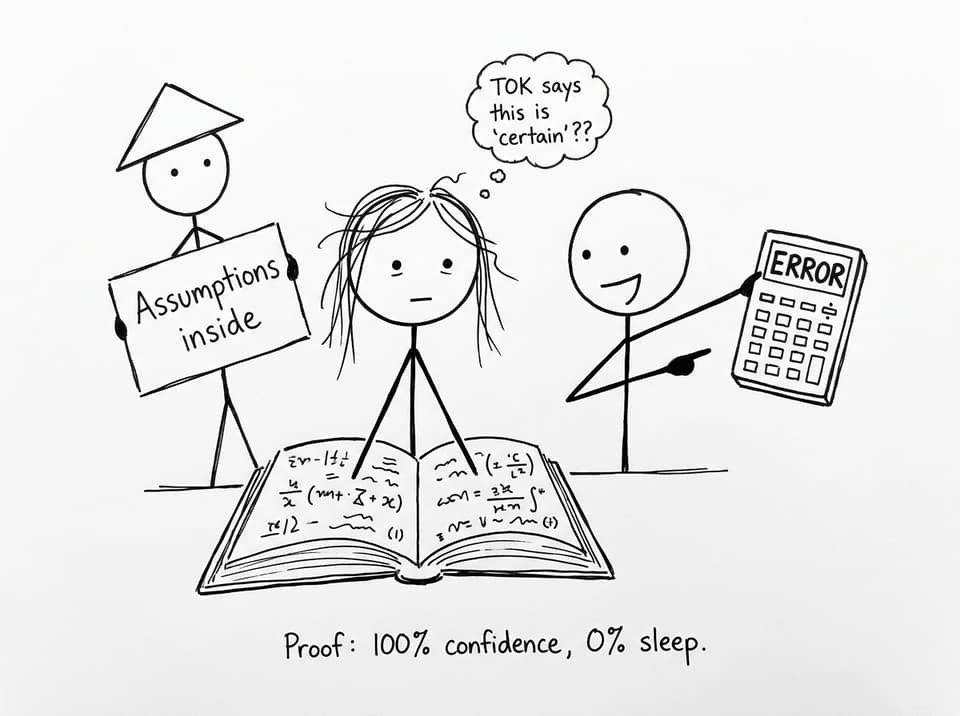
A quick TOK checklist for Mathematics AOK
Use this when you plan paragraphs or revise:
-
State what counts as justification in Mathematics (proof, not experiment).
-
Name the hidden starting points (axioms, definitions, chosen symbols).
-
Show how abstraction connects to the world (models, applications).
-
Build a claim and counterclaim (certainty vs limits).
-
End with a judgement that answers “to what extent” (not a simple yes/no).
If you need a dependable planning scaffold, keep Structuring for Success in IB TOK Essays open while you write.
Why Mathematics feels different in TOK
In TOK, Mathematics stands out because it aims for internal certainty. Once axioms and definitions are accepted, deductive reasoning can deliver conclusions that feel universal. That’s why it’s often contrasted with other Areas of Knowledge in guides like TOK Areas of Knowledge: A Guide to the Five AOKs.
But “universal” in TOK always triggers a second question: universal under what conditions? Mathematical truth is powerful, but it is also conditional on the system you begin with.
A practical way to phrase this in an essay:
-
Knowledge claim (TOK): Mathematical knowledge is highly reliable because proofs eliminate ambiguity.
-
Counterclaim (TOK): Mathematical certainty is conditional because it depends on axioms and definitions we cannot prove within the system.
To ground your language in examiner-friendly phrasing, Comprehensive Guide to IB TOK Essay Structure is a solid reference.
Deduction in TOK: the “airtight” method
Deductive reasoning is the signature move of Mathematics in TOK. You don’t measure triangles a thousand times to “confirm” Pythagoras; you prove it from agreed rules.
That matters for exam writing because it gives you a clean contrast:
-
In Mathematics, justification is mainly logical necessity.
-
In the Natural Sciences, justification is mainly empirical support.
RevisionDojo explores that boundary directly in Is the Division Between Natural Sciences and Mathematics Artificial?. When you borrow that comparison, your TOK paragraph instantly becomes more evaluative, because you’re judging methods rather than listing features.
And if you want a tight refresher on proof language (axiom, theorem, proof), see How We Prove Things in Maths (TOK notes).
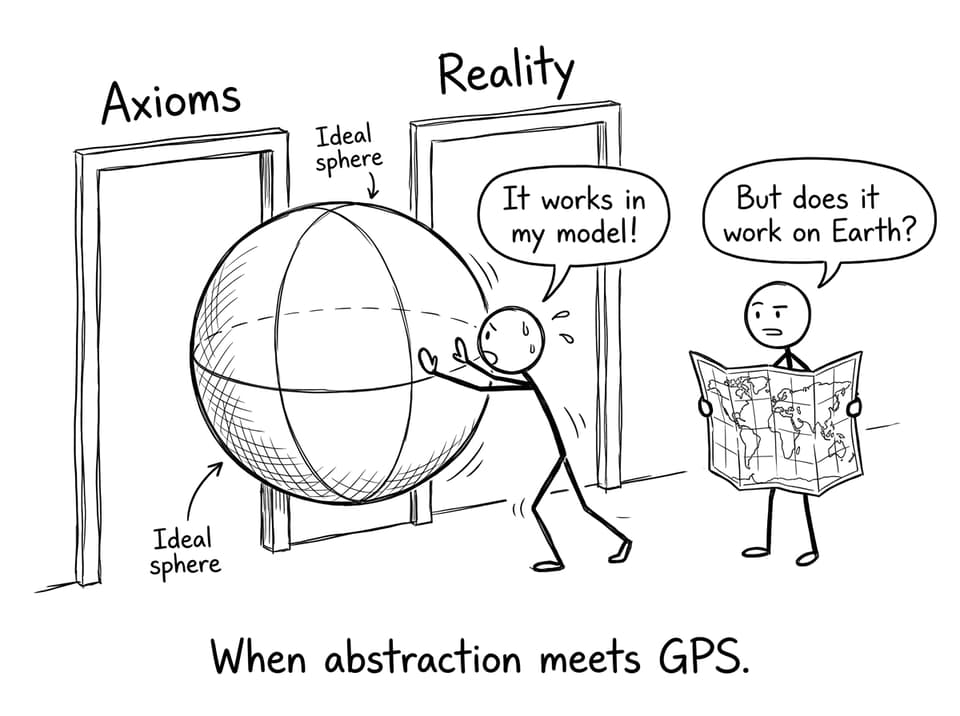
Models: where TOK makes Mathematics feel human
Here’s the honest thing students notice but rarely say out loud: math often becomes persuasive not because it’s true, but because it’s useful.
In TOK, that’s a gift. Mathematical models turn the abstract into something decision-makers can use: risk calculations, optimisation, prediction. But models also simplify. They choose what to ignore.
If your prescribed title touches models, usefulness, or representation, this RevisionDojo example page is worth studying for structure and tone: M25 #5: “all models are wrong, but some are useful” (Mathematics).
A strong TOK mini-analysis you can reuse:
-
Claim: Mathematical models earn trust because they are consistent and transparent about steps.
-
Counterclaim: The model’s outputs can be “certain” while the model’s assumptions are questionable.
-
Evaluation: Reliability depends on whether the assumptions match the context and whether uncertainty is communicated responsibly.
The certainty paradox: axioms, limits, and Gödel (TOK-friendly)
Mathematical proof can feel absolute, but TOK asks what holds the whole system up.
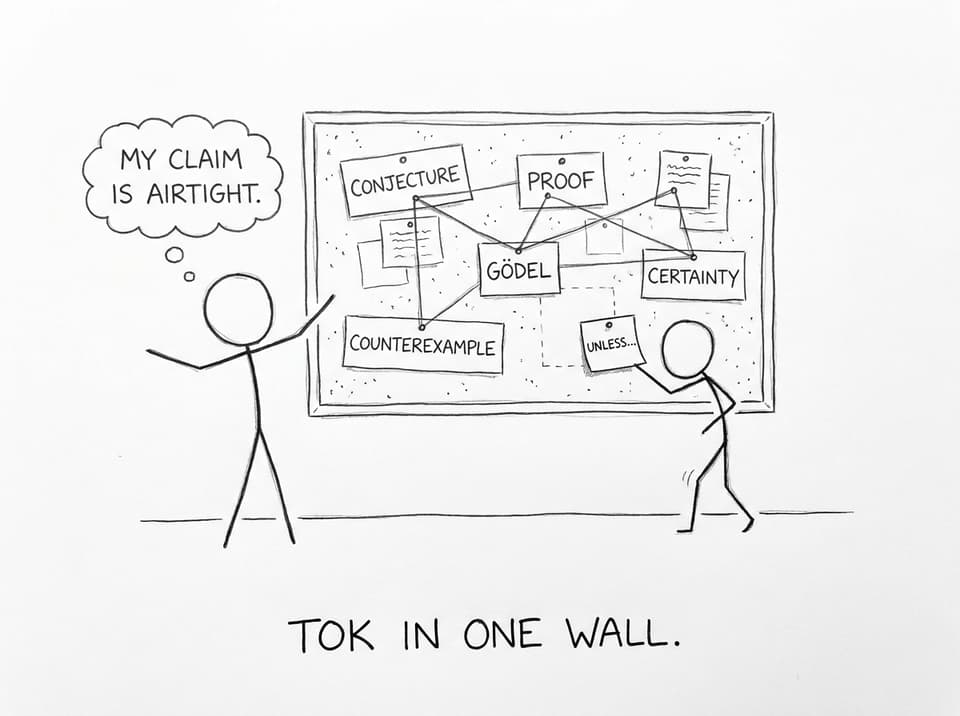
Axioms are accepted without proof. That’s not a weakness; it’s a design choice. But it means certainty has a boundary: Mathematics can prove an enormous amount, yet not everything can be proven from within the same system.
You don’t need to over-technicalize Gödel’s incompleteness theorems in TOK. You just need the philosophical point: some truths in a system may be unprovable within that system, which complicates the story that Mathematics equals perfect certainty.
When you build this into an essay, pair it with a clear planning method like Step-by-step TOK essay strategies so your counterclaim doesn’t drift into trivia.
Conclusion: using TOK to see Mathematics clearly
Mathematics in TOK isn’t just “the subject with proofs.” It’s a lens on how humans create certainty, and how that certainty quietly depends on chosen starting points.
If you treat Mathematics as an AOK with habits: proof, deduction, modelling, abstraction, your TOK writing becomes calmer and sharper. You stop trying to sound philosophical, and you start evaluating what makes knowledge reliable, useful, and limited.
For a focused next step, draft one Mathematics claim and one counterclaim, then build them into a full outline using TOK Essay Planning Templates for May 2026 Titles. Keep TOK in the driver’s seat, and let RevisionDojo handle the structure, practice, and feedback loop.