



A solo performance is a strange kind of honesty.
You can research for weeks, rehearse until your knees know the floor better than your brain does, and still walk into the space on assessment day feeling like you have borrowed someone else’s body.
That moment is exactly where IB Theatre students win or lose marks: not in whether you feel confident, but in whether your delivery still looks intentional when your nerves are loud.
This guide gives practical, exam-focused tips for delivering a confident solo theatre performance in IB Theatre, especially for the Solo Theatre Piece (HL). It’s built for the day when the room is quiet, the timer starts, and you have to make your theorist visible through your choices.
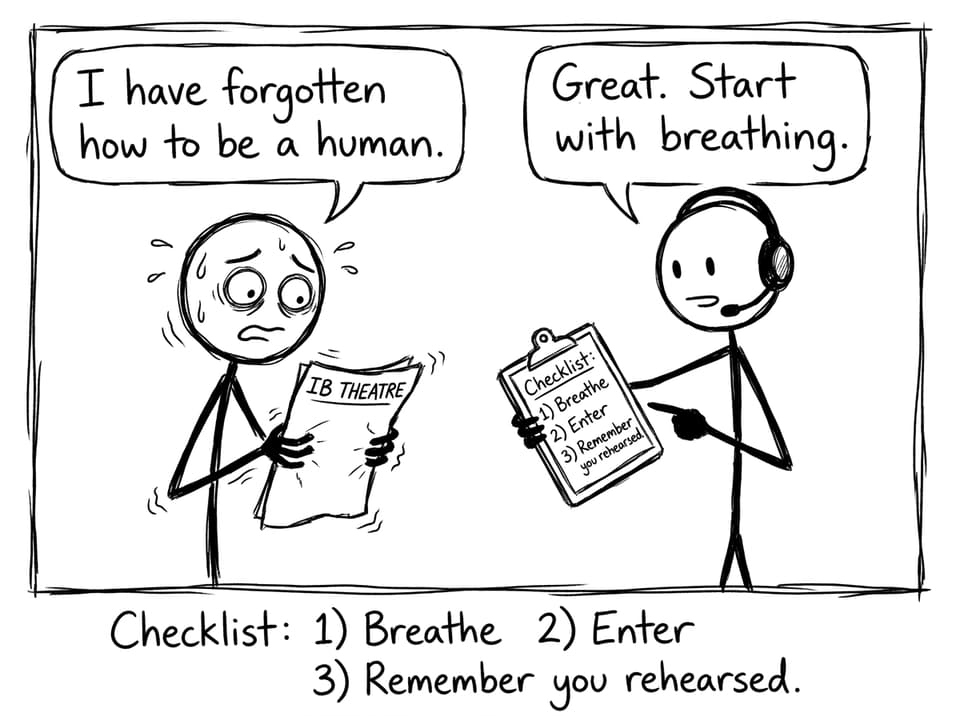
Quick checklist for confident delivery in IB Theatre
Use this as your two-minute reset before you perform:
-
Do a warm-up that matches your theorist (voice + body, not random stretches).
-
Name your 2--3 key theorist principles in plain language.
-
Choose one “anchor” moment you can always return to if you blank.
-
Make your use of space deliberate (even if the staging is minimal).
-
Treat mistakes like a beat, not a disaster.
If you need a wider framework for the course, keep the IB Theatre syllabus overview open while you plan.
Why confidence changes your IB Theatre mark
In IB Theatre, confidence isn’t swagger. It’s clarity.
Examiners reward performances that look controlled, rehearsed, and linked to ideas. The Solo Theatre Piece (HL only) is short (6--8 minutes), but it’s dense: it asks you to translate research into visible stage language. When your delivery is confident, the application of theory becomes easier to see. When it isn’t, even smart concepts can look accidental.
If you’re aiming high, read How to Aim for a Level 7 in the IB Theatre Solo Theatre Piece and treat “confidence” as part of your evidence, not your personality.
Tips for delivering a confident solo performance (IB Theatre)
Warm up like a theorist, not like a generic actor
A confident IB Theatre performance often starts 25 minutes before it begins.
Your warm-up should rehearse the rules of the world you are about to step into:
-
Stanislavski-inspired work: breath, focus, relaxation, and playable objectives.
-
Brecht-inspired work: articulation, direct address precision, and clean gesture.
-
Artaud-inspired work: sensory activation, physical intensity, and rhythm.
-
Grotowski-inspired work: rigorous physical preparation and vocal release.
If you want rehearsal structure that builds this kind of control, use Best Rehearsal Strategies for the IB Theatre Solo Piece as your weekly template.
Make “confidence” a byproduct of clear choices
Confidence shows up when your body knows what it is doing.
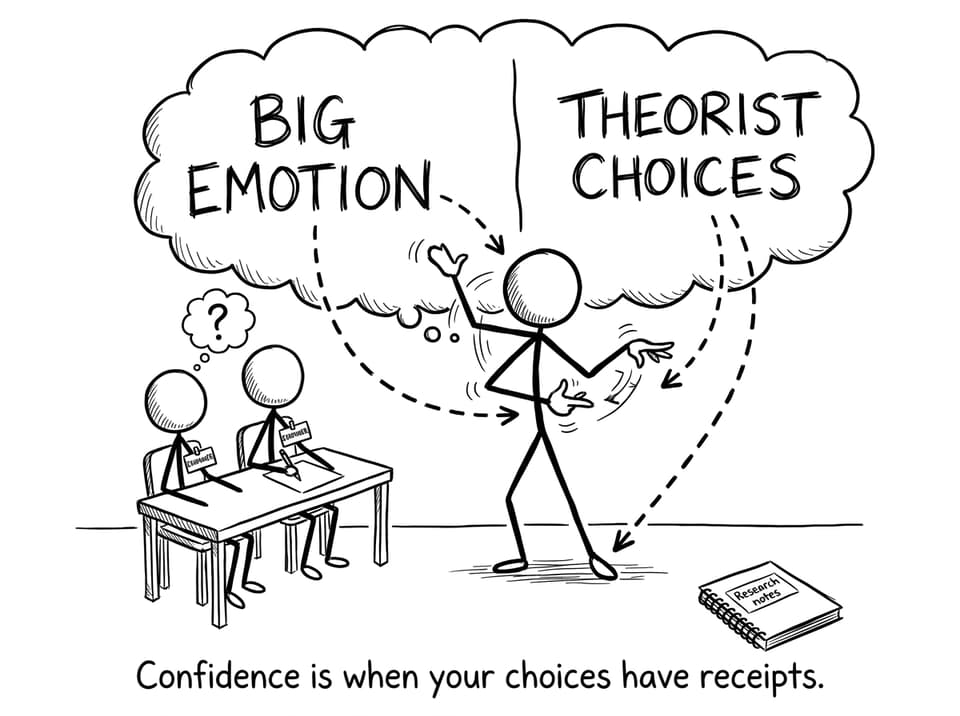
A useful trick in IB Theatre is to reduce your piece to three choices you can defend:
-
a repeated physical motif (gesture, posture, tempo)
-
a vocal rule (pace shifts, projection style, intentional stillness)
-
a spatial pattern (where you begin, where you turn, where you confront)
Then rehearse those choices until they feel like muscle memory. The examiner doesn’t need you to be fearless; they need you to be consistent.
Control the space so you don’t get controlled by it
Students often wait for “a real stage” to feel confident. But IB Theatre assessment spaces are unpredictable: classrooms, studios, halls.
So choose a simple blocking plan that works anywhere:
-
Define a clear “home base” (neutral point) you return to.
-
Use corners or edges for shifts in status, tone, or argument.
-
Rehearse transitions more than moments. Transitions are where nerves steal time.
For assessment-day specifics, keep How to Prepare for Assessment Day in the IB Solo Theatre Piece bookmarked.
Build a recovery plan for mistakes
The confident performer isn’t the one who never slips. It’s the one who knows what to do when they do.
Write a recovery plan like stage directions:
-
If you forget a line: pause, breathe, replace with a physical action, continue.
-
If you lose pacing: go to your anchor moment and reset the tempo.
-
If a prop fails: treat it as intentional and commit to the new reality.
This is also a common pitfall area--see Common Mistakes in the IB Theatre Solo Piece and How to Avoid Them and pre-empt what usually goes wrong.
Film once, then adjust with discipline
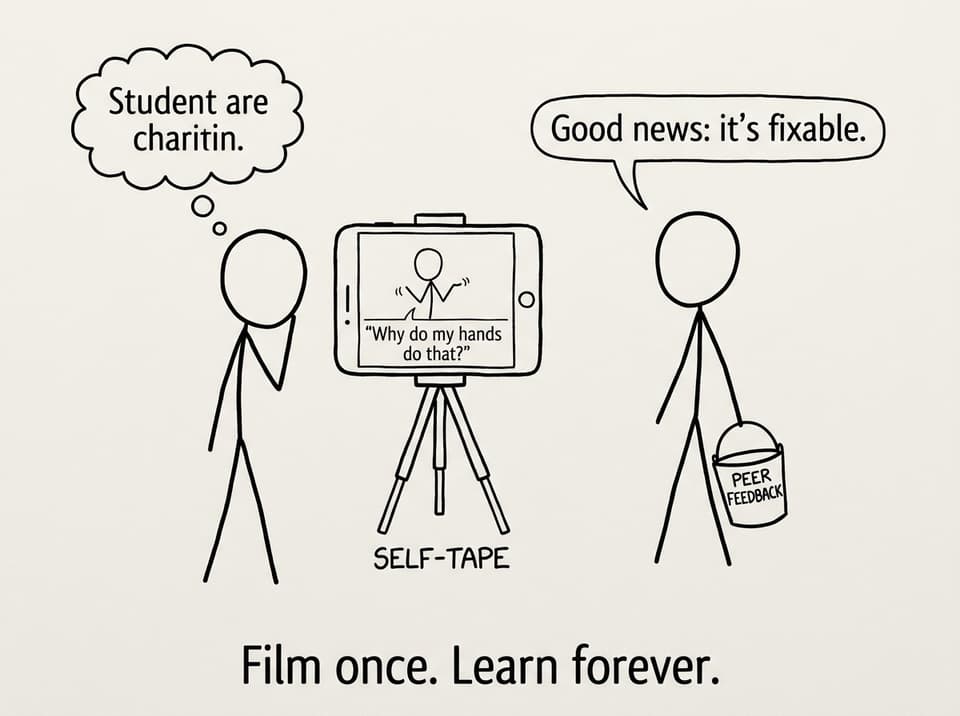
Self-recording feels awkward, but it is one of the fastest confidence builders in IB Theatre.
Watch your rehearsal video with one question only: Can I see the theorist in my body? If not, refine one thing, not everything.
Keep your supporting material simple enough to carry
A solo piece collapses when the material demands more than 6--8 minutes can hold.
If you are still choosing or refining your base text/theme, use How to Choose Material That Supports Your Solo Theatre Piece to pressure-test whether it actually serves theory and performance.
How RevisionDojo helps you perform with confidence
Confidence in IB Theatre comes from knowing what you’re being assessed on, then training that under pressure.
RevisionDojo is built for that loop: use Study Notes to clarify practitioner ideas, turn them into Flashcards for fast recall, and stress-test your understanding through the Questionbank. When you get stuck, AI Chat helps you translate theory into playable choices. And when you want a reality check, the Grading tools (including the Solo rubric grader), Mock Exams, and Predicted Papers help you practise staying clear when it counts. If you need human feedback, the Coursework Library and Tutors add examples and coaching without drowning you in noise.
For a bigger routine that fits alongside rehearsals, follow Best Study Strategies for IB Theatre Students (SL & HL).
Closing: make confidence your evidence
The most memorable IB Theatre solos aren’t perfect. They are precise.
Confidence comes from building a performance you can steer: a theorist-led warm-up, a few defendable choices, a simple plan for space, and a calm response when something slips. If you want that clarity to show up on the day, practise it the same way you practise lines: repeatedly, intentionally, and under conditions that feel real.
When you’re ready to tighten your theory, recall key terms fast, and rehearse with examiner focus, use RevisionDojo’s Study Notes, Flashcards, Questionbank, AI Chat, Grading tools, Mock Exams, Predicted Papers, Coursework Library, and Tutors to turn preparation into calm delivery in IB Theatre.