


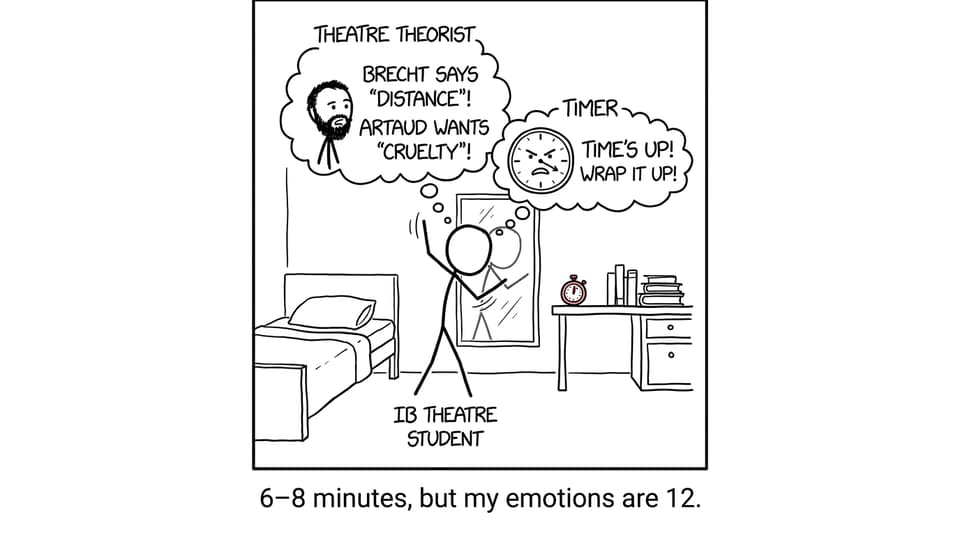
In the last week before your Solo Theatre Piece, rehearsal starts to feel like trying to hold water in your hands. You run the piece again. And again. You tighten the timing. You adjust a gesture. But the bigger question keeps tapping your shoulder: does this look like IB Theatre, or just “a monologue I can do from memory”?
The IB Theatre Solo Theatre Piece (HL) is only 6-8 minutes long, but the examiners aren’t only watching your performance. They’re reading the trail you leave behind: experimentation, application of a theatre theorist, and reflection that proves you learned something real.
IB Theatre Solo Piece rehearsal checklist (fast)
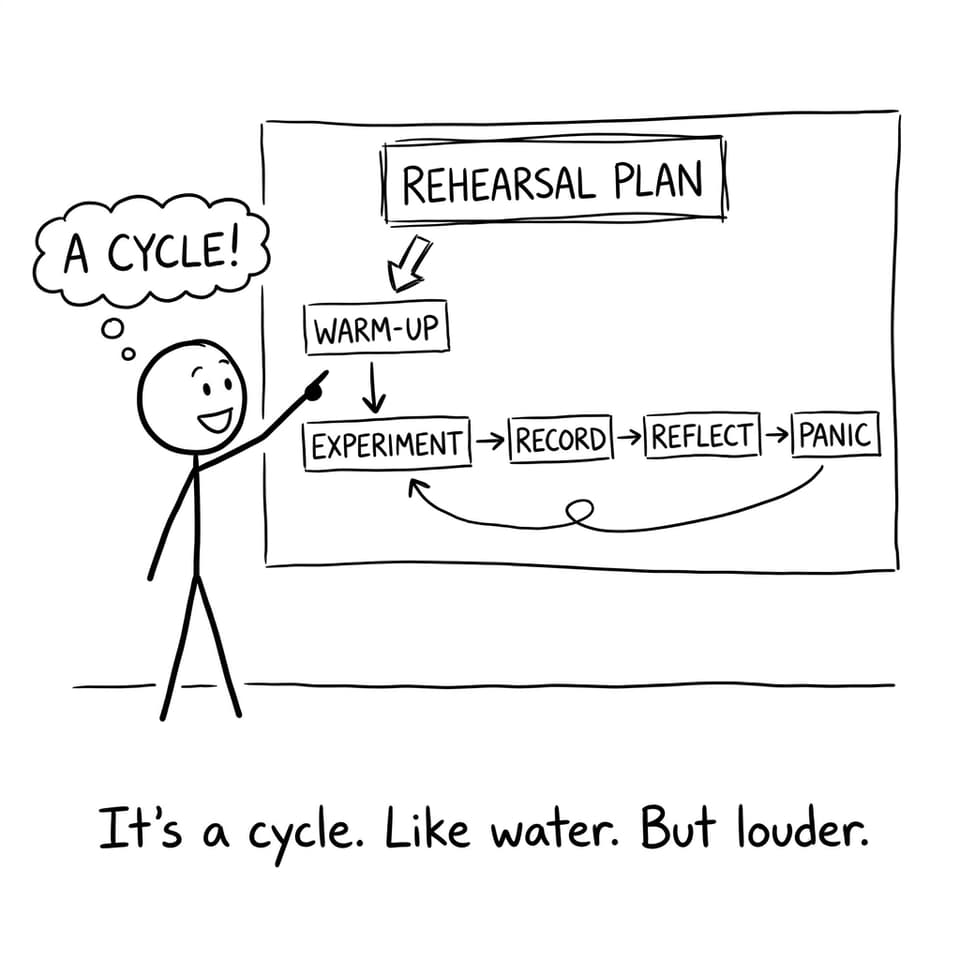
Use this as your simple rehearsal loop for IB Theatre:
-
Split the solo into 4-8 rehearseable “beats” (not one giant run).
-
Choose 2-3 theorist principles you can show, not just explain.
-
Record rehearsals twice a week (minimum) and review with one question: “Where is the theory visible?”
-
Schedule one “wild experiment” rehearsal where nothing is final.
-
End every session with a 10-minute reflection you can actually use later.
If you want a broader study rhythm beyond this task, pair the loop with Best Study Strategies for IB Theatre Students (SL & HL).
Why rehearsal is the real assessment in IB Theatre
In IB Theatre, the Solo Theatre Piece sits at the intersection of research and craft. The most convincing solos don’t feel like a student “performing theory.” They feel like a performer whose choices have a spine.
Rehearsal is where that spine is built.
And it’s also where most marks leak away: students repeat what already works, instead of testing what could work better. If you’re unsure what examiners tend to penalize, read Common Mistakes in the IB Theatre Solo Piece (and How to Avoid Them) and treat it like a pre-rehearsal safety check.
Best rehearsal strategies for the IB Theatre Solo Piece
Rehearse in sections, then stitch
Running the full 6-8 minutes every time is comforting, but it’s not efficient. In IB Theatre, section work is how you make clear, examinable progress.
Try this:
-
Identify “beats” where intention shifts (new objective, new relationship, new tactic).
-
Rehearse one beat three ways: faster, slower, and “wrong on purpose.”
-
Only then reconnect the beats and do a full run.
This builds control. It also generates reflection material that is specific, not generic.
Keep the theatre theorist physically present in rehearsal
Your theorist shouldn’t live only in your written work. Put them in the room.
Practical prompts:
-
Brecht: rehearse direct address as a choice, not a gimmick. Decide what the audience must think in that moment.
-
Artaud: explore vocal and physical extremes, then scale back to what still feels dangerous.
-
Stanislavski: rehearse objectives moment-by-moment and test whether emotional truth stays consistent under pressure.
If your research is getting messy, organize it before rehearsal spirals. Use Best Ways to Organize Your Research for the IB Theatre Research Presentation as a model for sorting theory into conventions you can actually apply.
Record, review, and ask better questions
Recording is only helpful if you review like a director, not a critic.
After each recording, answer:
-
Where did the theorist’s influence read clearly?
-
Where did I default into “general acting”?
-
What would an audience misunderstand?
Then set one micro-goal for the next rehearsal (for example: “Brechtian gestus must land in beat 3”). This is the kind of clean cause-and-effect thinking that makes IB Theatre documentation stronger.
Build one rehearsal per week for feedback (and control the feedback)
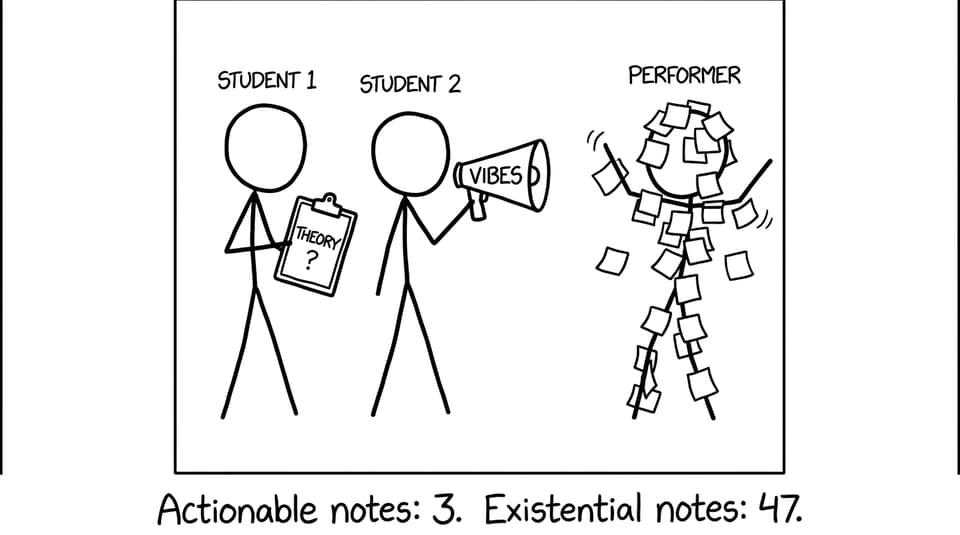
Peer feedback is powerful, but only if you structure it. Don’t ask, “Was it good?” Ask, “Where did you see the theory?”
Give viewers a tiny feedback form:
-
One moment the theorist was obvious.
-
One moment the theorist was unclear.
-
One moment that surprised you.
If you’re also juggling other coursework, anchor these feedback sessions into a bigger schedule using Time Management Tips for IB Theatre Coursework and Rehearsals.
Reflect immediately (before your brain rewrites the story)
The best reflection is written when the rehearsal is still warm. Ten minutes is enough.
Write:
-
What I tried (specific choice).
-
What happened (result).
-
What I’ll change next time (action).
This is where RevisionDojo becomes more than “revision.” It becomes a rehearsal partner: you can use AI Chat to pressure-test whether your reflection truly links back to theory, and the Coursework Library to compare how top students phrase experimentation and intention.
A simple 2-week IB Theatre rehearsal plan
Week 1: Discover
-
2 section rehearsals focused on theorist techniques
-
1 “wild experiment” rehearsal (try extremes)
-
1 recorded run + review
Week 2: Prove
-
2 section rehearsals to lock precision
-
1 peer audience rehearsal with targeted feedback
-
2 recorded full runs under performance conditions (props, shoes, spacing)
To keep your wider IB Theatre understanding sharp, browse All IB Theatre posts and plug one focused reading into your week.
Close: rehearse like a theatre-maker, not a line-runner
The best IB Theatre Solo Pieces aren’t the ones with the most dramatic moments. They’re the ones with the most intentional moments. Rehearsal is where you earn that intention: by breaking the work into sections, keeping theory visible, recording and reviewing honestly, inviting structured feedback, and reflecting while it still feels true.
When you’re ready to rehearse with more structure, RevisionDojo can support the full loop: Study Notes for practitioner clarity, Flashcards for key terminology, AI Chat for fast theory checks, a Coursework Library for exemplars, plus Tutors when you want a human eye on your choices. Your Solo Piece is short. Your process doesn’t have to be.