


Assessment day in IB Theatre has a strange way of shrinking the room.
The space is the same studio you rehearsed in. The same chair. The same prop. But suddenly the air feels heavier, like every choice you made in the last few months is waiting to be judged in real time. That’s the Solo Theatre Piece (HL only): a 6-8 minute performance carrying 35% of your HL grade, where your job is not just to act, but to prove you can translate a theatre theorist’s ideas into clear, controlled stage language.
This guide is about making assessment day feel familiar, not because you’re fearless, but because you’re prepared.
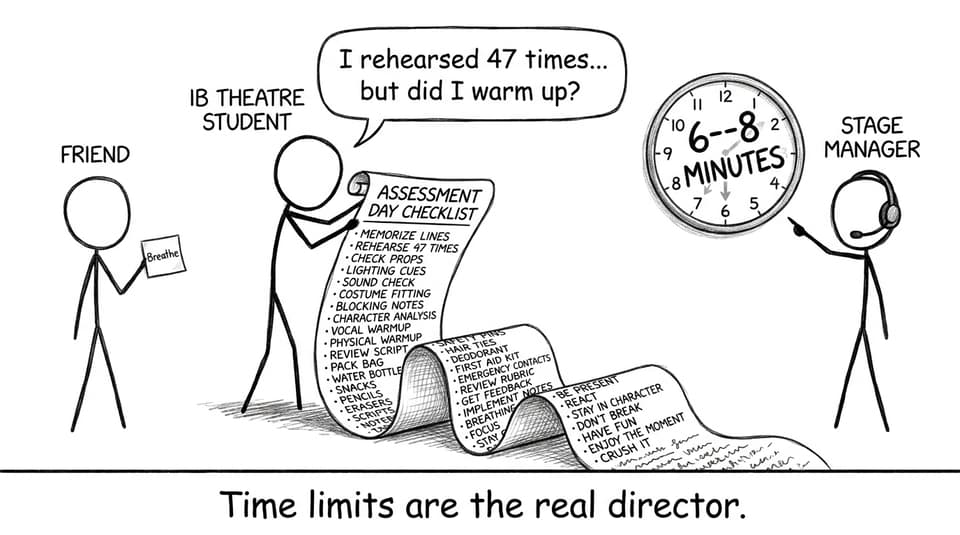
Quick assessment day checklist for IB Theatre
Keep this list short enough to use when your brain goes blank:
-
Run your IB Theatre Solo at least twice under performance conditions (full costume/props/sound).
-
Time it every run: 6-8 minutes, no exceptions.
-
Do a warm-up that matches your theorist (body + voice).
-
Name your top 3 theorist principles in one sentence each (and show them).
-
Decide your recovery plan for mistakes: pause, breathe, continue.
-
Write immediate post-performance notes for your report.
If you’re still refining the core approach, pair this with How to Approach the IB Theatre Solo Theatre Piece (HL Only).
Why assessment day preparation matters in IB Theatre
In IB Theatre, the examiner isn’t only watching whether the performance is engaging. They’re watching whether it’s intentional. That means:
-
Your physical and vocal choices look rehearsed, not accidental.
-
Your transitions and pacing support meaning.
-
Your work visibly applies theorist principles (not just a general “style”).
-
You communicate to an audience with clarity and control.
A strong process can still underperform if assessment day is the first time you treat the run like the real thing. The fix is simple: rehearse in a way that makes the final day boring.
Rehearse under exam conditions (so your body doesn’t panic)
The best assessment day prep is not “more rehearsal.” It’s different rehearsal.
Build a realistic run routine
Do at least a few runs where you:
-
Perform in the actual space (or one with similar sightlines).
-
Use the exact costume, props, and tech cues you intend to use.
-
Start from stillness, as you will on the day.
-
Finish without stopping, even if something goes wrong.
This is where you shift from repeating lines to rehearsing decisions. For more structure, use Best Rehearsal Strategies for the IB Theatre Solo Piece.
Make timing a creative constraint
If you’re at 8:30, you don’t need faster speech. You need sharper storytelling.
Cut anything that doesn’t do one of these jobs:
-
demonstrate the theorist,
-
reveal a transformation,
-
clarify the audience’s understanding.
If you’re unsure what examiners reward at the top end, read How to Aim for a Level 7 in the IB Theatre Solo Theatre Piece.
Warm-ups that actually support your theorist
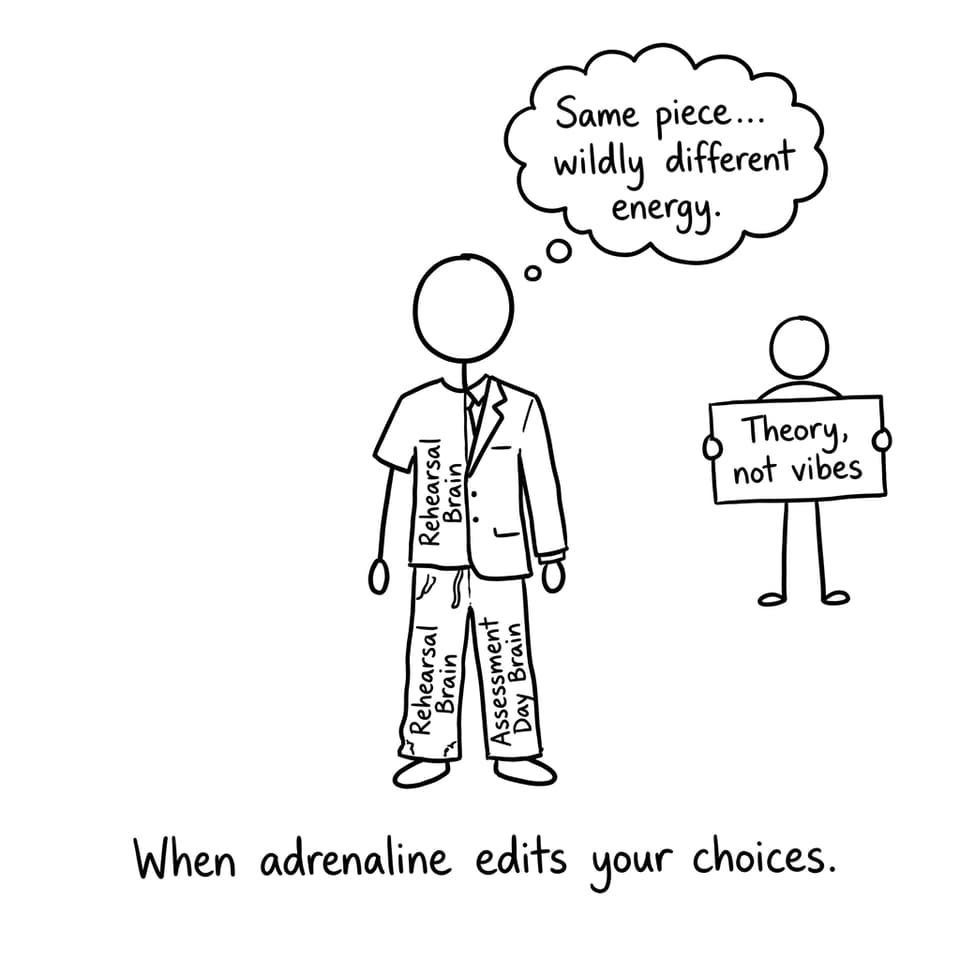
A generic warm-up can help. A theorist-aligned warm-up helps and reinforces your concept.
Try mapping your warm-up to the logic of your work:
-
Stanislavski: release tension, breath focus, sensory attention.
-
Brecht: crisp diction, projection, articulation with clear intention.
-
Artaud: energetic physical activation, intensity, breath-to-impulse work.
-
Grotowski: disciplined physical preparation, stamina, precision.
Then do one short “bridge exercise” that resembles your opening moment, so your first seconds onstage feel already lived in.
For help choosing a practitioner that fits your strengths, see Best Theorists to Research for the IB Theatre Solo Piece.
Nerves: how to stay in control when your heart is sprinting
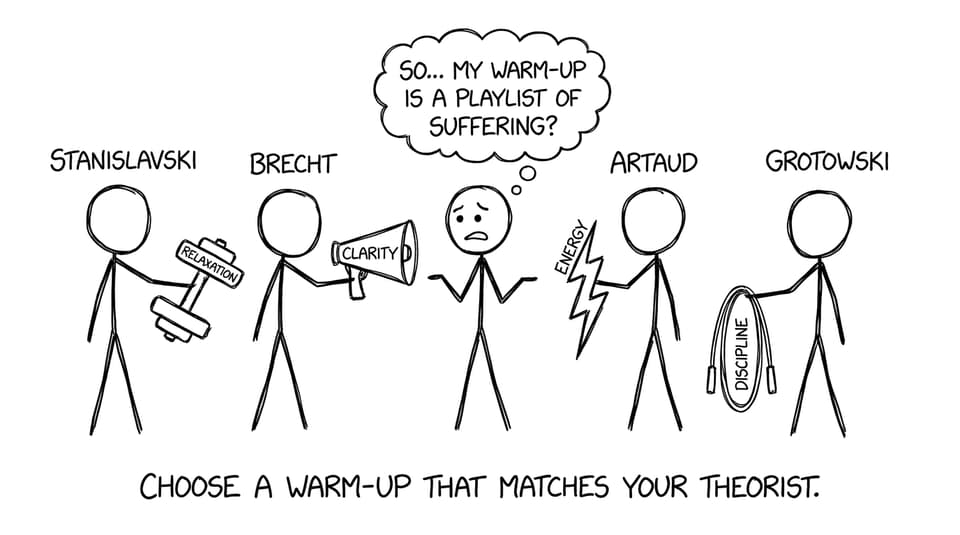
In IB Theatre, nerves are normal, and often useful. The goal isn’t to erase adrenaline. It’s to stop it from rewriting your performance.
Use a simple three-step reset:
-
Breathe low and slow (longer exhale than inhale).
-
Name the next intention (not the whole piece, just the next beat).
-
Commit to the action (do, don’t judge).
Also: plan a “mistake protocol.” If you forget a line or moment, don’t apologize to the room. Keep the logic of the piece moving. Examiners value professionalism and clarity more than perfection.
After the performance: capture gold for the report
Right after assessment day, your memory is your best resource.
Write quick notes on:
-
what changed in the room when you shifted energy,
-
what surprised you (audience reaction, timing, focus),
-
what you’d refine if you had one more week,
-
where theorist principles were strongest and weakest.
Those observations become evidence of reflection, which is part of what strong IB Theatre work looks like across the course. For broader study routines, use Best Study Strategies for IB Theatre Students (SL & HL) and Exploring the IB Theatre Syllabus: A Comprehensive Guide.
The calm way to finish strong
Assessment day success in IB Theatre isn’t built on a heroic final rehearsal. It’s built on small, repeatable systems: timed runs, theorist-aligned warm-ups, and a plan for what happens when something goes off-script.
If you want that structure in one place, RevisionDojo helps you practise like an examiner is watching: train terminology with Flashcards, clarify concepts with Study Notes and AI Chat, stress-test decisions with Mock Exams and Predicted Papers, and use the Grading tools to check whether your written reflections match rubric expectations. Add the Questionbank for quick skills practice across the IB, and you’ve got a preparation loop that makes assessment day feel like just another well-rehearsed run.
For more IB Theatre guidance, explore All IB Theatre Posts and keep building toward a performance that looks simple, because it’s been made deliberately.