
Academic integrity usually shows up in your life as a warning.
A teacher reminder. A policy slide. A quiet moment of panic when you realise your notes and your draft sound a little too similar.
But the IB was never really trying to scare you into behaving. It was trying to train you into thinking. Academic integrity in the IB is best understood the same way you understand exam technique: not a rule you remember, but a habit you practise until it becomes automatic.
Because on exam day, you do not get marks for having access to information. You get marks for what your mind can do with it.
A quick IB integrity checklist for exam season
Use this as your 60-second reset before you submit work, share notes, or ask AI for help in your IB prep:
-
Can I explain, out loud, how I produced this answer?
-
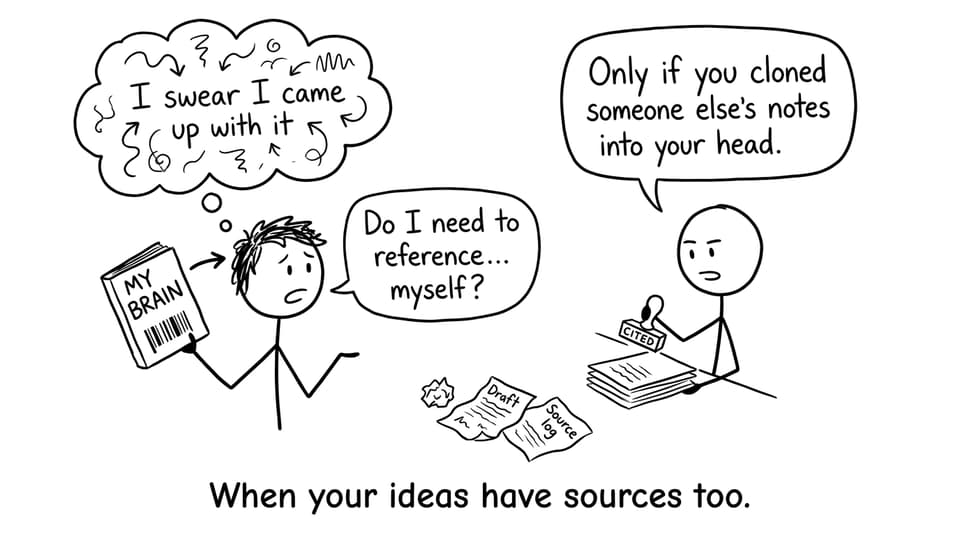
Are my sources tracked as I work (not reconstructed later)?
-
If I collaborated, did we only share ideas, not sentences?
-
Is my paraphrasing truly rewritten, or just rearranged?
-
Did I use AI in a way I can describe transparently?
-
Could I recreate this under timed conditions without the materials next to me?
If any answer feels shaky, that is not a moral failure. It is a systems problem. And systems can be fixed.
Why IB academic integrity matters more than “not plagiarising”
The easiest way to misunderstand academic integrity is to treat it like a fence: something that stops you from doing the wrong thing.
A better way is to treat it like a compass: something that keeps your learning pointed toward what the IB actually rewards.
In practice, IB academic integrity is connected to:
-
Trust: your teachers (and moderators) must be able to trust the work reflects your understanding.
-
Skill transfer: authentic work builds the thinking you need for timed exams.
-
Long-term confidence: you study differently when you know your grades are earned.
-
The learner profile: being principled and reflective is not decoration in the IB; it is part of the point.
If you want the clearest overview of how integrity shows up in real student decisions, read IB Academic Misconduct Explained: How to Avoid Plagiarism and Collusion.
The “habit of mind” shift: integrity as your default setting
Habits are powerful because they reduce decision fatigue.
When integrity is a habit, you do not ask, “Is this allowed?” every time. You ask, “What would make this work genuinely mine?” That is a subtle shift, but it changes everything.
Here are three ways to build that default setting during IB exam prep.
Build a source log the way you build revision notes
Most integrity mistakes happen at the exact moment you are overwhelmed: too many tabs, too many quotes, too little time.
So make it frictionless. Keep a living source log while you study. Add links, page numbers, screenshots of graphs, and quick notes about what you used and why.
If you are unsure what ethical studying looks like in a modern tool-heavy workflow, How RevisionDojo Helps You Maintain Academic Integrity While Studying gives a practical structure built for IB students.
Practise “teach-it-back” as an integrity test
A simple integrity check is this: can you teach the idea back without looking?
Try it after you read notes or watch a video:
-
Close the tab.
-
Write 4-6 sentences explaining the concept.
-
Add one example you choose.
-
Then compare your explanation to the source.
When you do this regularly, your voice becomes clearer, your understanding deepens, and plagiarism becomes less tempting because copying feels like moving backwards.
To make this faster, many IB students use RevisionDojo’s Digital IB Study Notes You Can Access Anywhere as the “reference spine,” then convert weak points into Flashcards for active recall.
Use practice questions to keep your work honest
Integrity is not just about writing. It is about proving you understand.
That is why exam-style practice is one of the cleanest academic integrity tools you have. If you can answer under timed pressure, it is yours.
RevisionDojo’s Questionbank is built for this exact loop: practise, get feedback, fix the gap, retest. If you want a method for using question sets without wasting time, see IB Question Bank: How to Use It Effectively.
Collaboration without collusion: the IB-friendly way to study together
Studying with friends is one of the best ways to stay motivated in the IB. It is also one of the fastest ways to drift into collusion if nobody defines the boundary.
A good rule is: share thinking, not text.
That means:
-
Discussing approaches, then writing separately.
-
Comparing outlines, not paragraphs.
-
Explaining solutions, not sending them.
-
Debriefing mistakes, not trading final answers.
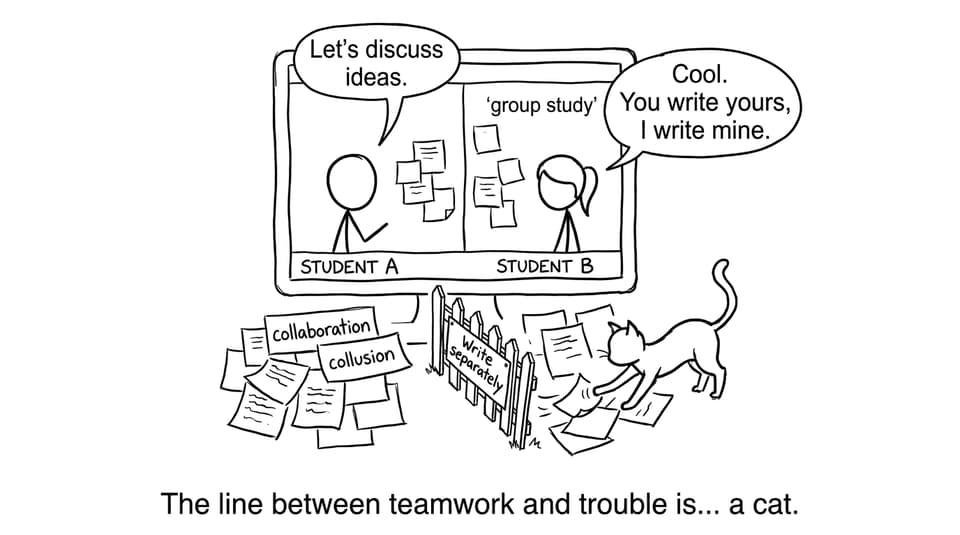
If you want a structured way to make group study safe and genuinely effective, Collaborative IB Mock Exams: Study with Friends Online shows how to run timed practice with a clean debrief.
Responsible AI use in the IB: keep your thinking visible
AI is not automatically dishonest. But it can quietly remove the very skill the IB exams will demand: producing your own thinking in real time.
A good way to use AI ethically is to treat it like a tutor who cannot take the test for you.
Use it for:
-
Clarifying concepts you already attempted to understand.
-
Generating practice questions you then answer yourself.
-
Checking whether your explanation makes sense.
-
Finding gaps in your argument structure.
Avoid using it to:
-
Produce final paragraphs you submit as your own.
-
Rewrite your voice until it becomes unrecognisable.
-
Generate analysis you cannot explain under questioning.
For a clear, IB-relevant standard on transparency, read Should I Mention My Use of AI in CAS Reflections or EE Research?.
The real enemy of integrity: panic
There is a pattern behind most academic integrity problems: they are rarely about character. They are about time.
When you leave the hardest work to the last minute, you stop making choices. You start grabbing solutions. And the line between “helpful” and “unacceptable” gets blurry.
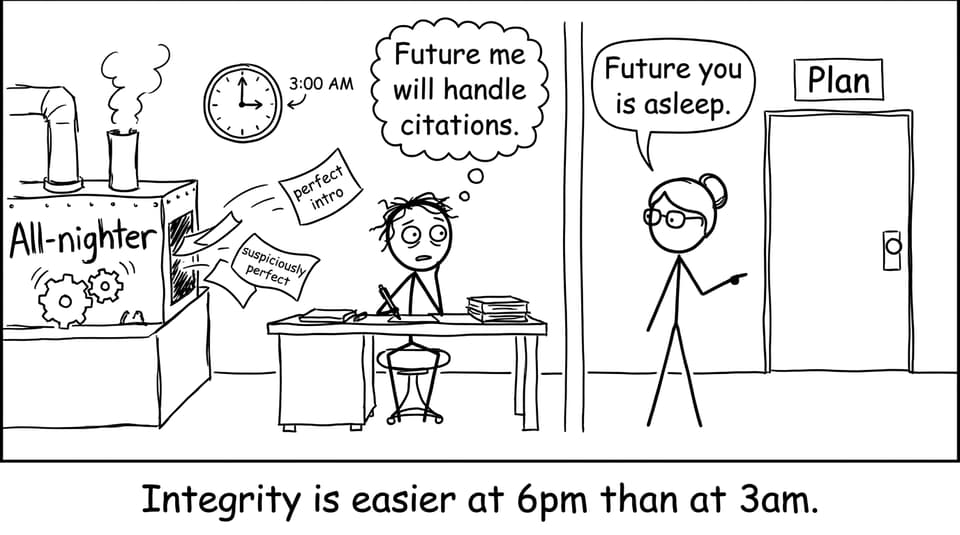
This is why timed rehearsal matters. RevisionDojo’s IB Predicted Papers and Mock Exams help you practise the exam version of honesty: producing answers under constraints. If you are deciding how to use different paper types, IB Predicted vs Specimen Papers: What They Mean is a strong guide.
Closing: make integrity your advantage in the IB
The students who score well in the IB are not the ones who collected the most information. They are the ones who built a repeatable process: understand, recall, apply, reflect.
Academic integrity is not separate from that process. It is the process, done in a way you can defend, repeat, and trust.
If you want a study system where integrity becomes automatic, RevisionDojo is built to help: Study Notes for clarity, Flashcards for recall, a Questionbank for exam-style practice, AI Chat for quick unblocking, Grading tools for feedback, Predicted Papers and Mock Exams for rehearsal, plus a Coursework Library and Tutors when you need guided support.
Explore RevisionDojo for IB and build an IB prep routine that makes honest work the easiest work.