A Year 2 student once told me something that sounded like a complaint, but was really a blueprint: “I don’t need more motivation. I need a map.”
That is the hidden advantage of cross-year collaboration in IB teams. When Year 1 and Year 2 students work together, you borrow maps. You inherit shortcuts. You learn what mattered, what didn’t, and what the examiners consistently reward. In IB, that kind of clarity is worth more than a new set of highlighters.
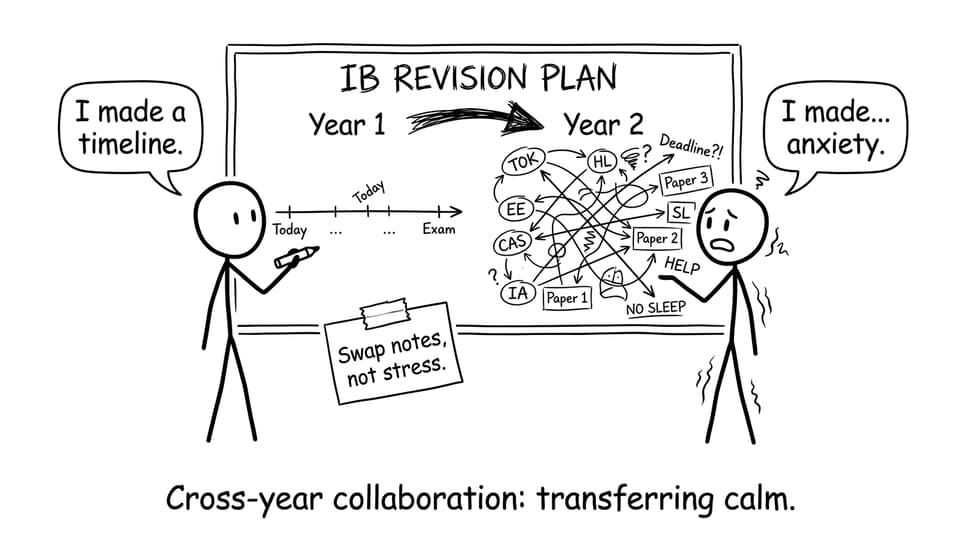
Cross-year collaboration is not about becoming dependent on older students. It is about compressing time. It turns someone else’s hard-won experience into your calmer routine. And if you build it well, it helps both sides: Year 1 gets direction, Year 2 gets repetition, structure, and confidence.
Quick checklist: cross-year collaboration that actually helps
Use this to keep your IB collaboration useful and exam-focused:
-
Pick one shared outcome per session (timing, command terms, essay structure, data response).
-
Share process, not final answers (stay academically honest).
-
Build a “mistake library” together (recurring errors and fixes).
-
Standardize resources: one notes source, one practice source, one feedback method.
-
End every session with a 48-hour follow-up plan.
If you want a single hub where that whole loop can live, RevisionDojo is built for it: Study Notes, Flashcards, Questionbank, AI Chat, Grading tools, Predicted Papers, Mock Exams, a Coursework Library, and Tutors.
Why cross-year collaboration matters for IB exam prep
In IB, the hardest part is rarely “learning the content.” It is learning what the content looks like when it becomes marks.
Year 2 students already know where time disappears, which topics spiral under pressure, and which command terms quietly change the entire question. When you collaborate across year levels, you get early exposure to that reality. You learn how a Paper 1 feels before it becomes urgent. You learn what “evaluate” looks like in a real response, not just in a glossary.
There is another benefit people miss: cross-year collaboration creates consistent language. If your group agrees on what “analysis” means, what a “counterclaim” needs, or how to label a diagram, you reduce friction every time you practice.
For students building a full revision system, it helps to anchor your routine to a single workflow. This guide is a useful backbone: How to Study for IB Exams: Step-by-Step Guide.
Build vertical alignment: skills that transfer from Year 1 to Year 2
Think of cross-year collaboration as vertical alignment for students. You are aligning the skills that compound:
Command terms and “what the question wants”
Year 2 students can translate the exam’s language into a checklist. In IB, that translation is often the difference between a 5 and a 7.
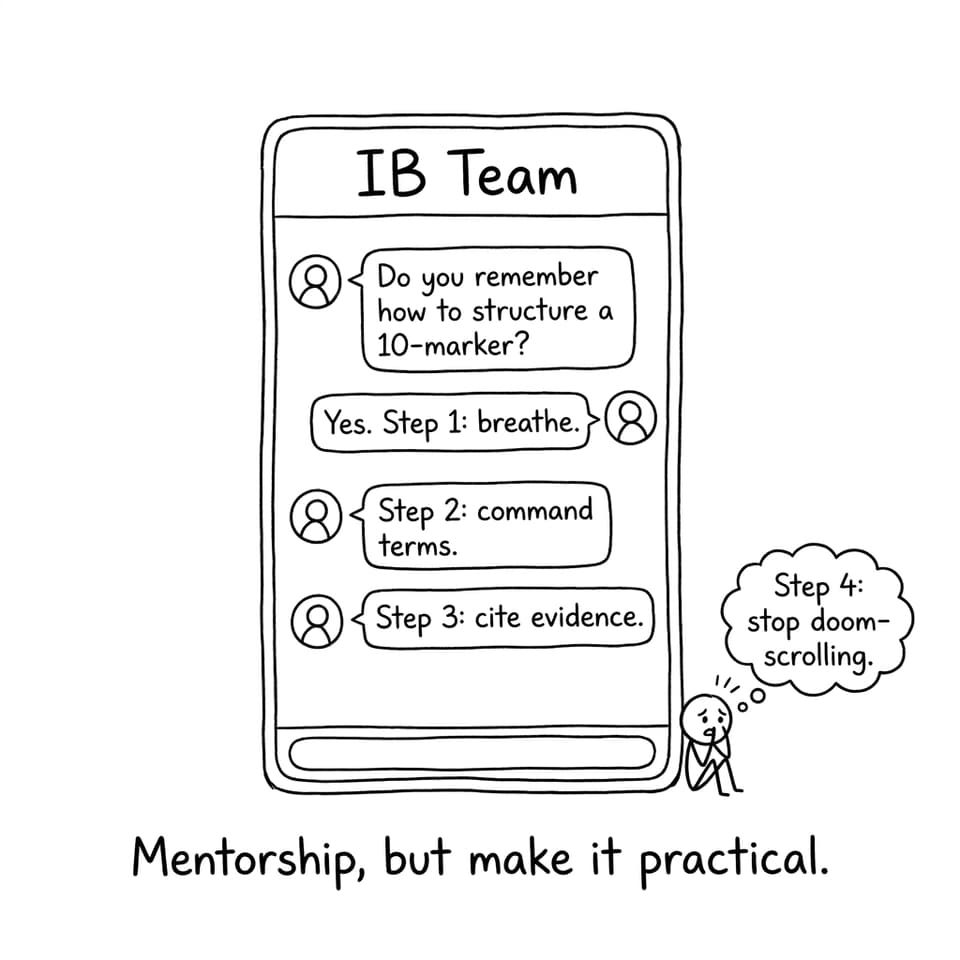
A practical activity: take five questions from a topic you are revising, and have Year 2 label what each command term demands (define vs explain vs evaluate). Then Year 1 writes a 3-sentence plan for each.
To keep practice structured, use a consistent question source like RevisionDojo’s Questionbank and pair it with guidance from IB Question Bank | How to Use It Effectively.
Revision materials that don’t sprawl
Year 1 students often over-revise. Year 2 students often under-sleep. Collaboration helps both groups meet in the middle.
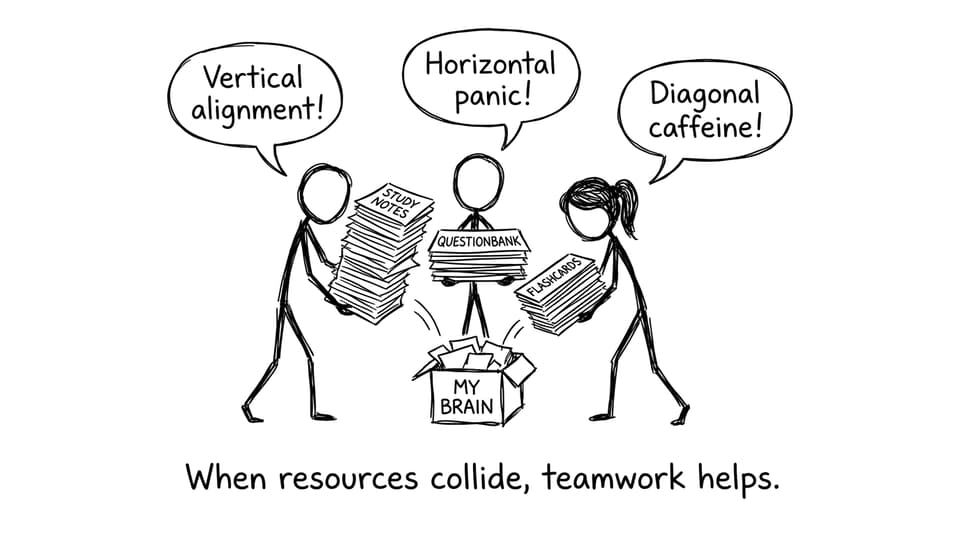
Agree on one “spine” resource for content clarity, then practice immediately. RevisionDojo’s Study Notes are designed for that: fast comprehension that turns into application.
For a method that works across subjects, see IB Subject Note Collections: Comprehensive Study Materials.
Memory systems that survive busy weeks
Year 2 students can show Year 1 how to make recall automatic. Daily repetition beats occasional intensity in IB.
Use a shared rule: if something cost you marks, it becomes a flashcard. RevisionDojo’s Flashcards make this lightweight, especially when the deck is tied to what you are studying right now.
Collaboration structures that work (without turning into chatter)
A lot of cross-year collaboration fails for one boring reason: it has no structure. The fix is simple: choose a format you can repeat.
The 30-30-10 session
This is a clean template for IB teams:
-
30 minutes: Year 1 attempts a timed mini-set (or one question type).
-
30 minutes: Year 2 reviews approach, identifies patterns, and models a better plan.
-
10 minutes: Both write a “next 48 hours” list: 1 note section, 1 flashcard set, 1 practice set.
If you want to run the “timed” part properly, you can borrow ideas from Collaborative IB Mock Exams: Study with Friends Online.
The “mistake library” (your shared advantage)
In IB, most students repeat the same 10 errors. Cross-year collaboration lets you collect them.
Make a shared document with:
-
The error (e.g., “I answered the topic, not the question”).
-
The trigger (e.g., “command term panic”).
-
The fix (e.g., “write a 1-line thesis that includes the command term”).
Then use RevisionDojo’s AI Chat to ask for alternative explanations when you get stuck, and use the Grading tools to compare what you wrote with what the criteria reward.
To see how the full routine fits together, this is helpful: RevisionDojo App: The Smarter Way to Prep for IB Exams.
Keep it IB-compliant: collaboration without crossing the line
Cross-year collaboration should make you better at thinking, not better at copying.
The safest rule is: share methods, planning frameworks, and feedback language. Do not share finished paragraphs intended for submission. Do not co-write coursework text. In IB, academic honesty is not a technicality; it is the foundation your results sit on.
If you want clear guidance on what’s allowed, read Collaborative IB Question Sharing: Community-Driven Content.
A simple cross-year plan for the final weeks before IB exams
Here is a calm, repeatable schedule for IB teams:
-
Weekly: one timed session together (mini-mock or paper section) + debrief.
-
Twice weekly: Year 1 brings 5 questions; Year 2 diagnoses patterns.
-
Daily (solo): flashcards and one short targeted practice set.
Add realism without guessing: RevisionDojo’s IB Predicted Papers are designed to simulate the structure and pressure of real exam papers, and they pair naturally with feedback tools.
If you want to understand how to use predicted sets well, see IB Predicted vs Specimen Papers: What They Mean.
Closing: turn IB teamwork into a repeatable advantage
The quiet power of cross-year collaboration is that it makes the IB feel less like a maze and more like a path. You stop revising blindly. You start practicing with intent. And you build a shared language for what good answers actually look like.
If you want one place to run that loop, covering content clarity, recall, practice, feedback, and timed rehearsal, RevisionDojo is the home base. Use Questionbank, Study Notes, Flashcards, AI Chat, Grading tools, Predicted Papers, Mock Exams, the Coursework Library, and Tutors to turn collaboration into measurable progress.
Start by setting up your routine here: RevisionDojo for IB.