

The difficult part of IB Business Management is rarely finding another definition of market share. It is learning how to turn knowledge into a decision, connect that decision to a case, support it with evidence, and evaluate what might happen next.
So, does RevisionDojo cover IB Business Management? Yes. RevisionDojo provides syllabus-aligned resources for both SL and HL students across all five units, the business management toolkit, case-study questions, quantitative practice, exam preparation, and the Business Research Project.
Students can move between Study Notes, Flashcards, the Questionbank, AI Chat, Grading tools, Predicted Papers, Mock Exams, the Coursework Library, and Tutors without piecing together a revision system from unrelated sources. The central IB Business Management resource hub is the best place to begin.
RevisionDojo IB Business Management at a glance
Here is the short checklist for students deciding whether the platform matches their course:
- Coverage of Units 1 to 5 for SL and HL
- Clear identification of HL-only content
- Topic-by-topic Study Notes and lessons
- Flashcards for definitions, formulas, and frameworks
- Exam-style Questionbank practice
- Case-study application and evaluation
- Quantitative questions for finance and operations
- Paper 1, Paper 2, and HL Paper 3 preparation
- Business Research Project exemplars and grading support
- Timed practice through Predicted Papers and Mock Exams
That breadth matters because Business Management is not one type of subject. One hour may involve leadership theory; the next may require ratio analysis, break-even calculations, or a recommendation for a social enterprise. Effective preparation has to connect those modes rather than treating them as separate courses.
Which IB Business Management units are covered?
The current IB course contains five compulsory units shared by SL and HL, with additional material studied at HL. RevisionDojo organizes its resources around that structure, so students can revise by unit or narrow their work to an individual subtopic.
| Unit | Main areas covered |
|---|---|
| Unit 1 | Business entities, objectives, stakeholders, growth, evolution, and multinational companies |
| Unit 2 | Human resource management, organizational structure, leadership, motivation, culture, communication, and employee relations |
| Unit 3 | Sources of finance, costs, final accounts, ratios, cash flow, investment appraisal, and budgets |
| Unit 4 | Marketing planning, research, forecasting, the seven Ps, and international marketing |
| Unit 5 | Operations methods, quality, location, break-even analysis, production planning, research, and information systems |
Unit 1: Introduction to business management
Unit 1 establishes the language used throughout the course. RevisionDojo covers business ownership, objectives, stakeholder conflict, growth strategies, multinational companies, and the external environment.
This unit can look straightforward because many ideas are familiar. The challenge is applying them precisely. A benefit of growth for one organization may become a risk for another, depending on ownership, finance, culture, or stakeholder priorities. Topic-level questions help students move beyond memorized advantages and disadvantages.
Unit 2: Human resource management
Unit 2 includes organizational structures, leadership, motivation, communication, and workforce planning. HL students also meet extensions such as organizational culture and industrial or employee relations.
These topics are especially suitable for case-study practice because a leadership decision affects several groups at once. Students can use the Business Management Questionbank to practise selecting an appropriate theory, applying it to the organization, and tracing its likely consequences.
Unit 3: Finance and accounts
Finance is where passive reading becomes particularly expensive. Recognizing a formula is not the same as selecting it from a data set, completing the calculation, interpreting the result, and explaining its limitations.
RevisionDojo covers final accounts, profitability and liquidity ratios, cash flow, investment appraisal, and related HL extensions. The IB Business Management data booklet provides a focused reference for formulas used across SL and HL, while practice questions train the decision-making that follows a calculation.
Unit 4: Marketing
Marketing coverage includes market research, planning, segmentation, positioning, sales forecasting, the seven Ps, and international marketing. Students can explore individual areas through pages such as the Introduction to Marketing resources.
A strong marketing response does more than recommend promotion. It considers the target market, costs, competitors, brand position, available data, and the organization’s wider objectives. This is why case application matters as much as knowing the components of a model.
Unit 5: Operations management
The Operations Management unit resources cover production methods, location, break-even analysis, quality management, and the broader production-planning decisions required at HL.
Operations often connects naturally to finance, human resources, sustainability, and strategy. A change in production method may lower unit costs while requiring significant finance, retraining employees, or creating quality risks. RevisionDojo’s topic structure lets students learn the individual concept before practising those cross-unit links.
How HL and SL coverage differs
Both levels study the same five-unit foundation, but HL includes extension topics and an additional examination paper. RevisionDojo identifies HL-only areas within its course navigation and practice resources, reducing the risk that SL students spend time on content they do not need or HL students overlook an extension.
The Business Management flashcard collection separates the subject into the five units and the business management toolkit. Flashcards are useful for terminology and formulas, but they should be treated as the beginning of revision rather than the final stage.
A practical sequence is:
- Learn a narrow topic through Study Notes.
- Recall the terminology or formula without looking.
- Complete a short topic-based question set.
- Review why marks were lost.
- Repeat the concept inside an unfamiliar case.
That sequence turns knowledge into usable exam skill. It also prevents a common illusion: feeling prepared because a definition looks familiar when it appears on a screen.
Does RevisionDojo include case-study practice?
Yes. Case-study application is built into the Questionbank, exam-style resources, Predicted Papers, and AI feedback workflow. This is important because the current assessment model relies heavily on stimulus material.
Paper 1 is based on a pre-released statement specifying the context and background for an unseen case study. Paper 2 uses unseen stimulus material and has a strong quantitative focus. HL students also take Paper 3, which uses unseen material about a social enterprise and requires a strategically justified plan of action.
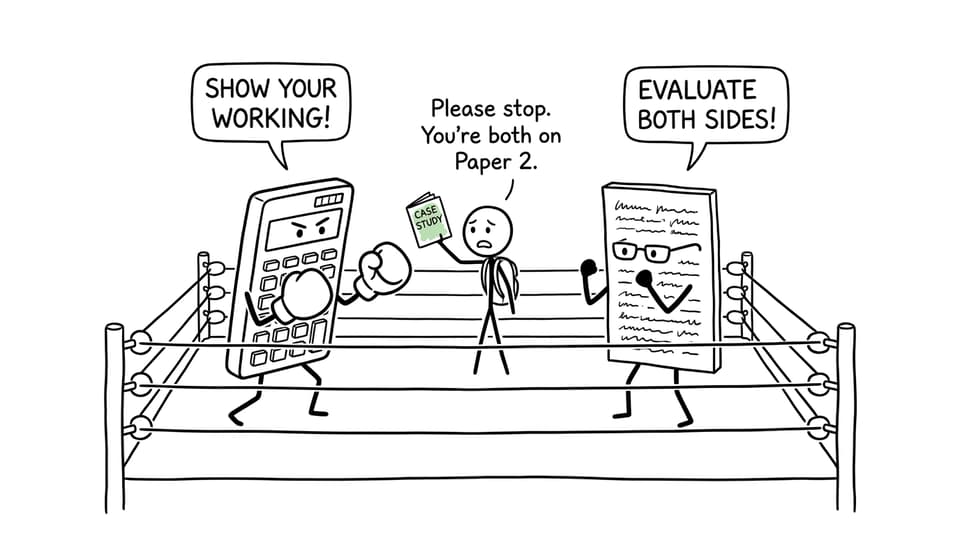
Good case-study practice follows four steps:
- Find the evidence: Identify relevant numbers, objectives, constraints, and stakeholder interests.
- Choose the concept: Use a theory or tool because it clarifies the decision, not merely because you remember its name.
- Build the chain: Explain how the case fact changes costs, revenue, motivation, capacity, risk, or another relevant outcome.
- Judge conditionally: State which option is preferable, for whom, over what period, and under which conditions.
RevisionDojo’s AI Chat can clarify why a tool fits a particular situation, while Grading tools can expose weak application or evaluation. The goal is not to let feedback replace thinking. It is to make the next attempt more precise.
Preparing for each examination paper
| Assessment | Current format | Revision priority |
|---|---|---|
| Paper 1, SL and HL | Pre-released context linked to an unseen case study; 90 minutes | Context research, case application, and balanced evaluation |
| Paper 2, SL | Unseen stimulus with quantitative emphasis; 90 minutes | Calculations, interpretation, structured analysis, and extended responses |
| Paper 2, HL | Unseen stimulus with quantitative emphasis; 105 minutes | HL calculations, integrated analysis, and evaluation |
| Paper 3, HL | Unseen social-enterprise stimulus; 75 minutes | Human needs, organizational challenges, and a justified plan of action |
Students can use IB Business Management Predicted Papers for timed simulation. HL students preparing for the social-enterprise assessment can also study the focused guide to planning the Paper 3 extended response.
Support for the Business Research Project
Exam preparation is only part of the course. Under the current syllabus, SL and HL students complete a Business Research Project about a real issue or problem facing a specific organization, examined through a conceptual lens. It contributes 30% of the final grade at SL and 20% at HL.
RevisionDojo’s Business Management IA exemplar library helps students examine how research questions, evidence, tools, analysis, and conclusions work together. Exemplars should be used as structural references, never as templates to imitate sentence by sentence.
The Business Management IA Grader can then provide criterion-based feedback on a student’s own work. The most valuable use of grading is diagnostic: identify one weak criterion, revise deliberately, and check whether the argument has genuinely improved.
A realistic weekly study plan
Coverage only becomes valuable when it changes what a student does. A balanced weekly routine might look like this:
- Two learning sessions: Study one subtopic with notes and summarize it from memory.
- Three application sessions: Complete targeted Questionbank sets and keep a short error log.
- One quantitative session: Practise finance or operations calculations, including written interpretation.
- One case session: Write a timed response using unfamiliar stimulus material.
- One review session: Use Flashcards, AI Chat, or a Tutor to resolve recurring weaknesses.
Every two or three weeks, replace the case session with a longer Mock Exam or Predicted Paper. Review the response by category: knowledge, application, analysis, calculation accuracy, evaluation, and time management. A single mark is less useful than knowing why it was lost.
RevisionDojo gives Business Management students one connected system
RevisionDojo covers IB Business Management across SL and HL, from the first definition in Unit 1 to the integrated decisions required in HL Paper 3. More importantly, it connects learning with retrieval, application, feedback, and timed performance.
Begin with the resource hub, choose one weak subtopic, and complete the full loop: Study Notes, Flashcards, Questionbank practice, feedback, and a second attempt. Add Predicted Papers and Mock Exams as the exam approaches, use the Coursework Library and Grading tools for the research project, and turn to AI Chat or RevisionDojo Tutors when a difficult idea needs a clearer explanation.
Business Management rewards students who can make sound decisions with incomplete information. Revision should work the same way: find the most important weakness, act on it, and use the result to decide what comes next.