
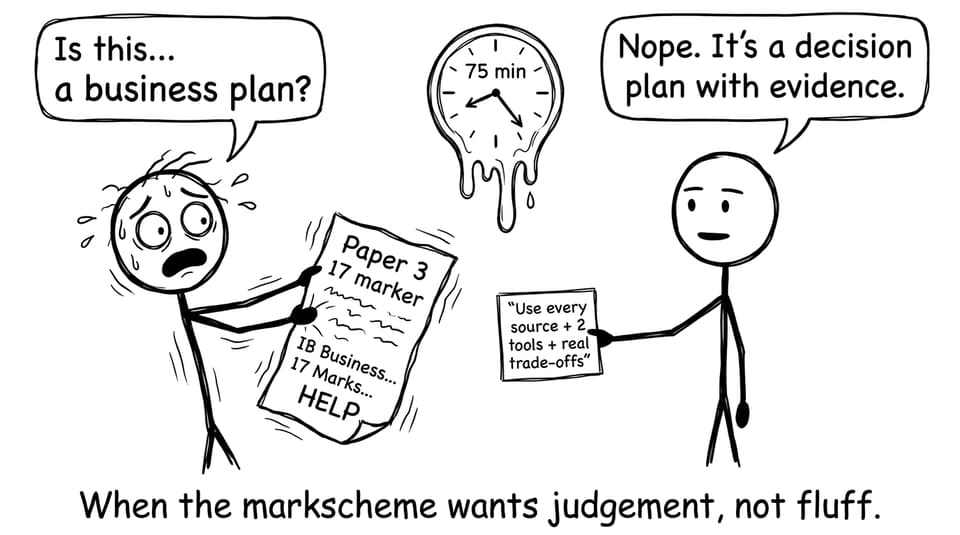
In the last minutes before an IB Business Management exam, the mind does something strange. It starts bargaining.
“If the 17-marker is basically a business plan, I can just write one.”
It’s a comforting thought because business plans feel familiar: headings, forecasts, a confident tone. But Paper 3 Question 3 (17 marks) isn’t asking you to launch a start-up. It’s asking you to make a decision plan for a social enterprise based on the stimulus in front of you, and to prove your judgement using the exam’s criteria.
If you learn to treat this question like what it really is: a structured recommendation under uncertainty, IB Business Management becomes less about luck and more about control.
The fast truth: what the Paper 3 17-marker actually wants
Paper 3 is HL-only and built around unseen stimulus material about a social enterprise. You get a short intro plus several resources (often 5-6): emails, reviews, social posts, extracts, charts, infographics.
The 17-marker asks you to recommend a plan of action, usually over a few years. The catch is that there’s no single “correct” strategy. Your marks come from how you build and justify your recommendation, not whether an examiner personally likes your idea.
For IB Business Management, that means one thing: you win the 17-marker by playing the rubric.
Helpful support pages to keep open while you practise:
A practical checklist before you write (5-8 minutes)
Use this checklist every time you practise the 17-marker in IB Business Management:
-
List every source (A, B, C...) on your planning page.
-
Write 2-3 recommendations only (depth beats breadth).
-
Next to each recommendation, note:
-
which sources you will use
-
which tool/theory fits naturally (not forced)
-
which evaluation angles you’ll cover (short/long term, stakeholders, finance vs mission)
-
-
Decide the sequence (what happens first, second, third) and why.
If you want timed practice with feedback loops, build a routine using RevisionDojo’s Business Management Predicted Papers and then mark your writing with the Business Paper 3 17 Marker Grader.
The four criteria: how to turn them into marks
Use of resources (Criterion A)
Top responses in IB Business Management use all resources, not just the convenient ones. The stimulus is not decoration; it’s your evidence.
How to do it without awkward quoting:
-
Use simple signposting: “The customer reviews in Source C suggest…”
-
Combine sources: “Source B’s operations email conflicts with Source E’s community post, implying…”
-
Track your coverage: tick each source as you use it.
A quiet trick: if a source seems unhelpful, it’s often the evaluation key. A critical review, a skeptical stakeholder comment, or a worrying cost figure is perfect for trade-offs.
Business tools and theories (Criterion B)
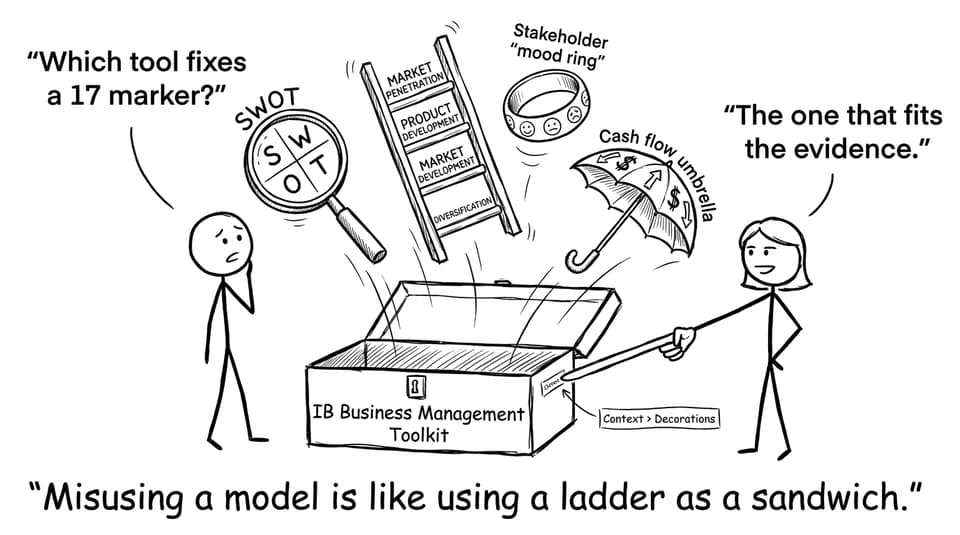
Every recommendation should be anchored in at least one relevant tool or theory from IB Business Management.
Good tool choices are the ones that explain a decision:
-
SWOT to frame internal vs external constraints
-
Ansoff to clarify growth direction and risk
-
Stakeholder conflict to show mission vs money tension
-
Motivation theories (Herzberg, Taylor) when staff capability is central
-
Finance tools (cash flow, investment appraisal) when feasibility matters
Avoid the common trap: tool-dumping. A misapplied model often reads like you’re decorating the answer instead of thinking.
For targeted tool practice, RevisionDojo’s BM Toolkit: core frameworks and tools helps you revise models in a way that matches IB Business Management exam phrasing.
Evaluation (Criterion C)
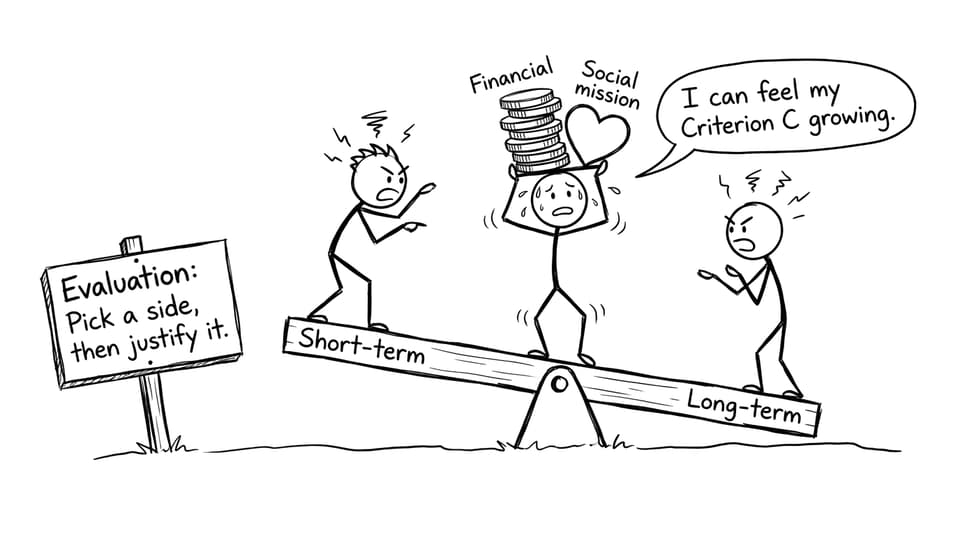
This is the biggest mark chunk, and it’s where many IB Business Management students unknowingly cap themselves.
Evaluation means you do more than explain benefits. You weigh consequences and defend a judgement despite uncertainty.
To reliably hit the top band, evaluate across at least three lenses:
-
Short term vs long term
-
Financial vs non-financial
-
Stakeholder effects (who wins, who loses)
-
Fit with objectives and mission
-
Fit with context (competition, capacity, reputation, regulation)
Trade-offs are your best friend. They prove you can think like a decision-maker.
Sequence of ideas (Criterion D)
This is small in marks but huge in impression. Your plan should feel like a timeline, not a list.
In IB Business Management, sequence marks often come from two moves:
-
State the order in your introduction.
-
Use transition language in the body (“First… Next… Finally…”) while explaining why one step enables another.
A high-scoring structure you can reuse
Below is a reusable template for the 17-marker in IB Business Management. Adapt it to the stimulus, but keep the logic.
Introduction: recommendation + roadmap
-
One sentence: overall direction (your thesis).
-
Two to three actions (your recommendations).
-
The sequence and why that order makes sense.
-
A quick reference to the core problem from the stimulus.
Body paragraph 1: Recommendation 1 (the “first domino”)
-
What to do (specific action).
-
Evidence: at least one stimulus source.
-
Tool/theory: one that genuinely fits.
-
Evaluation: 2-3 angles, including at least one trade-off.
Body paragraph 2: Recommendation 2 (builds on #1)
Repeat the pattern. Try to use different sources and add a new evaluation lens.
Body paragraph 3: Recommendation 3 (optional, only if strong)
Only add a third recommendation if you can evaluate it properly.
Conclusion: judgement with a price tag
Your conclusion should feel like a decision, not a summary.
-
Restate the plan.
-
Name the biggest risk or sacrifice.
-
Justify why it’s still the best choice given the social enterprise’s objectives.
To drill this structure under time, use the IB Business Management Predicted Paper 3 and then generate targeted practice in RevisionDojo’s Questionbank from the subject hub.
How to “sound evaluative” without rambling
A simple way to level up IB Business Management evaluation is to reuse a few sentence frames that force balance:
-
“In the short term, this would… however in the long term…”
-
“Financially, this is feasible if… but it may reduce the social mission by…”
-
“This benefits [stakeholder] because… yet it risks conflict with [stakeholder] as seen in Source…”
-
“This is only likely to work if [condition]. If not, a contingency would be…”
Then anchor each frame in a case fact from the stimulus.
Practising the 17-marker the smart way (with RevisionDojo)
The best IB Business Management practice isn’t doing more full papers. It’s building a feedback loop.
A simple loop that works:
-
Use RevisionDojo Predicted Papers to simulate Paper 3 conditions: Business Management Predicted Papers
-
Build stamina with Mock Exams (timed + debrief): Collaborative IB Mock Exams
-
Use AI Chat to challenge your recommendation: ask it for counterarguments and stakeholder objections.
-
Submit your response to the Grading tools: Business Paper 3 17 Marker Grader
-
Patch knowledge gaps fast with Study Notes, Flashcards, and the Questionbank from the IB Business Management Resources hub
If you want to sharpen context application (objectives, stakeholders, feasibility), practise those building blocks directly:
Closing: turn the 17-marker into a repeatable win
The Paper 3 17-marker feels intimidating because it looks open-ended. But IB Business Management is kinder than it seems: the criteria tell you exactly what to do.
Use all resources. Choose tools that fit. Evaluate like a real decision-maker. Put your ideas in sequence. Then make a judgement and accept the trade-off.
If you want a single place to practise this properly, RevisionDojo is built for it: the Questionbank for targeted drills, Study Notes and Flashcards for fast recall, AI Chat for counterarguments, Grading tools to mark against the rubric, plus Predicted Papers and Mock Exams to make exam performance feel normal. Start here: IB Business Management Resources hub.