
A World Religions investigative study can contain thoughtful research and still lose marks. Usually, the problem is not a lack of effort. It is a gap between what the student researched and what the assessment criteria reward.
The most damaging world religions IA mistakes are predictable: choosing a question that is too broad, presenting preliminary research without using it, summarizing fieldwork instead of interpreting it, and leaving critical evaluation until the final paragraph. The solution is to treat the five criteria as a connected argument rather than unrelated boxes.
Your study must remain within 1,500-1,800 words and is marked out of 30. That makes judgment more valuable than volume. Every paragraph needs a clear job.
A quick World Religions IA checklist
Before submitting, check that your investigation:
- Uses the five required headings in the correct order
- Explains how preliminary research shaped the research question
- Presents a practical and relevant plan
- Selects significant findings rather than reporting everything collected
- Compares findings with preliminary research
- Evaluates evidence, methods, limitations, and the investigation
- Uses consistent citations and a complete reference list
- Protects participants through consent and appropriate anonymity
- Remains between 1,500 and 1,800 words
RevisionDojo's World Religions IA criteria guide provides a mark-by-mark overview, while the five-heading format and word-count notes help you check the final structure.
| Criterion | Required section | Maximum marks | Practical working budget |
|---|---|---|---|
| A | Rationale and preliminary research | 8 | 300-400 words |
| B | Plan for study | 3 | 100-175 words |
| C | Summary of significant findings | 6 | 350-450 words |
| D | Critical reflection and evaluation | 10 | 600-700 words |
| E | References and compliance with format | 3 | Usually addressed through presentation |
These are planning suggestions, not official section limits. Adjust them to your evidence, but protect enough space for Criterion D, which carries one-third of the marks.
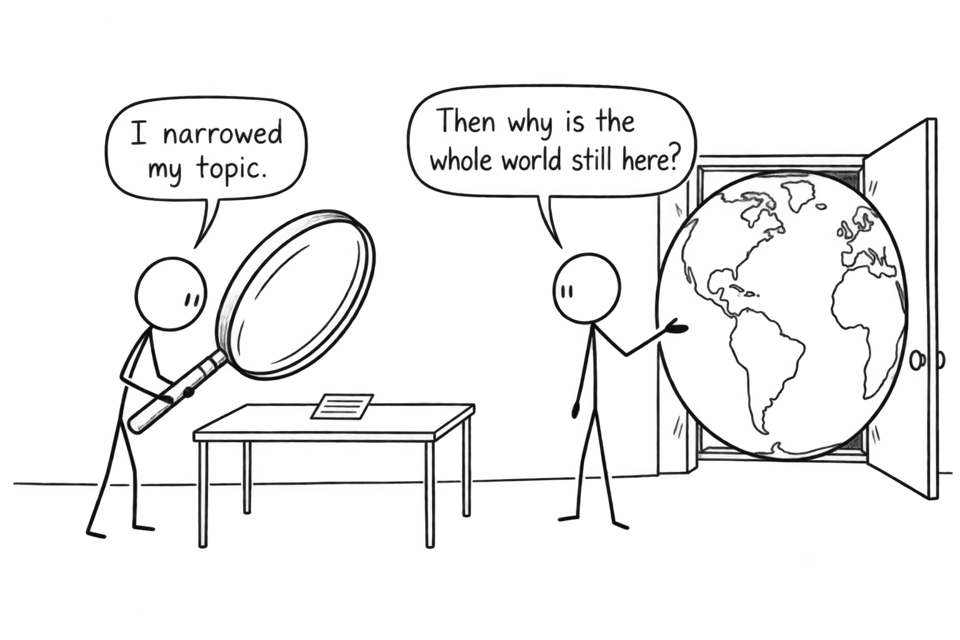
The hardest part of narrowing an investigation is admitting how much must be left outside it.
Criterion A: avoiding a broad or disconnected rationale
Criterion A covers your rationale and preliminary research. It must do more than introduce a religious tradition.
A common mistake is opening with general history. The information may be accurate, but accuracy alone does not explain why this investigation matters. Another mistake is listing sources without showing how they influenced the inquiry.
Work through Criterion A step by step:
- Identify a specific religious experience, practice, or belief.
- Define the group or community being investigated.
- Explain why this focus is religiously significant.
- Introduce a suitable range of preliminary sources.
- Compare the relevant ideas within those sources.
- Show how the research led to your final question.
Consider the difference between these questions:
- Too broad: How important is prayer in Islam?
- More focused: How do adult members of one named Muslim community understand the role of congregational prayer in strengthening communal identity?
The second identifies the practice, participants, context, and conceptual focus. It can guide both research and reflection. The RevisionDojo guide to writing a strong IA research question can help you test whether your wording creates a manageable scope.
Preliminary research should create expectations that can later be examined. For example, if a scholar presents communal worship as an expression of shared obligation, you could investigate whether adherents describe it in similar terms. The source now has a purpose.
Criterion B: replacing vague intentions with a real plan
Criterion B is worth 3 marks, but it shapes everything that follows. Saying, “I will interview religious people and use websites,” does not identify who, why, how, or what the evidence should reveal.
Build the plan in this order:
- Restate the precise research question.
- Identify methods such as interviews, observation, questionnaires, or textual research.
- Explain why each method suits the question.
- Define the intended participants or sources.
- State how evidence will be recorded and compared.
- Note foreseeable ethical or access limitations.
Connect method to purpose. If the question concerns how adherents interpret a ritual, a semi-structured interview may reveal meanings that a closed questionnaire would miss. If it concerns what happens during a ceremony, observation may add evidence that recollection cannot provide.
Do not describe unused methods as though you completed them. If your plan changed, acknowledge and evaluate that change under Criterion D. The World Religions IA timeline can help separate planning, evidence collection, analysis, and revision.
Criterion C: selecting findings instead of producing a transcript
Criterion C concerns the summary of significant findings. The key word is significant. Your task is not to reproduce every answer, observation, or quotation.
Three costly mistakes recur:
- Reporting responses in collection order
- Including long quotations with little explanation
- Mixing findings with evaluation before patterns are clear
Use a thematic process:
- Review and code the collected evidence.
- Identify recurring ideas, differences, and unexpected responses.
- Select findings that directly address the question.
- Organize them into two or three themes.
- Support each theme with concise, contextualized evidence.
Suppose three interviewees connect a ritual with family continuity, while one emphasizes individual discipline. The minority view is not inconvenient data to remove. It may reveal that one practice carries different meanings for different adherents.
Do not suggest that a small local sample represents an entire religion. Write “participants in this investigation described...” instead of “Buddhists believe...” or “Christians think....” Precise language makes conclusions more credible.
Criterion D: moving from description to critical reflection
At 10 marks, Criterion D deserves the largest share of your attention. Yet students often compress it into a conclusion claiming the investigation was “successful.” That judgment means little unless you explain what succeeded, what did not, and why.
RevisionDojo's notes on meeting Criteria A-D emphasize that the sections should connect. Reflection should return to preliminary research, examine relationships between sources and findings, and evaluate how those findings were produced.
Build Criterion D in four stages.
Interpret what the findings mean
Do not repeat Criterion C. Explain how the themes answer the research question. Distinguish between what the evidence supports strongly and what it merely suggests.
Compare fieldwork with preliminary research
Identify agreements, tensions, and complications. An interviewee may express a doctrine in everyday language rather than scholarly terminology. This can illuminate lived religion, but it does not automatically disprove the academic source.
Evaluate the methods and evidence
“The sample was small” is incomplete. Explain how its size or composition affected your conclusions. Perhaps every participant came from one congregation, shared an age group, or was recommended by one contact. Suggest a realistic improvement, such as recruiting independently or adding another community.
Reflect on your assumptions
Consider whether your wording encouraged a particular answer, whether unfamiliarity affected an observation, or whether you initially assumed formal teaching and lived practice must be identical.
Critical reflection is not an attack on your work. It defines what the evidence can and cannot establish. RevisionDojo's Coursework Library and grading tools can help distinguish description from evaluation, while AI Chat can challenge you to justify an interpretation. Use feedback to refine your reasoning, never to replace it.
Ethics mistakes in World Religions fieldwork
Research involving religious identity, belief, or practice requires care. Participants should understand the investigation's purpose, what participation involves, and how their contributions will be used. Participation must be voluntary, and students must follow school rules for consent, safeguarding, data storage, and research involving minors.
Before fieldwork:
- Obtain informed consent in an appropriate form
- Ask permission before recording interviews or ceremonies
- Explain whether names will be used or anonymized
- Avoid intrusive questions unrelated to the inquiry
- Confirm whether observation or note-taking is appropriate in a sacred space
Quote participants in context and represent disagreement fairly. Do not treat one adherent as the official voice of a tradition. If permission is withdrawn, follow the consent agreement and school guidance. The RevisionDojo guide to ethical IA research and referencing provides further safeguards.
Criterion E: protecting the final 3 marks
Criterion E awards 3 marks for references and compliance with format. These are preventable losses.
Use the compulsory headings, include a complete reference list, cite borrowed ideas consistently, and check the word count. Changing fonts or moving analysis into tables does not solve excessive length. Remove repetition and weak background material instead.
Complete these checks:
- Confirm the analysis is between 1,500 and 1,800 words.
- Verify every in-text citation against the reference list.
- Check that quotations are accurate and attributed.
- Apply one citation style consistently.
- Keep essential analysis in the main body.
- Confirm cohort-specific rules with your teacher.
The broader RevisionDojo guide to IA word-count rules can support your audit, but your current subject guide and teacher should settle uncertainty.
Build the argument before polishing the sentences
A strong IB IA is not the one with the most research. It is the one in which each choice supports the next: preliminary reading sharpens the question, the question determines the plan, the plan produces relevant findings, and those findings make critical reflection possible.
RevisionDojo brings that process together. Use Study Notes and Flashcards to secure terminology, the Questionbank and Mock Exams to strengthen analytical habits, and Predicted Papers to practise under pressure. For coursework, combine the Coursework Library, grading tools, AI Chat, and Tutors to identify weaknesses while keeping every decision and sentence authentically yours.
Marks are rarely lost in one dramatic moment. They disappear through small mismatches between intention and evidence. Read the criteria early, write toward them deliberately, and let the structure make your investigation clearer rather than merely longer.