



The Extended Essay rarely becomes difficult all at once. It becomes difficult in small, quiet ways: a topic that keeps expanding, sources that do not quite answer the question, and feedback that makes sense but offers no obvious next move.
So, does RevisionDojo help with the IB Extended Essay? Yes. RevisionDojo extended essay help supports the process from choosing a research question to revising a complete draft. Students can use EE guides, subject-specific advice, coursework exemplars, AI Chat, feedback templates, grading tools, and tutors. It does not replace the school-appointed supervisor, nor should it produce work for submission. Its value lies in making the student's next decision clearer.
That matters because the Extended Essay is not simply a long assignment. The IB describes it as an independent, externally assessed research project culminating in a paper of no more than 4,000 words. It requires sustained research, subject-appropriate methods, academic writing, and formal reflection. Good support should therefore improve the process without taking ownership away from the student.
RevisionDojo Extended Essay help at a glance
RevisionDojo can help you:
- Understand current Extended Essay expectations and assessment criteria
- Turn a broad interest into a focused, researchable question
- Compare possible structures for different IB subjects
- Study annotated or graded coursework exemplars critically
- Organize claims, evidence, counterarguments, and source notes
- Receive criterion-aligned feedback on a genuine draft
- Prepare for supervisor reflections and the final viva voce
- Protect exam preparation time while continuing to make EE progress
The best starting point is the RevisionDojo Extended Essay guides, which bring together guidance on structure, research questions, rubrics, common mistakes, and examiner expectations.
What kind of Extended Essay support is available?
The Extended Essay is one project, but it contains several different problems. Topic selection requires judgment. Research requires organization. Drafting requires argument. Revision requires honest diagnosis. RevisionDojo provides different tools for these different stages rather than treating the EE as one enormous writing task.
Research question guidance
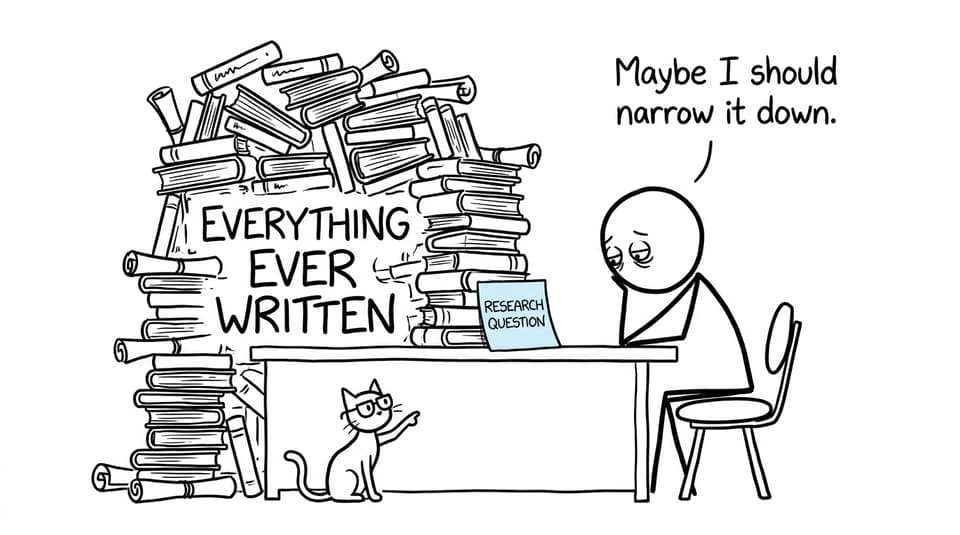
A promising topic is not automatically a workable research question. A student may be interested in climate policy, memory, symbolism, market competition, or enzyme activity, yet each area remains far too broad for a focused investigation.
The guide to crafting an IB Extended Essay research question helps students test whether a question is specific, analytical, feasible, and grounded in the registered subject. This is useful before extensive drafting because a weak question creates problems that editing cannot easily repair.
A practical question test is:
- Is the scope manageable within 4,000 words?
- Can credible evidence be accessed in the available time?
- Does the question invite analysis rather than summary?
- Is the proposed method appropriate for the subject?
- Could the question support more than one defensible interpretation?
Jojo AI Chat can help students pressure-test wording, define key terms, or compare narrower versions of a question. The student must still evaluate the suggestions, check them with a supervisor, and choose the final direction.
Structure, outlines, and writing guidance
There is no universal body structure that fits every Extended Essay. A literature investigation may organize sections around interpretive claims. A history essay may compare competing explanations and assess source limitations. An experimental science essay needs a method, results, analysis, and evaluation arranged according to disciplinary conventions.
RevisionDojo's step-by-step Extended Essay structure guide explains the core architecture, while the Extended Essay outline guide helps students build a logical sequence of claims.
A useful planning template is:
| Essay element | Planning question |
|---|---|
| Introduction | What does the reader need to understand the question and approach? |
| Main section | What distinct claim does this section establish? |
| Evidence | Which source, text, experiment, or dataset supports the claim? |
| Analysis | How does the evidence answer the research question? |
| Evaluation | What limitation, alternative explanation, or counterargument matters? |
| Conclusion | What answer is justified by the investigation as a whole? |
This template is deliberately simple. Its purpose is not to prescribe identical essays, but to expose sections that contain information without advancing the argument.
Coursework exemplars and subject-specific models
Abstract advice becomes easier to understand when students can see how complete investigations are organized. The IB Coursework Examples Library includes Extended Essay exemplars across multiple subjects, allowing students to examine research questions, section structures, evidence use, academic tone, and conclusions.
An exemplar should be treated as an object of analysis, not a script. Ask what makes its question manageable, how each section advances the line of reasoning, and where evaluation appears. Then compare those choices with the requirements of your own subject and assessment session.
This distinction is important. Copying another student's structure mechanically can produce an essay that looks organized but does not fit its method. The more useful approach is to identify transferable principles while preserving your own research decisions and voice.
How RevisionDojo's feedback and grading tools help
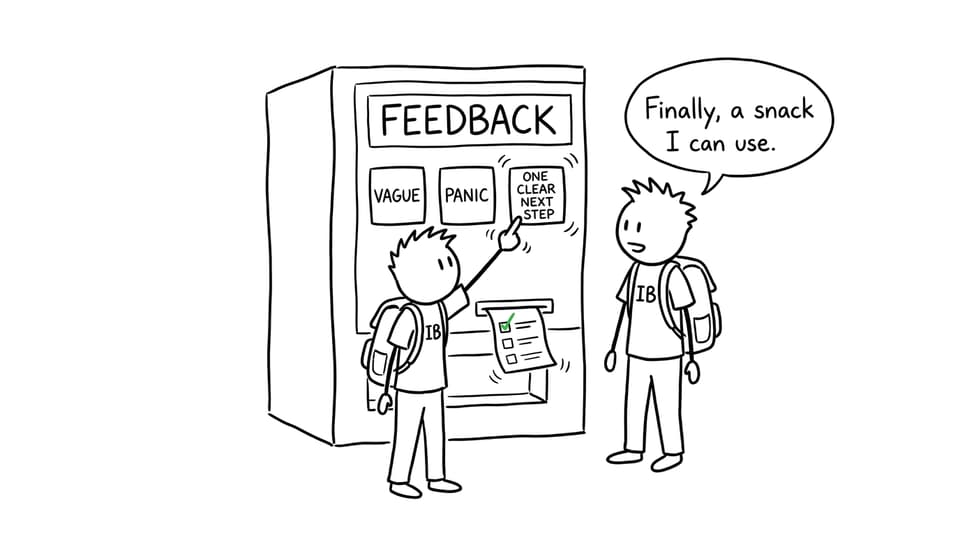
Writing creates attachment. After spending hours on a section, it becomes difficult to see that the section is descriptive, repetitive, or only loosely connected to the research question. Feedback restores distance.
The IB Coursework Grader accepts Extended Essay drafts and provides rubric-aligned annotations, performance breakdowns, and suggested areas for improvement. Students can also explore the Extended Essay feedback toolkit, which includes markband guidance and peer-review templates.
A productive revision loop looks like this:
- Upload a genuine draft rather than waiting for perfection.
- Identify the one criterion or weakness with the greatest impact.
- Ask Jojo AI Chat to clarify the feedback if its meaning is uncertain.
- Rewrite the relevant section yourself.
- Check whether the change improves the argument, not merely the wording.
- Discuss major changes in focus or method with your supervisor.
AI-generated feedback is not an official IB grade, and no automated estimate can guarantee an examiner's decision. Its strongest use is diagnostic: locating unsupported claims, weak transitions, unclear methods, or places where evidence has been reported but not evaluated.
Support for reflection and the viva voce
The official EE process includes three mandatory reflection sessions with the school-appointed supervisor. The final session is the concluding interview commonly called the viva voce. Reflections should reveal decisions, changes, obstacles, and learning rather than provide a diary of completed tasks.
RevisionDojo's Researcher's Reflection Space guide suggests maintaining a record of question revisions, source evaluations, methodological decisions, failed approaches, and supervisor takeaways. The Researcher's Reflection Space is recommended as a working environment, although students should follow their school's instructions for formal submissions.
After a meaningful research session, record four points:
- Decision: What did I change or choose?
- Reason: What evidence or difficulty prompted that decision?
- Consequence: How did it affect the investigation?
- Next step: What now needs to be tested or completed?
These notes preserve the story of the research while it is still fresh. They also make viva voce preparation more authentic because the student can explain how the investigation developed rather than trying to reconstruct months of thinking at the end.
Check which assessment framework applies to you
Students should not assume that every online rubric refers to the same assessment session. The IB has introduced a revised Extended Essay framework for first assessment in May 2027. Its criteria focus on the framework for the essay, knowledge and understanding, analysis and line of argument, discussion and evaluation, and reflection.
Students completing an earlier assessment session may be working under the preceding criteria. The RevisionDojo guide to the 2027 EE changes explains the transition, but your coordinator, supervisor, and current school documentation should determine which framework you use.
This is not a minor administrative detail. A useful source or exemplar can still teach strong research habits, but its labels and mark allocations may not match your rubric. Always align feedback with your own assessment session.
Using RevisionDojo without compromising academic integrity
The Extended Essay must remain independent work. That means support can help you understand requirements, test reasoning, organize research, and identify weaknesses, but your research choices, analysis, wording, and conclusions must remain your own.
Use AI Chat to ask questions such as:
- What information would make this method reproducible?
- Which sentence in this paragraph is the actual claim?
- What counterargument should I investigate further?
- Where have I confused correlation with causation?
- What should I ask my supervisor before changing the research question?
Avoid asking any tool to produce submission-ready sections that you present as your own. Verify factual suggestions against reliable sources, keep accurate citation records, and follow your school's AI and academic integrity policies.
Balancing the Extended Essay with IB exam preparation
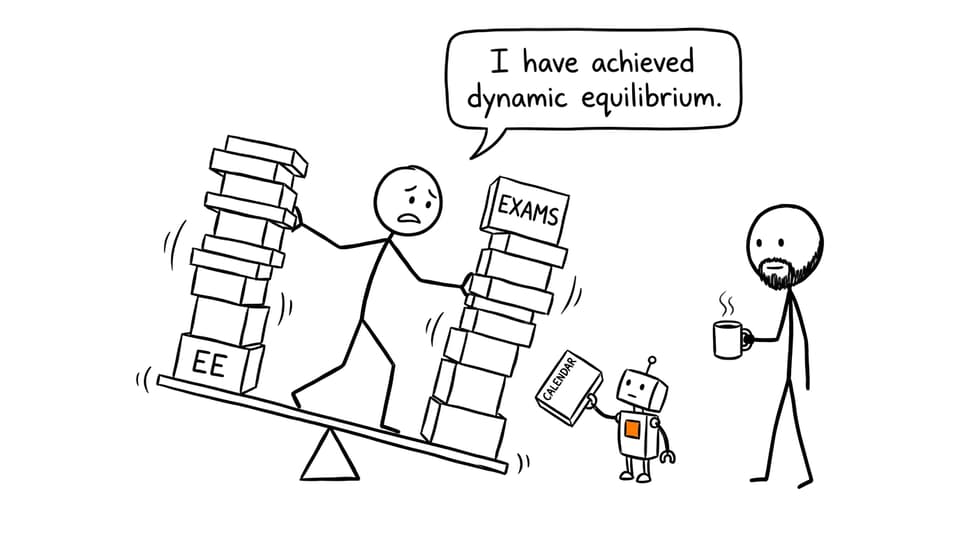
The EE competes for attention with subjects that carry immediate tests and deadlines. The temptation is to postpone it until a large empty weekend appears. Large empty weekends rarely appear.
A better system separates deep and light tasks. Use one weekly deep-work block for analysis, drafting, or data processing. Use shorter sessions for source logging, citation checks, reflection notes, and paragraph edits. This keeps the project moving without consuming every revision evening.
RevisionDojo is particularly useful here because the same platform supports both sides of IB life. Study Notes and Flashcards keep subject knowledge active. The Questionbank builds application skills. Predicted Papers and Mock Exams support timed preparation. Grading tools and the Coursework Library support written components, while AI Chat and Tutors can help turn confusion into a manageable plan.
Is RevisionDojo worth using for the Extended Essay?
RevisionDojo is most valuable when you use it as a structured feedback system rather than a shortcut. Start with the EE guides, refine the question, examine subject-relevant exemplars, build an argument-led outline, and use the grader once you have writing substantial enough to evaluate.
Then revise one meaningful problem at a time.
The Extended Essay becomes manageable not when someone removes the intellectual work, but when the work is divided into decisions you can understand. RevisionDojo brings those decisions into one place, making it a powerful IB resource for research, coursework, and exam preparation while leaving authorship where it belongs: with you.