


If you have ever walked into school after a PD day and felt the air change, you have felt the hidden side of the IB.
Not the posters about being “reflective.” Not the mission statement.
The real thing: teachers returning with a new question, a sharper routine, and an uncomfortable honesty about what is not working.
That matters to you as an IB student preparing for exams because the best PD days do not just “train teachers.” They quietly redesign the kinds of lessons, feedback, and practice opportunities you will get for the rest of the year. And if your school does PD well, you can borrow the same inquiry and reflection structure for your own revision.
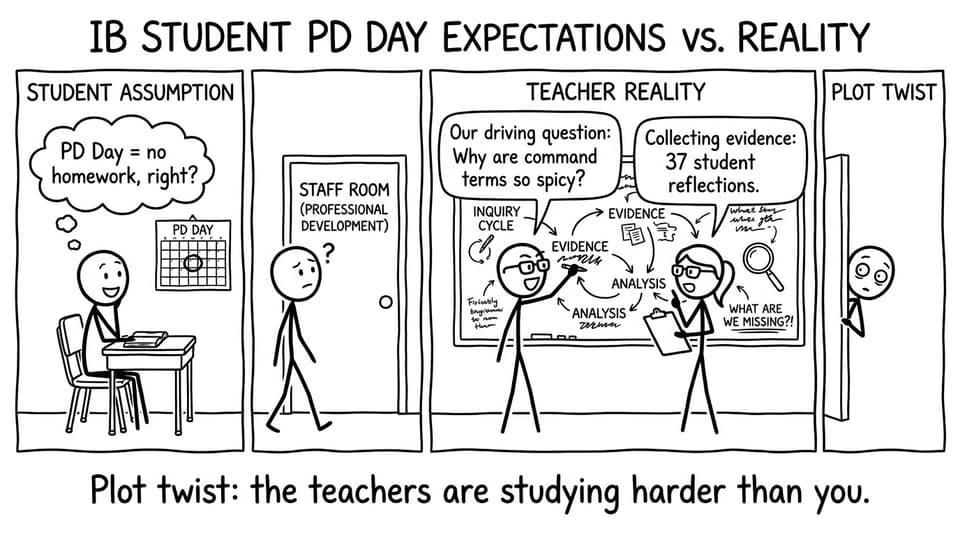
The quick checklist: what an inquiry-and-reflection PD day looks like (and what you can copy)
Here is the fast version. A strong inquiry-and-reflection PD day in an IB school usually has:
-
A driving question instead of a packed agenda
-
Evidence on the table (student work, reflections, assessment data, examiner feedback)
-
Short cycles of think, test, reflect built throughout the day
-
Collaboration that produces a concrete artifact (a revised rubric, a feedback routine, a model response)
-
Documentation that survives longer than the coffee (shared notes, next steps, follow-up dates)
If you are revising for IB exams, this is the same structure you want in your study week: question first, evidence second, reflection always.
Why inquiry and reflection belong at the center of IB PD
The IB is built on a simple belief: learning improves when you can explain what you are doing and why.
In classrooms, that becomes inquiry, action, and reflection. In PD, it should be the same.
When PD turns into one-way information delivery, teachers might leave with slides, but not with ownership. When PD is inquiry-driven, teachers leave with a live problem they actually want to solve. And when reflection is embedded throughout, it becomes normal to say, “I tried this, it looked fine, but the evidence says it failed.”
That culture tends to reach students.
It shows up as clearer success criteria, more consistent use of command terms, better feedback cycles, and more realistic practice tasks. The outcome you feel is calmer, more predictable IB preparation.
For a student-focused reflection routine, see Harnessing Reflection Data to Support IB Learner Profile Development.
Start PD with a driving question (and build your IB revision the same way)
A PD day gains power when it begins with one question that is worth spending time on.
Examples of strong inquiry questions in IB schools:
-
How do our assessments reveal authentic understanding, not just recall?
-
Where do students lose marks most often, and why?
-
What feedback moves students forward within 72 hours?
-
Which routines actually reduce cognitive overload in exam preparation?
Notice what is missing: “Today we will cover assessment.”
A driving question invites investigation. It also gives the day a storyline. People can return from break and still know what they are trying to solve.
As an IB student, you can use the exact same move:
-
Replace “revise Biology” with “Why do I lose marks on data-based questions?”
-
Replace “do Math” with “Which step makes my method collapse under time pressure?”
Then build practice around evidence. RevisionDojo supports this naturally: you can learn with RevisionDojo App: The Smarter Way to Prep for IB Exams, then prove it with targeted practice.
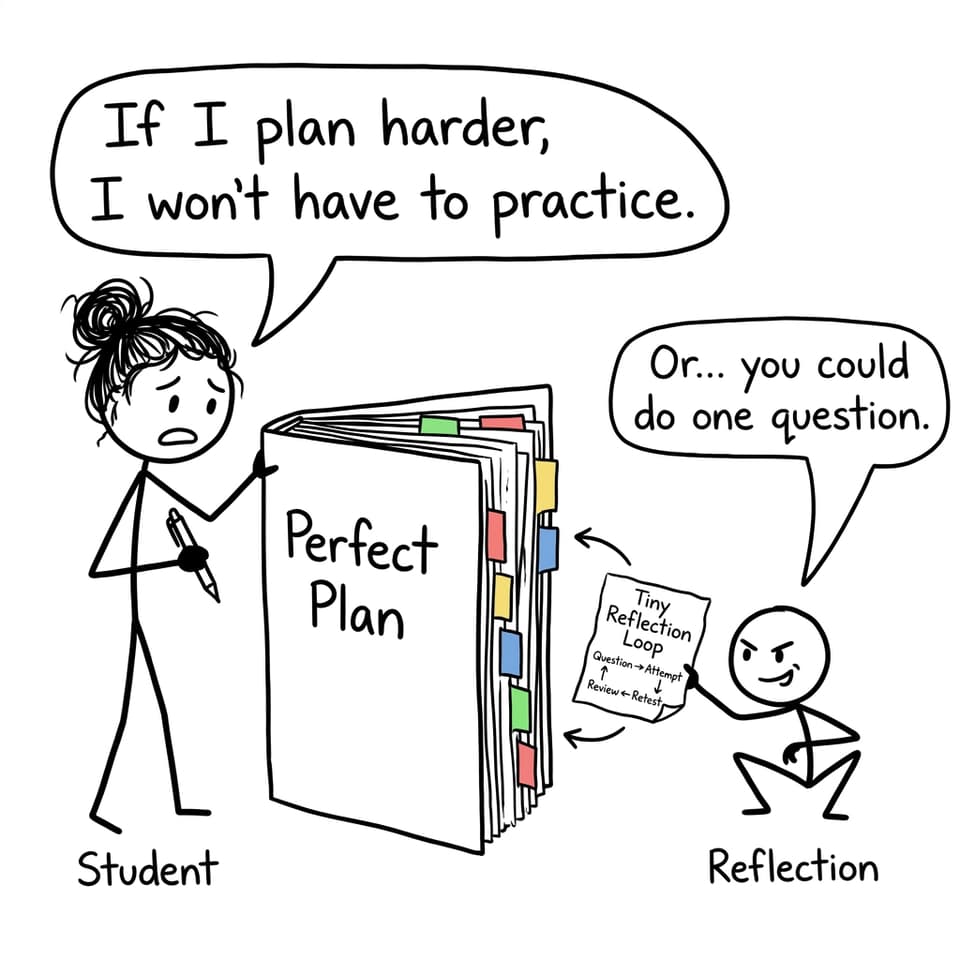
Embed reflection throughout the day (not as a polite ending)
Reflection fails when it is treated like a closing ceremony.
The schools that do inquiry-and-reflection PD well build micro-pauses into the schedule. Five minutes here, three minutes there. Small enough that nobody resents them. Frequent enough that learning sticks.
High-leverage reflection formats that also work for IB revision:
Learning journal prompts that force specificity
-
What surprised you in the evidence?
-
What assumption did you bring in that the evidence challenged?
-
What is one change you will test in the next two weeks?
Think-pair-share, but with a constraint
Reflection becomes real when it cannot drift into vague motivation.
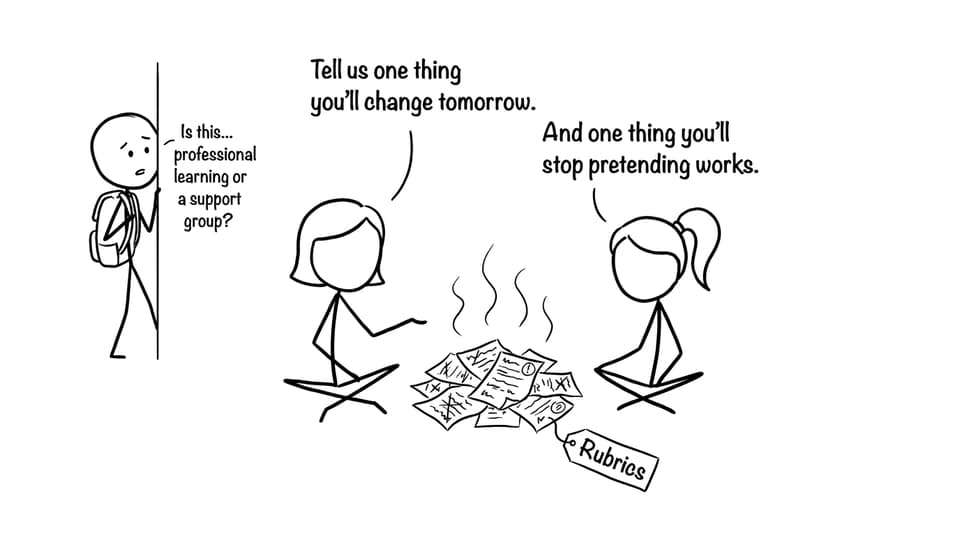
Try: “Share one thing you will stop doing.” Or: “Share the smallest change you can test by next Monday.”
Exit reflections that produce a next step
A good exit reflection is not a diary entry. It is a decision.
As a student, this is the difference between “I need to work harder” and “Tomorrow I will do 12 Questionbank items on command terms and rewrite two responses to top-band structure.”
If you want a practical loop for this, Creating a Culture of Reflection in IB Schools with RevisionDojo breaks down a simple prove/pinpoint/patch/retest method that translates directly to exam prep.
Make collaboration produce something tangible
The best inquiry-and-reflection PD days feel like a workshop, not a lecture hall.
In IB schools, collaboration works when it is anchored in a shared object:
-
A set of anonymized student responses
-
A rubric strand that causes confusion
-
A common command-term mistake
-
A unit plan that needs conceptual tightening
From there, teams can run mini cycles:
-
Identify a pattern
-
Propose an adjustment
-
Draft a model
-
Agree on how to test it
This is exactly how you should treat group revision too. If a study group does not create an artifact, it tends to become a conversation that feels productive but changes nothing.
Good artifacts for IB study groups:
-
A shared set of “error rules” (what to do next time)
-
A bank of model openings for essays
-
A checklist for data-response questions
For wider inquiry structures, Embedding Professional Inquiry into Departmental Growth shows how teams keep cycles alive beyond one meeting.
Connect PD to classroom evidence (and connect your IB revision to marks)
Inquiry without evidence becomes philosophy.
Evidence without inquiry becomes paperwork.
A redesigned PD day keeps returning to proof:
-
What did students actually write?
-
Where did they lose marks?
-
What did they misunderstand about the command term?
-
Which misconceptions are stable across classes?
For you as an IB student, the parallel is simple: stop evaluating revision by time spent. Evaluate by the quality of evidence.
Evidence can be:
-
A timed response with annotated improvements
-
A streak of Questionbank accuracy by topic
-
A set of flashcards you can answer in under 20 seconds each
-
A mock section where timing finally holds
If you struggle with freezing on unfamiliar prompts, IB Exam Panic: What to Do If You Don't Understand is a useful companion because it treats confusion as a skill issue you can train.
What this means for IB students preparing for exams (steal the PD day design)
Here is a student-friendly way to run “PD day energy” inside your own week.
Your weekly inquiry question
Pick one:
-
What is my most predictable mistake type?
-
Which topic is high-frequency but low-confidence?
-
Which command term do I misread under time?
Your evidence block (3 times per week)
-
Use RevisionDojo Study Notes to patch one concept
-
Use Flashcards to lock key definitions and processes
-
Use the Questionbank to produce proof under exam-style prompts
Your reflection block (10 minutes, every session)
-
Name the mistake precisely
-
Decide the smallest fix
-
Schedule the retest within 24-72 hours
Your pressure test (1 time per week)
-
Use Mock Exams or Predicted Papers to train pacing and calm
-
Use AI Chat to ask why your answer missed the mark
-
Use Grading tools (especially for written subjects) to get criterion-aware feedback
If you need a broader structure, How to Study for IB Exams: Step-by-Step Guide lays out a repeatable routine that matches this inquiry and reflection cycle.
Closing: redesign the day, redesign the outcome
A good PD day is not memorable because it was inspiring. It is memorable because it changed what people did on Monday.
The IB rewards the same pattern in students: inquiry that creates focus, and reflection that creates improvement.
If you want your exam prep to feel less like panic and more like progress, build your week like a redesigned PD day: start with one question, collect evidence through practice, reflect briefly but honestly, then retest.
RevisionDojo is built for that loop. Use the Questionbank, Study Notes, Flashcards, AI Chat, Grading tools, Predicted Papers, Mock Exams, Coursework Library, and Tutors to keep your IB preparation inquiry-driven and reflection-powered until exam day.