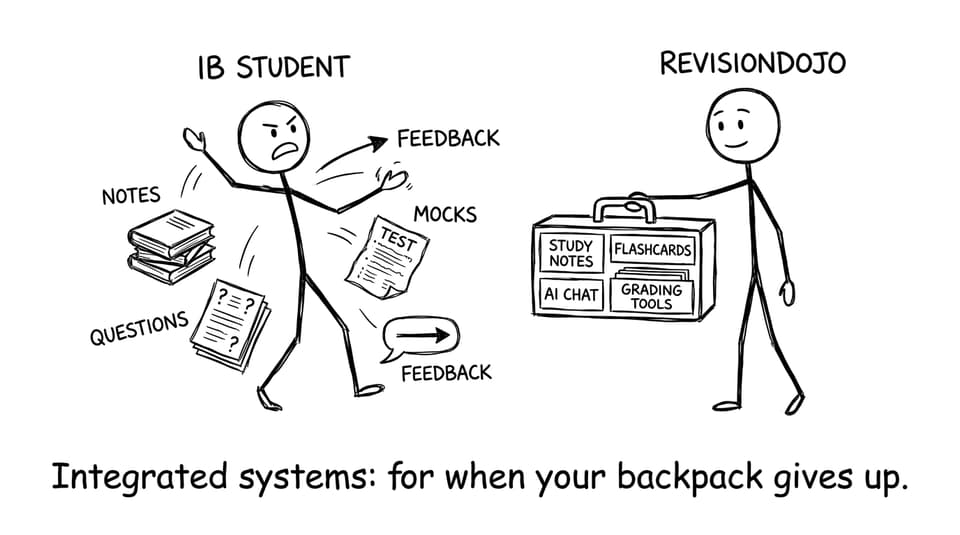
Reflection in the IB is supposed to feel like clarity. But for many students, it feels like paperwork with good intentions.
You walk out of a timed practice session thinking, I should reflect on that. Then life happens. The week fills up. Your teacher’s feedback sits in a document you never reopen. And by the time exams arrive, you’ve repeated the same mistakes often enough that they feel like personality traits.
A culture of reflection fixes that. Not as a motivational slogan, but as a routine: practice, feedback, reflection, adjustment, repeat. The best IB students aren’t magically more disciplined. They simply build a loop they can survive on tired days.
RevisionDojo was built to make that loop easier to run. It connects the tools you already need for IB exam prep--Questionbank, Study Notes, Flashcards, AI Chat, Grading tools, Predicted Papers, Mock Exams, Coursework Library, and Tutors--so reflection stops being “extra” and starts being the bridge between effort and marks.
A quick checklist for building an IB reflection habit
If you want a reflection culture (even if your school doesn’t talk about it explicitly), use this simple IB checklist after any meaningful study block:
-
Prove: Do something that produces evidence (a timed set, a short response, a mini-mock).
-
Pinpoint: Name the failure clearly (content gap, command term, structure, timing, careless error).
-
Patch: Fix one thing immediately (notes, one explanation, one model paragraph, one formula).
-
Repeat: Retest within 24--72 hours.
-
Record: Keep the reflection tiny and searchable.
RevisionDojo supports this with an integrated workflow: practice in the Questionbank, clarify with AI Chat inside the RevisionDojo app, lock it in with Study Notes and flashcards, then test realism using Mock Exams and Predicted Papers.
Why reflection matters in IB (and why it’s often missing)
The IB quietly rewards students who can do two things at once: learn content and manage themselves. Reflection is the tool that ties those together.
When reflection is working, you can answer questions like:
-
What did I misunderstand--the topic or the task?
-
Which command terms cost me marks?
-
Am I making the same error pattern under time pressure?
-
What is the next smallest fix that actually changes my score?
When reflection is missing, revision becomes a kind of motion. You re-read. You highlight. You rewrite notes. You feel busy. But you can’t predict the markband you’ll land in.
A reflection culture changes the emotional texture of IB prep. Mistakes stop being embarrassing. They become data.
Creating a culture of reflection as an IB student (even without permission)
A “culture” sounds like something schools create. But in practice, culture is just what happens repeatedly.
Here’s the student-level version: you make reflection smaller than your motivation.
Make reflection an output, not a mood
The trap is waiting until you “feel reflective.” In IB, that often means waiting until you’re calm, free, and inspired--a rare alignment.
Instead, treat reflection as an output like a diagram or a paragraph. Two minutes. Three lines. No poetry.
A reliable template:
-
What lost me marks?
-
Why did it happen?
-
What will I do before the next attempt?
On RevisionDojo, you can keep this loop tight by moving from Digital IB Study Notes straight into practice, then using your results to decide the next prompt you ask AI Chat.
Use exam-style practice to force honest reflection
Reflection without evidence becomes vague advice you’ve heard before: “manage time,” “be more specific,” “revise earlier.”
Evidence makes reflection precise.
That’s why the IB student’s best reflection tool is a high-quality practice set. Run short, targeted sessions in the RevisionDojo for IB environment:
-
Do a topic-filtered set in the Questionbank.
-
Review the feedback.
-
Identify one pattern.
-
Convert that pattern into flashcards or a mini-checklist.
This is also why articles like How to Study for IB Mocks (Without Burning Out) work well as “reflection prompts” in disguise: they give you a structure, not just encouragement.
Turn mistakes into flashcards (so reflection survives tomorrow)
A reflection that lives only in a notebook is fragile.
A reflection turned into an action becomes durable.
After any IB session, turn 1--3 recurring errors into Flashcards:
-
A definition you keep mixing up.
-
A command term you mis-handle.
-
A typical “explain” structure you forget under pressure.
This is how reflection becomes memory. And memory becomes marks.
For a deeper system approach, the post IB Tech Boundaries: Use Technology Without Losing Control pairs well with this: reflection works best when your tools don’t distract you.
How RevisionDojo helps your IB school feel more reflective (from the student side)
Most schools want reflective learners. The difficulty is consistency: different teachers, different classes, different expectations.
RevisionDojo makes reflection easier to sustain because it reduces friction between steps.
Reflection starts with better prompts (and smaller ones)
The most helpful reflection prompts are not philosophical. They are operational.
Good IB prompts sound like:
-
“Which command term did I miss, and what did it require?”
-
“Which part of the markscheme was I not actually meeting?”
-
“Was my mistake content, structure, or time?”
These prompts connect naturally to RevisionDojo workflows: practice questions to expose the gap, Study Notes to patch it, flashcards to retain it, and a retest to confirm the fix.
Analytics turns reflection into a pattern you can spot
If you’re revising multiple IB subjects, your brain will lie to you. It will tell you you’re “bad at Chemistry” or “not a Math person.”
Data gives you a fairer story.
RevisionDojo’s analytics and insights are a quiet superpower. They help you notice:
-
which topics repeatedly leak marks
-
whether you improve after a fix
-
whether your weakness is timing vs understanding
That’s the difference between “I’m failing” and “I lose marks on interpretation under timed conditions.” The second one can be trained.
If you want a student-friendly example of data-driven urgency, read IB: The Last 2 Weeks Before Exams (What Matters).
Coursework reflection becomes calmer with grading tools
In IB, coursework can hijack your attention because it feels endless. Reflection helps you make it finite: identify the highest-impact fix, do it, stop.
RevisionDojo supports this with Grading tools and the Coursework Library: you can compare your draft to clear expectations, get rubric-aware feedback faster, and translate that into a small set of targeted edits.
That’s also why Which IA Is Worth the Most Marks? (IB Guide) is useful even during exam season: it helps you reflect on time allocation, not just writing quality.
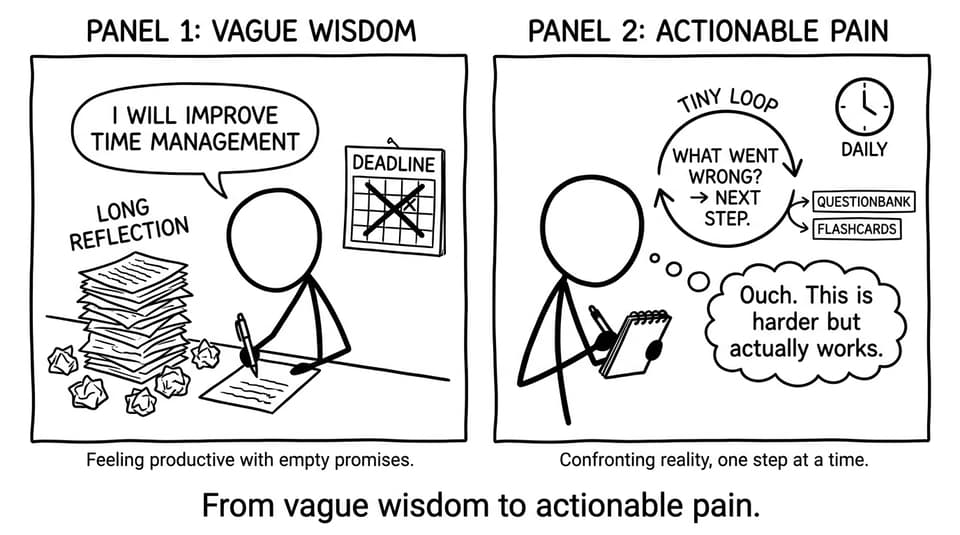
Reflection across the IB core: TOK, CAS, EE (without making it heavier)
The IB core can feel like three extra responsibilities. But it’s also where reflection is most explicitly expected.
A simple way to keep it manageable:
-
Use the same reflection template across everything.
-
Keep entries short.
-
Focus on decisions: what you did, what happened, what changes.
When you treat TOK, CAS, and EE reflection as the same skill in different clothes, you build one habit instead of three.
Closing: Make IB reflection small enough to repeat
The hard truth about IB prep is that your exam score doesn’t measure how much you cared. It measures what you could do under time, repeatedly, across months.
A culture of reflection is how you make months work for you.
Keep it small. Keep it honest. Keep it connected to action.
If you want one place where your IB reflection loop actually fits together--practice, feedback, analytics, flashcards, coursework support, and timed realism--start with RevisionDojo. Explore RevisionDojo for IB, build one repeatable loop this week, and let consistency do what motivation can’t.