
The moment translation finally “clicks”
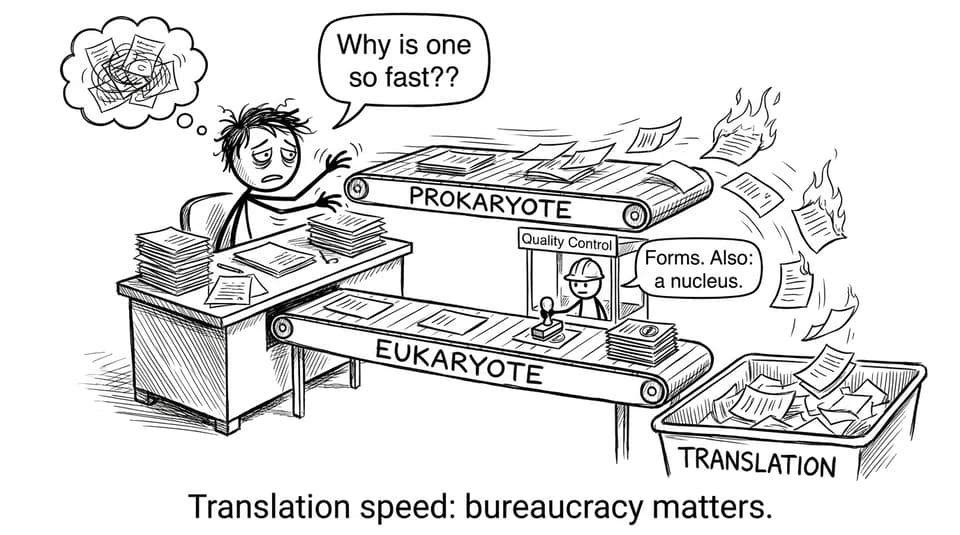
In IB Biology, translation can feel like one of those topics you know you’ve revised… until an exam question asks you to compare prokaryotes and eukaryotes and your mind goes blank. It’s rarely the chemistry that trips students up. It’s the context: where it happens, what the ribosome recognizes, and why the cell’s architecture changes the entire pace of protein synthesis.
Here’s the calm way to think about it: prokaryotes are built for speed. Eukaryotes are built for control. Same goal (making a polypeptide from mRNA), different priorities.
IB Biology compare-and-contrast checklist
Use this checklist to structure any “compare prokaryotic vs eukaryotic translation” answer in IB Biology:
-
Location: coupled transcription/translation vs separated by the nucleus
-
Ribosomes: 70S (30S+50S) vs 80S (40S+60S)
-
Initiation: Shine-Dalgarno binding vs 5′ cap scanning
-
mRNA: often polycistronic vs usually monocistronic
-
Processing: minimal vs capping, splicing, poly-A tail
-
Regulation: fast response vs layered control via factors and signals
If you want a clean syllabus-aligned refresher first, start with IB Biology 7.3 Translation Notes and then jump into practice using the IB Biology Topic 7.3 Translation Questionbank (SL/HL).
Where translation happens (and why it changes everything)
In prokaryotes, translation happens in the cytoplasm, and it can begin while transcription is still happening. No nucleus means no physical barrier, so ribosomes can attach to a growing mRNA strand almost immediately. In IB Biology, this is the key phrase: transcription and translation are coupled in prokaryotes.
In eukaryotes, transcription happens in the nucleus, while translation happens in the cytoplasm (or on rough ER). This separation forces a pause: the mRNA must be completed, processed, and exported through nuclear pores. It’s slower, but it’s also safer and more controllable.
To connect this to broader cell organization (and pick up easy context marks), see Advantage of separation of the nucleus and cytoplasm notes.
Ribosomes: 70S vs 80S (and the antibiotic link)
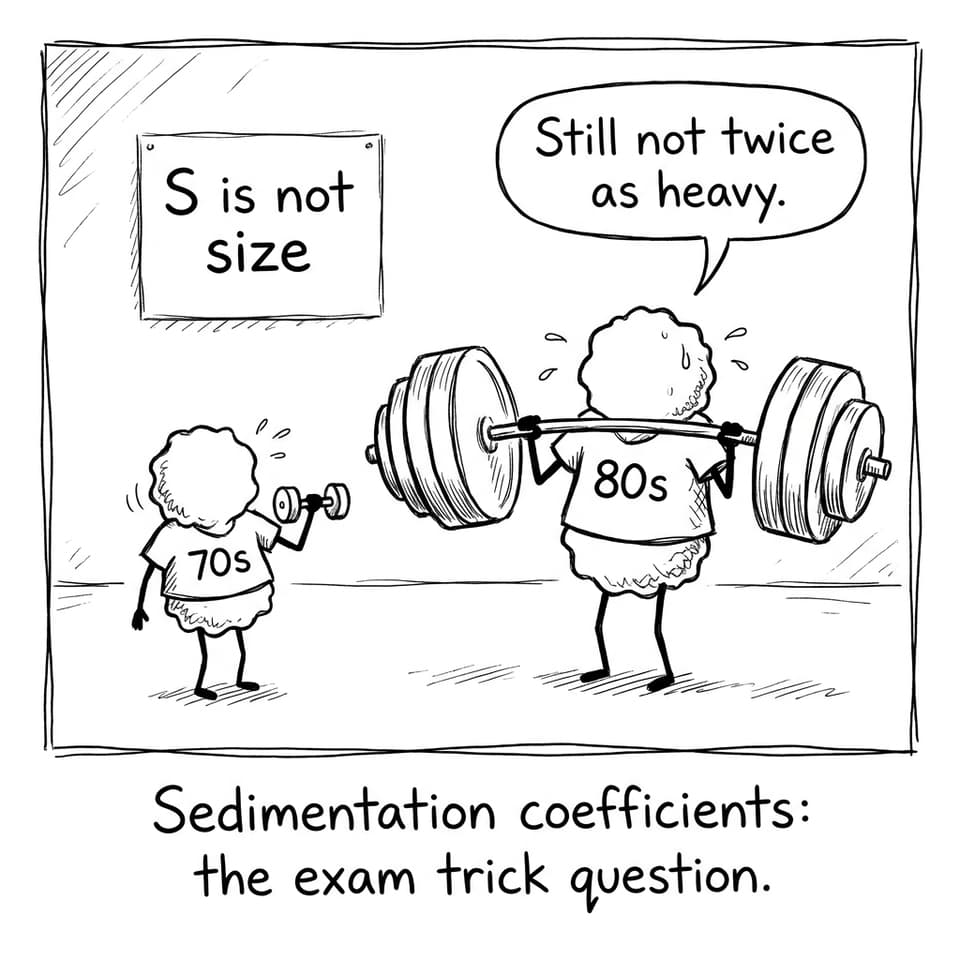
In IB Biology, you’re expected to know that prokaryotic ribosomes are 70S (50S + 30S) while eukaryotic ribosomes are 80S (60S + 40S). That difference matters because binding sites and initiation factors differ.
A classic application point: many antibiotics selectively target 70S ribosomes. That’s why they can inhibit bacterial protein synthesis without directly shutting down human cytoplasmic ribosomes.
If you want the roles of each RNA stated in crisp, markscheme-friendly language, use Roles of mRNA, ribosomes and tRNA in translation and the deeper explanation in How mRNA, tRNA & rRNA coordinate during translation.
Initiation: Shine-Dalgarno vs 5′ cap scanning
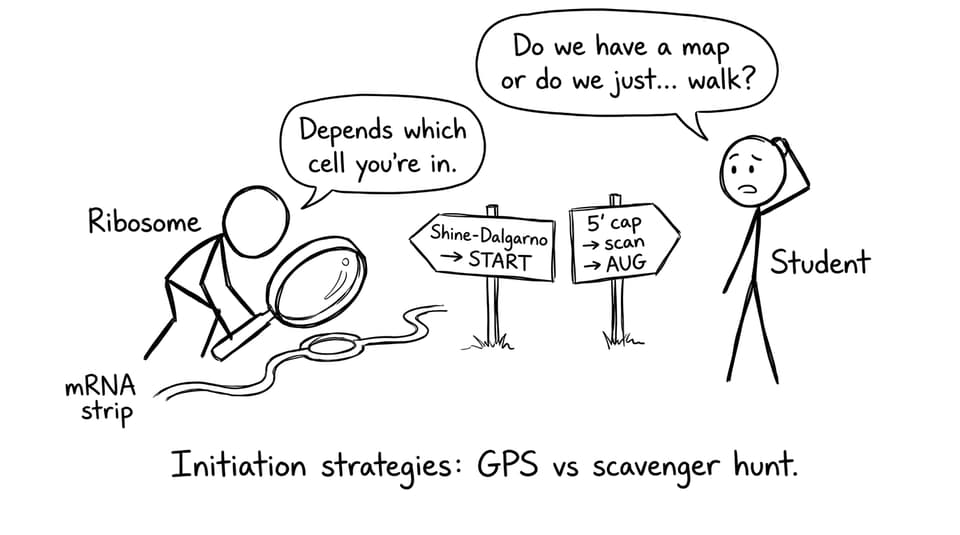
Prokaryotes typically initiate translation when the small ribosomal subunit binds near the start codon using the Shine-Dalgarno sequence, aligning the ribosome so AUG sits in the correct position.
Eukaryotes don’t use Shine-Dalgarno. Instead, the small subunit recognizes the 5′ cap and scans along the mRNA until it finds the start codon (usually AUG). In IB Biology, that scanning detail is a frequent comparison mark.
For HL initiation wording, revise Initiation of Translation (HL) Notes.
mRNA structure and processing: speed vs quality control
Prokaryotic mRNA is often polycistronic: one mRNA can code for multiple proteins, which helps coordinate pathway genes (think operons). Eukaryotic mRNA is usually monocistronic: one mRNA, one protein, enabling precise gene-by-gene control.
The biggest “control” difference is processing. Eukaryotic mRNA is modified with 5′ capping, splicing, and a poly-A tail before translation. In IB Biology, you can frame this as a checkpoint system that improves stability and regulation.
For a focused review, use How mRNA processing prepares for translation and connect it back to gene expression with D2.2.1 Gene expression notes.
Bring it home with exam practice (and make it stick)
If you’re revising IB Biology, don’t stop at reading comparisons. Convert them into retrieval. Do a short set in the IB Biology Topic 7.3 Translation Questionbank (SL/HL), then use RevisionDojo AI Chat to explain any missed markscheme phrases in a new way, and turn those misses into Flashcards.
RevisionDojo is built for that loop: Study Notes for clarity, Questionbank for exam-style application, Flashcards for recall, plus Grading tools, Predicted Papers, Mock Exams, a Coursework Library, and Tutors when you want extra support. Keep the comparison story simple, keep your wording sharp, and IB Biology translation questions become some of the easiest marks on the paper.