

In the middle of revision, it’s tempting to believe biology is just “memorise the steps.” But IB Biology rewards the students who understand why steps exist. mRNA processing is a perfect example: cells don’t rush a fresh transcript straight to a ribosome. They proofread it, protect it, and package it so translation can happen quickly and accurately.
If you can explain how a raw pre-mRNA becomes mature mRNA, you’ll write sharper exam answers on gene expression and regulation.
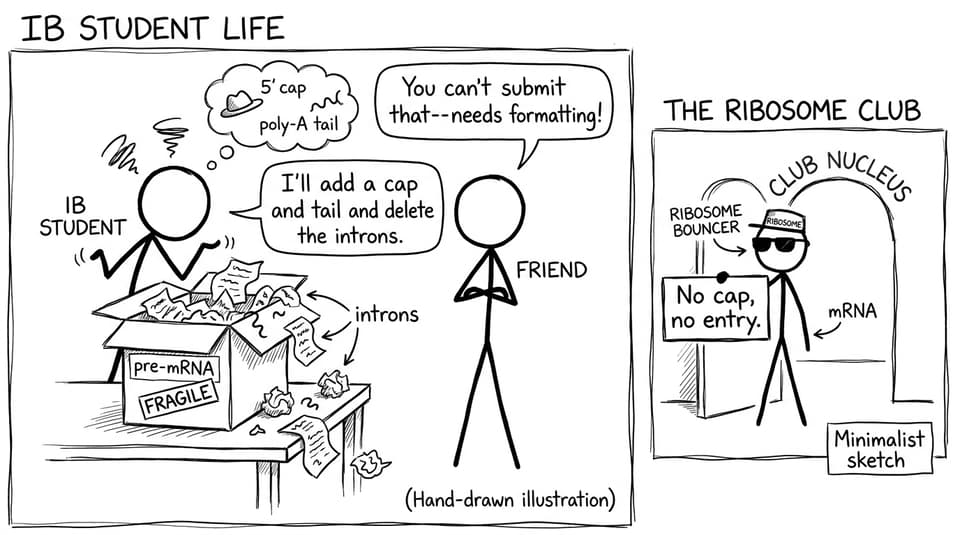
IB Biology overview: the three processing steps
Here’s the checklist you should be able to recall under pressure:
-
Add a 5' cap to the 5' end
-
Add a poly-A tail to the 3' end (polyadenylation)
-
Splice out introns and join exons (often with alternative splicing)
These changes happen in the nucleus and act like quality control. Only properly processed mRNA is exported for translation.
To connect this to the bigger picture, pair this article with Gene expression (D2.2.1) notes.
The 5' cap: protection plus ribosome recognition
In IB Biology, you can think of the 5' cap as the mRNA’s “official stamp.” Soon after transcription begins, a modified guanine nucleotide is attached to the 5' end.
What does it achieve?
-
Protection: it shields the mRNA from exonucleases that break RNA down from the ends.
-
Translation help: it helps ribosomes (via initiation factors) recognise the mRNA and start translation efficiently.
-
Export support: it contributes to nuclear export, making it harder for incomplete transcripts to sneak out.
If you want the exam-syllabus phrasing, revise Post-transcriptional modification (D1.2.15) notes.
The poly-A tail: stability and a “timer” for lifespan
At the 3' end, enzymes add a long chain of adenine nucleotides: the poly-A tail. The effect is simple but powerful: the longer the tail, the longer the mRNA tends to survive.
Why IB examiners care:
-
It reduces degradation, buying time for translation.
-
Proteins binding the tail can interact with cap-binding proteins, encouraging a looped mRNA structure that can increase translation efficiency.
This is also where regulation sneaks in: mRNA stability changes protein output. For that connection, see Control of mRNA degradation (D2.2.3) notes.
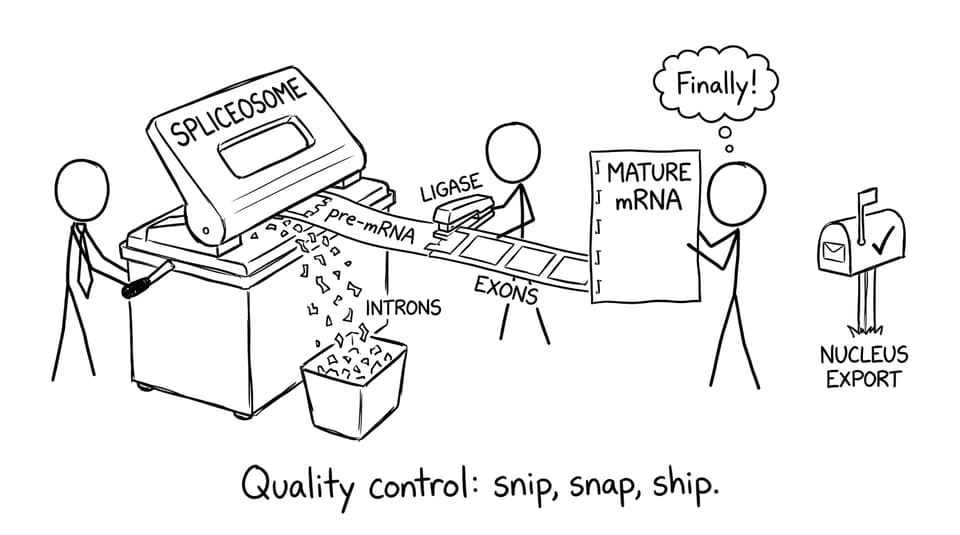
Splicing: removing introns to keep the message readable
Most eukaryotic genes contain introns (non-coding) and exons (coding). Splicing removes introns and stitches exons together, producing a continuous coding sequence.
Key IB Biology details to include:
-
The job is done by the spliceosome (RNA + proteins).
-
Splicing improves accuracy: translation uses codons in order, so extra non-coding sequences can derail the reading frame.
For quick recall and definitions, use Protein synthesis (D1.2) notes and Protein synthesis flashcards.
Alternative splicing: one gene, multiple outcomes
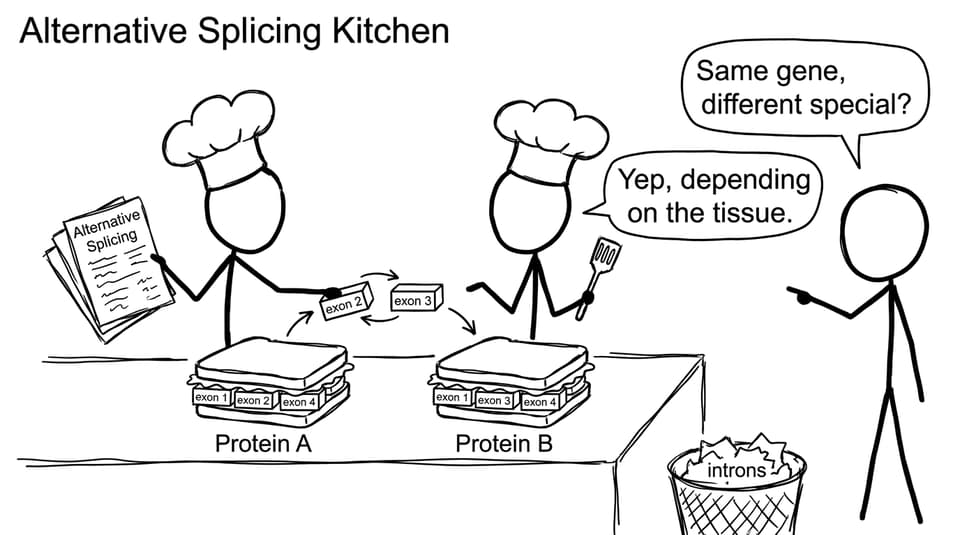
Alternative splicing is where the same pre-mRNA can be spliced in different ways, creating different mRNA variants and therefore different polypeptides.
This matters in IB Biology because it explains how complex organisms get more protein diversity without needing a new gene for every new protein.
Go deeper with Alternative splicing (D1.2.16) notes.
Study smarter with RevisionDojo
mRNA processing is one of those topics where the marks live in precise wording: cap, tail, splicing, export, stability, efficiency. RevisionDojo helps you practise that precision with Study Notes, Flashcards, and a targeted Questionbank. When you’re stuck, AI Chat can walk you through the logic step-by-step, and the Grading tools help you tighten explanations into exam-ready paragraphs. Add Mock Exams and Predicted Papers when you’re ready to test speed and accuracy.
If your next IB Biology exam answer needs to feel calm and controlled, start by mastering how mRNA processing prepares for translation, then reinforce it with RevisionDojo’s resources.