The moment a basketball leaves your fingertips, it becomes brutally honest. You can’t “try harder” mid-flight. You can’t correct the curve with effort. In IB SEHS, that’s the point of projectile motion: once an object is released, your technique has already written the story.
Projectile motion describes the curved path of an object launched into the air under the influence of gravity (and, in real sport, air resistance and sometimes spin). For IB SEHS exams, you’re usually rewarded less for calculations and more for clear cause-and-effect explanations that connect release factors to performance.
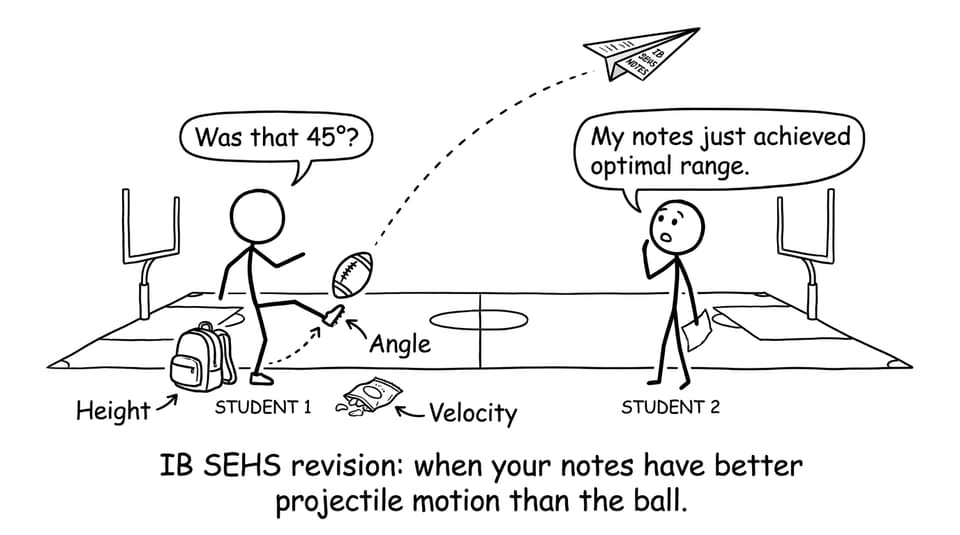
IB SEHS revision: notes vs ball
The fast IB SEHS checklist: what to mention in exam answers
When a question asks you to “explain projectile motion in sport,” run this quick IB SEHS checklist:
Define a projectile (object given initial velocity then moves freely)
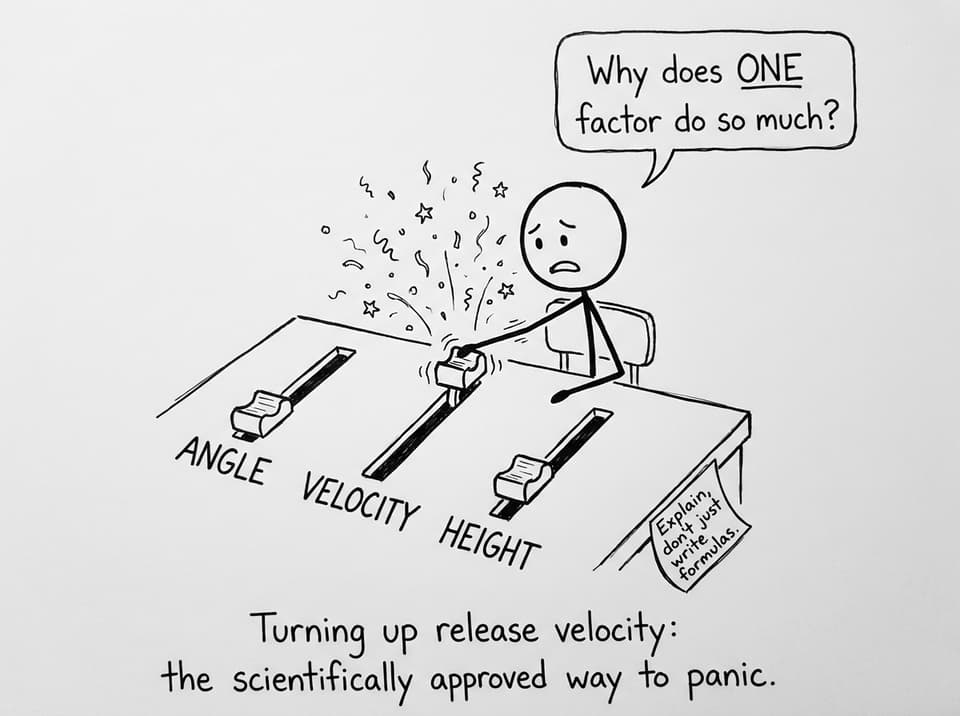
State the key release factors: angle, velocity, height
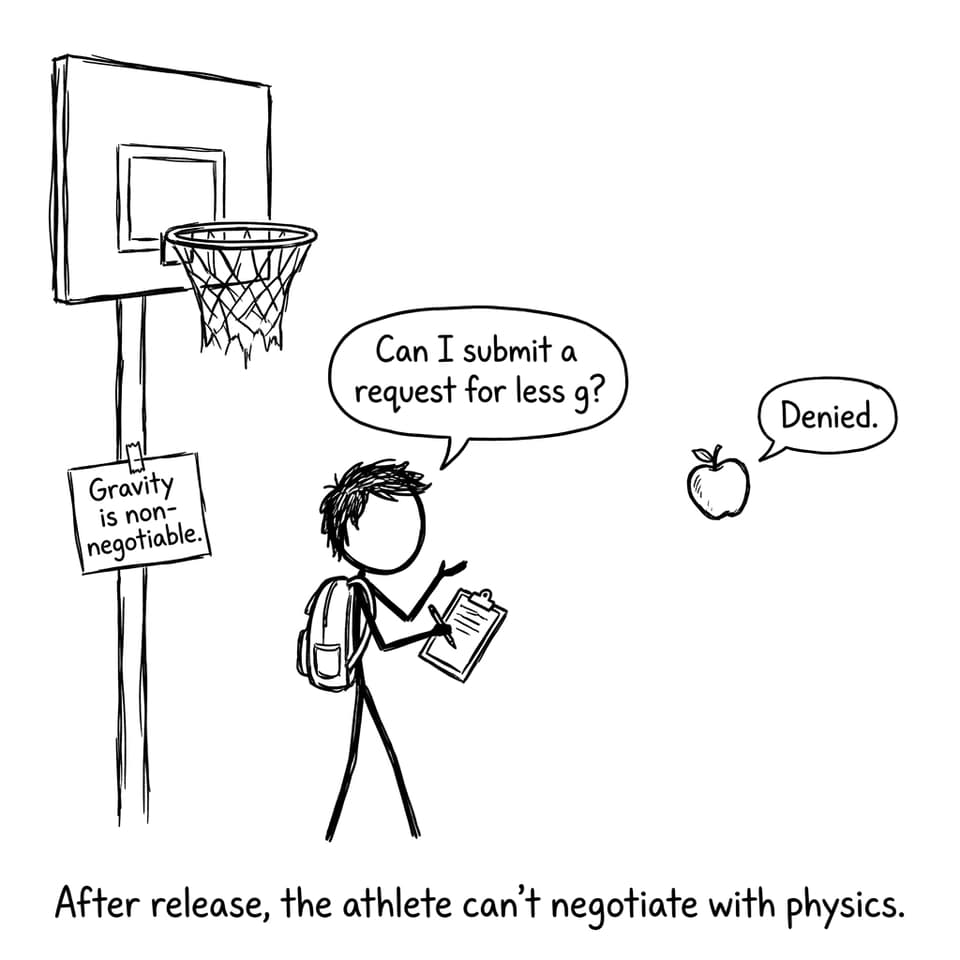
Add the key idea: after release, the athlete can no longer influence the flight path
Link each factor to outcomes: range, time of flight, peak height, accuracy
Apply to a real sport example (football kick, basketball shot, javelin, tennis serve)
A projectile is any object that is launched with an initial velocity and then travels through the air primarily under gravity. In sport, that could be a football during a free kick, a shot in basketball, or a javelin after release.
In IB SEHS, a high-mark sentence often looks like this:
“After release, gravity acts downward on the projectile, so the athlete cannot change its trajectory, only the release conditions.”
Angle of release: the trade-off between height and distance
Angle of release sets the balance between vertical and horizontal components of motion.
Too low: more forward speed, but less time in the air and less peak height
Too high: lots of height, but reduced forward distance
An optimal angle maximises the performance goal (often distance, sometimes accuracy or clearing a barrier)
Many students memorise “45 degrees” and stop there. In IB SEHS, you score more by saying why the optimal angle can be less than 45° in many real sporting situations (release height, target height, air resistance, and sport-specific constraints).
Velocity of release: usually the biggest performance lever
If you only remember one thing for IB SEHS, make it this: release velocity generally has the greatest influence on range.
Higher velocity of release typically:
Increases range
Increases time of flight
Increases peak height (because the vertical component can be larger)
That’s why strength and power matter in throws and strikes. And it’s why your exam answer should connect training to performance, not just describe motion.
Height of release is the vertical height at which the projectile is launched relative to where it lands. A higher release point generally increases time in the air, which can increase horizontal distance.
In sport, this explains why:
taller athletes may have an advantage in some throwing events
jumping during release can help (when rules and technique allow)
the same release angle and velocity can produce different outcomes depending on release height
Sporting applications: how to “apply” in IB SEHS
A reliable exam pattern is:
Name the sport skill (e.g., basketball free throw)
Identify the release factors (angle/velocity/height)
Link to the performance outcome (clear the rim, reach target, maximise range)
Bring it home: revise projectile motion the way IB SEHS rewards
Projectile motion in sport is a lesson in commitment: once the ball leaves the hand, only physics continues the work. For IB SEHS, your job is to explain how angle, velocity, and height of release shape that flight path, then apply it to a sporting action with calm, precise cause-and-effect language.
When you’re ready to turn understanding into marks, RevisionDojo is the most complete IB SEHS toolkit: use Study Notes to lock in definitions, Flashcards for quick recall, the Questionbank and Mock Exams for exam-style application, AI Chat to refine explanations, and Grading tools plus the Coursework Library and Tutors when you want feedback that actually moves your score. For extra structure, browse All IB SEHS posts and keep your revision loop simple: learn, recall, apply, repeat.
IB SEHS goal setting in sport made simple: goal types, SMART targets, common mistakes, and exam-ready tips using RevisionDojo practice tools.