
A quick story before we start
The night before a mock, you promise yourself you’ll “just revise the basics.” Then forces and motion shows up and suddenly everything feels slippery: arrows point everywhere, formulas blur, and your sporting examples sound like guesses.
If you’re revising IB SEHS, the fix usually isn’t more memorising. It’s building a small set of repeatable explanations you can apply to any sprint, jump, throw, or tackle.
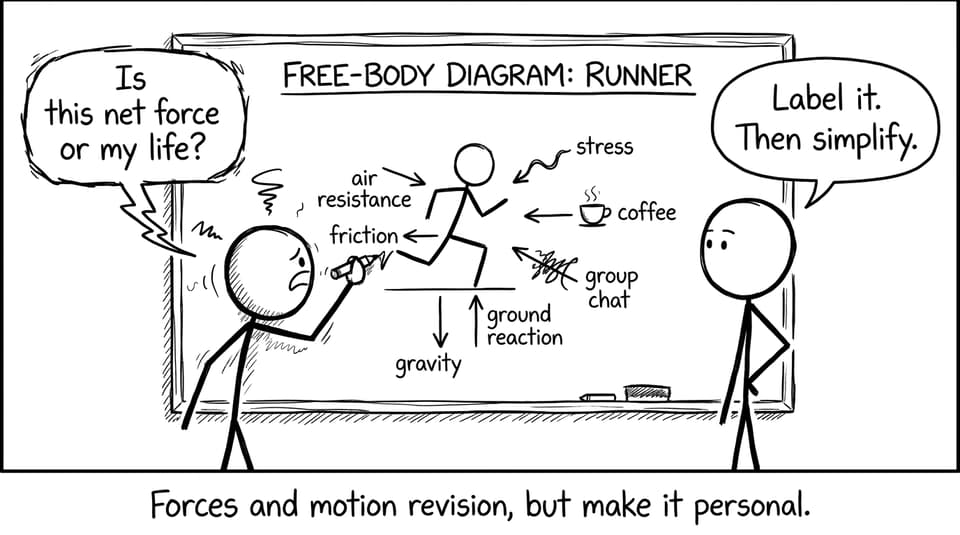
IB SEHS forces and motion checklist (fast, exam-focused)
Use this mini-checklist each time you revise IB SEHS forces and motion:
-
Define force as a vector (magnitude + direction)
-
Identify all forces acting (not just the “main” one)
-
Decide if forces are balanced or unbalanced
-
Link net force to a change in velocity (speed and/or direction)
-
Anchor the explanation in one sport movement
For the full syllabus-aligned subtopics, keep a tab open to B.2 Forces, motion and movement.
Start with the foundation: forces cause change
A common IB SEHS trap is describing motion without explaining the cause. In biomechanics questions, marks tend to live in cause-and-effect language.
A clean sentence template:
“An unbalanced net force acts in (direction), causing acceleration, so velocity changes by (speed/direction), affecting performance by (outcome).”
If you want a structured place to drill this, use the B.2 Forces, motion and movement Questionbank and force yourself to write one cause-and-effect chain per question.
Revise Newton’s laws by “casting” them into sport
In IB SEHS, Newton’s laws score best when they sound like movement analysis, not quotes.
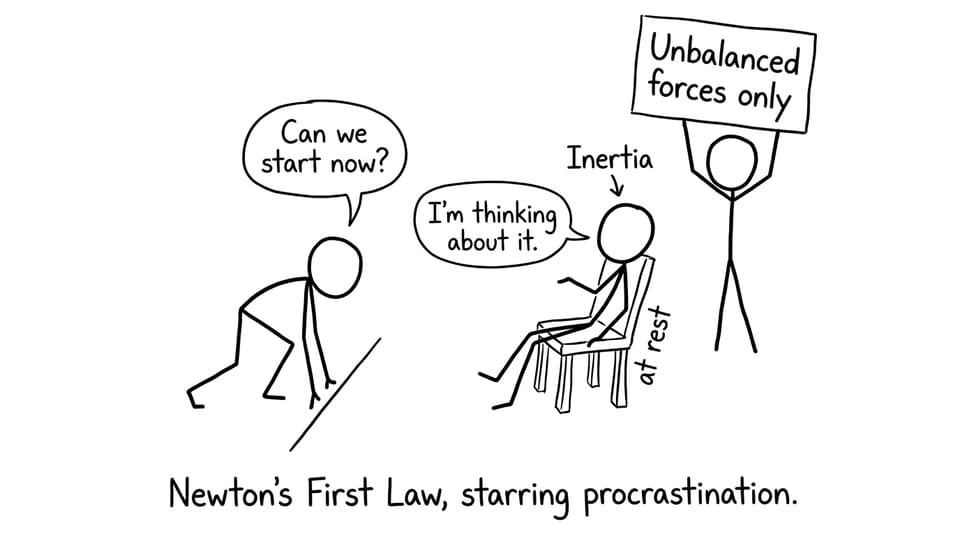
Newton’s First Law (inertia): the start/stop story
Inertia is resistance to change in motion. So in sport, higher mass often means more force needed to start, stop, or change direction.
Try revising with one movement (e.g., sprint start) and one line:
- “The sprinter remains at rest until an unbalanced force is applied against the ground.”
For an exam-ready version, see Newton’s First Law in Sport.
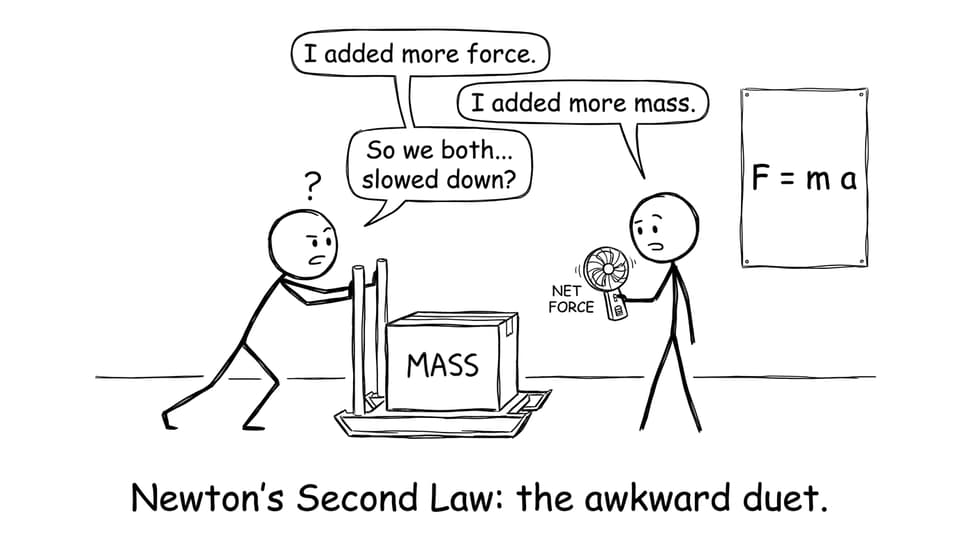
Newton’s Second Law: stop treating F = ma like a spell
Students often write F = ma and stop. In IB SEHS, you must interpret it.
-
Same force, bigger mass: smaller acceleration
-
Same mass, bigger net force: bigger acceleration
Revision tip: whenever you see “increase” or “decrease” in a question, answer in comparatives.
To practise this in a guided way, use Lessons for B.2.1 Newton’s laws of motion.
Newton’s Third Law: ground reaction force is your best friend
Every push into the ground creates an equal and opposite reaction. That reaction force helps explain acceleration, jumping, and changes of direction.
Pair this with friction: you need grip to “use” that reaction force effectively. A great applied read is Friction and Performance in Sport.
Build three “go-to” sporting examples (and reuse them)
For IB SEHS, pick three movements and practise applying multiple concepts to each:
-
Sprint acceleration (net force, inertia, friction)
-
Jump take-off/landing (ground reaction force, impulse ideas, stability links)
-
Throwing/kicking (force direction, sequential movement, acceleration)
Then reinforce with concise notes from IB SEHS Resources and a broader overview like Conquering Biomechanics: SEHS Topic 4.
How RevisionDojo makes this easier
When revision gets messy, structure wins. RevisionDojo supports IB SEHS forces and motion with:
-
Study Notes to lock definitions and direction language
-
Questionbank for exam-style application under time pressure
-
Flashcards for vectors, laws, and command terms
-
AI Chat to test your explanations and fix unclear phrasing
-
Grading tools to match examiner-style wording
-
Mock Exams and Predicted Papers to practise realistic coverage
-
Tutors if you want feedback on your movement analysis
Final push
Forces and motion feels hard when it’s a pile of definitions. It gets easier when it becomes a small set of reusable explanations you can drop into any IB SEHS scenario.
If you want that structure in one place, build your next revision block around RevisionDojo: start with the B.2 notes, drill the Questionbank, tighten your phrasing with AI Chat and grading tools, then pressure-test with Mock Exams and Predicted Papers. That’s how IB SEHS forces and motion turns from “concept-heavy” into “mark-friendly.”